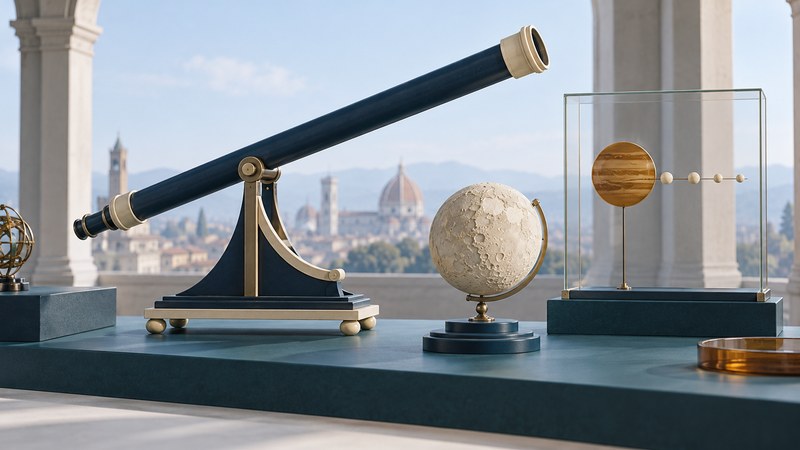
Galileo Galilei made instruments and mathematical arguments central to questions about the heavens and motion. His telescope revealed details that ordinary eyesight missed; the harder task was deciding what those details established. Following that reasoning is a useful way to understand both his achievements and the limits of individual observations.
This profile pairs discoveries with the claims they support, explains a simple law of motion, and places the 1633 trial within Galileo's life.
A mathematician working with instruments
Born in Pisa in 1564, Galileo held mathematics posts at Pisa and then Padua. His interests included mechanics and practical instruments as well as astronomy. In 1610 he became mathematician and philosopher to the Grand Duke of Tuscany. The Museo Galileo biography traces this career and his later years at Arcetri.
- 1609: He developed telescopes for his own observations.
- 1610: Sidereus Nuncius, or Starry Messenger, reported observations including lunar terrain and Jupiter's satellites.
- 1632–1633: Publication of the Dialogue was followed by the Roman Inquisition's trial.
- 1638: Two New Sciences appeared in Leiden.
- 1642: Galileo died at Arcetri.
The telescope was already a recent invention when Galileo began improving it. Museo Galileo traces the instrument to Dutch maker Hans Lipperhey in 1608, before describing Galileo’s improvements. His distinctive contribution combined instrument development, repeated astronomical observation, and persuasive publication. The quality of a lens, its magnification, and the observer's interpretation all mattered.
What the telescope showed
Read an observation as a specific constraint on an explanation. Museo Galileo's account of the discoveries describes lunar relief, stars in the Milky Way, and four satellites of Jupiter. Its explanation of Venus’s phases makes the competing models especially clear.
On a narrow screen, scroll the table sideways. Keyboard: focus the table region, then use the arrow keys.
| Observation | What it supported | What still needed explaining |
|---|---|---|
| Uneven light and shadow on the Moon | Lunar mountains and valleys, challenging the picture of a perfectly smooth heavenly body. | The Moon’s surface appearance alone establishes little about whether Earth moves. |
| Points changing position around Jupiter over successive nights | Four satellites orbiting Jupiter; a system of motions centered on another planet. | Earth’s own motion requires additional arguments and evidence. |
| Venus showing a wide range of phases | Venus travels around the Sun, inconsistent with the traditional Ptolemaic placement always between Earth and Sun. | Both Copernican and Tychonic arrangements can accommodate those phases. |
Recording several nights matters: positions that repeat in an orderly pattern offer more evidence than one ambiguous view. A useful notebook separates the observed positions from the orbit you infer from them. This distinction remains valuable when reading modern scientific images.
A worked example in scientific reasoning
The museum’s Venus explanation supplies the historical comparison. Use the same habit elsewhere: name the observation, state each model's prediction, and identify which possibilities remain.
How a mathematical pattern makes a test
Galileo also investigated accelerated motion. For an ideal body starting from rest under constant acceleration, distance traveled is proportional to elapsed time squared: d ∝ t². Museo Galileo's inclined-plane model illustrates the pattern.
A museum reconstruction can demonstrate a principle without documenting the exact apparatus a scientist used. Museo Galileo explicitly notes that evidence is lacking for Galileo's use of its particular bell-and-pendulum inclined-plane arrangement. That distinction helps separate the history of an idea from a later teaching model.
The trial and the work that continued
The dispute involved Copernican astronomy, biblical interpretation, and the authority to decide what could be taught. In letters of 1613 and 1615, Galileo argued about the relationship between natural investigation and scripture. In 1616, Cardinal Bellarmine warned him against advocating the Copernican position.
His Dialogue Concerning the Two Chief World Systems appeared in 1632. It was banned, and Galileo was tried in Rome in 1633. On June 22, the Inquisition condemned him and forced him to recant. Museo Galileo's trial account lays out the sequence. His confinement ultimately took the form of house arrest at Arcetri.
Work continued in these constrained circumstances. Two New Sciences, published in the Netherlands in 1638, brought together investigations of mechanics. Galileo died in 1642. A biography should hold the institutional conflict, the scientific arguments, and his continuing work together.
Read an image, a document, and an argument
- Identify the source. Is this Galileo's text, a later translation, a museum explanation, or a reconstruction? Record its date and author.
- Separate the layers. Describe what the instrument showed before repeating the conclusion drawn from it.
- Ask what alternatives predict. An observation has more force when competing explanations would give different results.
- Keep the historical setting. Read the instrument, publication, patronage, and dispute as parts of the same life.
Next, explore how Newton connected forces with motion, then how Einstein revised models of space, time, and gravity. Return to the Scientists collection to compare their approaches.