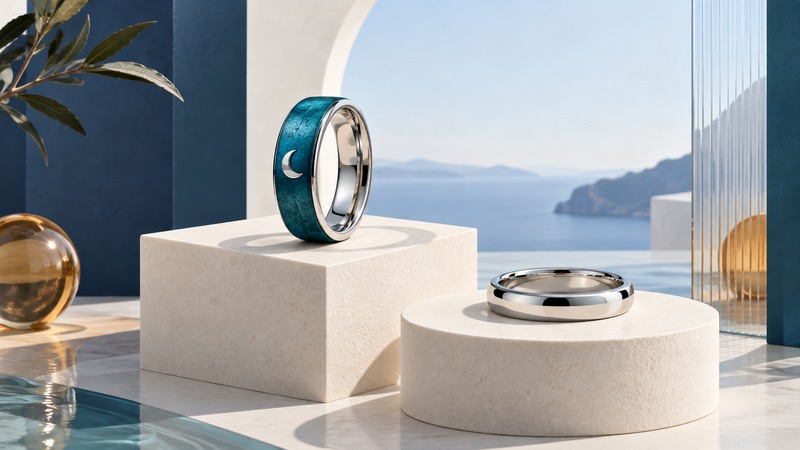
A singles ring can be a personal reminder, a design preference, or a message its wearer chooses to explain. Singelringen offers a useful case study: a distinctive piece of jewelry was given an explicit social meaning by its creators. Understanding that story helps you separate a maker's intended symbolism from what any individual means today.
The original Singelringen idea
A January 2008 Singelringen overview describes founder Johan Wahlbäck introducing the ring in Scandinavia in April 2005. The promotional document presents single life as complete in itself while remaining open to new possibilities.
The described object pairs a turquoise-colored acrylic exterior with a sterling-silver inner band. A crescent opening exposes the silver. The overview assigns that shape a meaning of openness to conversation, friendship, or romance, and describes a registration number engraved on the ring.
These details establish a dated design and its creators' explanation. The document's sales counts, price, registration benefits, and community services belong to that period. Treat a current offer, website, or similarly named product as a separate item to verify.
Three layers of meaning
Scroll horizontally to see all columns.
| Layer | Useful evidence | How to respond |
|---|---|---|
| The maker's story | A dated description of the original design and its intended symbolism. | Use it to understand the product's history. |
| The wearer's meaning | What the person chooses to say about their own ring. | Let their explanation lead; it may concern friendship, independence, memory, or appearance. |
| An observer's interpretation | A resemblance or association that may be incomplete. | Ask a neutral question when appropriate and accept the answer without pressing. |
For example, “That's an interesting ring—does it have a story?” invites an explanation without assigning relationship status. A ring never supplies consent to attention, touch, or a romantic advance. The other person's expressed wishes determine whether a conversation continues.
Someone may retain a meaningful ring through changing relationships or wear a similar design simply because they like its color. A shared symbol becomes useful through communication; visual recognition alone leaves the person's circumstances and intentions uncertain.
Choose a symbol you can explain in your own words
Before shopping, write a one-sentence purpose: “I want a reminder that my life is already full,” “I want to mark a new chapter,” or “I like this blue-and-silver design.” These are examples of personal choices, not meanings every singles ring carries.
- Choose the role. Decide whether you want a private reminder, a conversation piece, or a visual element in an outfit.
- Choose the form. Compare band width, profile, surface texture, and weight. Try a similar shape in the intended wearing position.
- Check the materials. Ask what the inner and outer components are made from, whether they are bonded, and what care instructions apply.
- Confirm fit and alterations. Ask whether the exact design can be resized. A ring assembled from different materials may need a different solution from a plain metal band.
- Plan your explanation. Decide what you are comfortable sharing. A brief personal answer is enough; you do not owe someone your relationship history.
For a gift, ask about the recipient's taste and preferred symbolism first. A ring intended as encouragement works best when the recipient welcomes the idea and chooses what it means.
Researching an older blue-and-silver ring
Start with the object. Photograph its profile, interior, crescent detail, and any marks. Record the size and condition, then compare with dated manufacturer material. Keep a possible identification separate from a confirmed one.
The old overview describes a number associated with registration services. An engraved number can be part of an object record; establish whether any present-day service actually recognizes it before entering personal details or paying for a promised benefit. Historical paperwork supports history, while a working service requires current confirmation.
Care begins with the complete construction
Obtain care advice for both the metal and any acrylic or bonded component. Until the construction is established, keep the ring separate from abrasive items and avoid experimenting with solvents, polishing compounds, heat, or resizing. Ask a jeweler to examine a loose layer, cracked surface, or sharp edge before further wear.
If you want to commission a personal ring, the jeweler consultation guide helps translate the meaning into materials, dimensions, fit, and a written brief. For questions about the metal itself, see silver purity and the material journey.