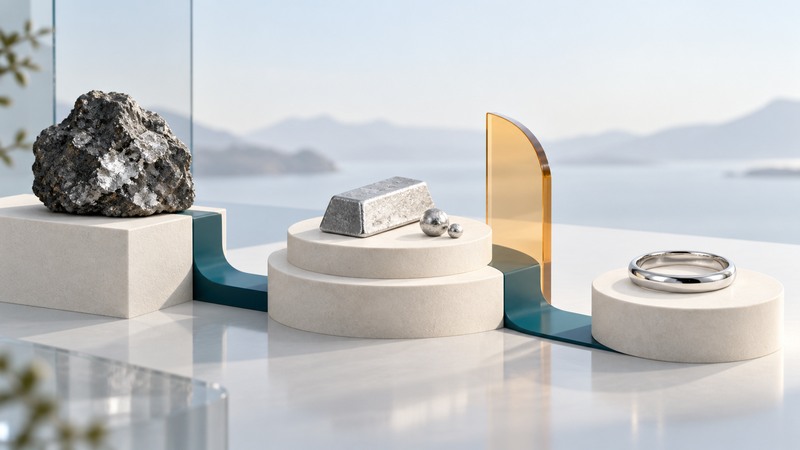
A silver ring is the end of a long material chain. Ore is mined and processed, silver-bearing products are refined, and the resulting metal is alloyed and manufactured into jewelry. Understanding those stages helps you interpret production figures, purity marks, and claims about recycled or traceable silver.
Follow the material through separate stages
- Extraction: rock containing economically recoverable minerals is removed. Its mass includes much more than its silver content.
- Concentration or other processing: the ore is treated using a process appropriate to its mineralogy, producing a silver-bearing product and residual material.
- Smelting and refining where applicable: metals are separated and purified. The route depends on the concentrate and the other metals present.
- Alloying and fabrication: refined silver is blended to a specified composition and made into casting material, sheet, wire, findings, or other forms.
- Jewelry manufacture and finishing: forming, joining, setting, polishing, and assembly turn the material into the finished object.
Silver can be a primary product or recovered alongside other metals. The USGS Mineral Commodity Summaries 2026 silver chapter reports that U.S. production in 2025 came from silver mines and numerous base- and precious-metal operations. It also distinguishes mine output, refining, scrap recovery, and uses. Those categories answer different supply questions.
Refining and remelting can bring together material from multiple sources. A statement about silver's purity describes composition; a statement about its mine or recycled origin depends on a documented supply chain. The finished surface generally cannot tell you that history.
Lucky Friday: a concrete mine-to-concentrate example
Hecla's Lucky Friday operation in Idaho is an underground silver, lead, and zinc mine. The company describes a mill producing concentrates that leave the site for further treatment. This is a useful reminder that “silver production” does not necessarily mean silver bars emerge from the mine itself.
For technical process context, the 2022 Lucky Friday technical report filed with the SEC describes its flotation concentrator. Read that as a dated description of the operation and its assumptions; use newer filings for current capacity, reserves, and operating plans.
Hecla's operation page reports 5,260,686 ounces of silver for calendar 2025, approximately 5.26 million ounces. That is a dated production figure, not a forecast or a measure of all silver remaining underground. When using a company page with sections updated at different times, follow the date attached to the individual table or claim.
Keep units and accounting categories visible
Scroll horizontally to see all columns.
| Term | Question it answers | What to check in the report |
|---|---|---|
| Ore tonnage | How much ore is being described or processed? | Metric tonnes versus short tons, and whether the basis is dry mass. |
| Grade | How much silver is present per unit of ore? | Grams per tonne or ounces per ton, with both numerator and denominator defined. |
| Recovery | What fraction of contained silver reaches the specified process product? | The process boundary and whether the figure is assumed, tested, or achieved. |
| Production | How much silver was reported for a period? | The period, product basis, and whether the figure is actual or estimated. |
| Resource or reserve | What mineral inventory is reported under a defined classification? | The reporting standard, date, confidence category, economic assumptions, and whether categories overlap. |
Resources describe mineral inventory under stated geological and reporting criteria. Reserves refer to the economically mineable portion under the applicable standard and assumptions. Neither is a promise that the same quantity will become finished jewelry. The report's own definitions and qualifications matter more than a promotional headline.
For continuing research, use the USGS silver statistics index to find dated summaries and datasets. Record the edition and table date with each number so that a later reader can reproduce your comparison.
Worked example: ore grade and recovery
Check the unit system before multiplying. “200 ounces per ton” is a very different grade from “200 grams per metric tonne.” Also establish whether a recovery figure refers to silver alone or another metal, and whether reported production has already incorporated recovery. Applying the percentage twice would undercount it.
Connect purity and sourcing to the finished piece
Sterling silver conventionally contains 925 parts silver per thousand by mass, as explained in the FTC guide to precious-metal jewelry. Under the U.S. FTC Jewelry Guides, precious-metal descriptions must accurately represent the product. Ask the seller whether a piece is solid alloy, plated, or contains components of different materials.
For a simple hypothetical example, 10.00 grams of a uniform 925 silver alloy contains 9.25 grams of silver. A real jewel's total weight may also include stones, enamel, springs, or other parts. A metal-content calculation therefore needs the relevant alloy mass; it is not a jewelry appraisal or a purchase offer.
For a recycled-silver claim, ask what proportion is covered, how recycled input is defined, and which supplier records or assurance system support it. Determine whether the claim applies to the principal casting, the chain and findings, or the entire piece. For a mine-origin claim, ask how material identity was maintained through intermediate processing.
USGS's 2026 summary treats scrap recovery as a distinct supply source. Recycled origin, purity, and documented labor or environmental practices answer separate questions. Keep each claim attached to its own evidence.
Finally, a ring's price includes design, labor, fabrication, setting, finishing, distribution, and service as well as material. Use the jeweler consultation guide to discuss those choices, and the appraisal guide when you need an opinion of value for a defined purpose.