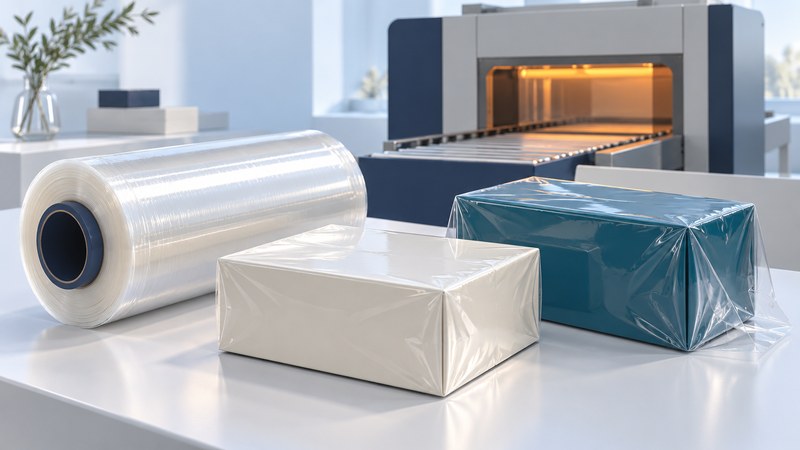
Choose shrink film by the package it must produce and protect. Product geometry, heat sensitivity, film properties, sealing equipment, tunnel conditions, and downstream handling all influence the result.
This guide helps packaging engineers prepare a trial and investigate rejects. Bring the film's exact grade and technical data, the equipment manual, representative products, and the customer's acceptance criteria. Trained operators should carry out adjustments under the site's approved operating and isolation procedures.
Begin with the packed product
Record product dimensions and variation, sharp edges, compressibility, heat sensitivity, surface finish, and the need to keep several items together. Define which surfaces must remain visible and whether the package must pass scanning, conveyance, storage, and distribution checks. A showroom sample may miss the damage that appears after ordinary handling.
Film families are a starting vocabulary. Polyolefin display films offer several combinations of clarity, strength, and shrink behavior; polyethylene shrink films are also used in bundling applications. Exact grades and structures matter. Clysar's film comparison describes these distinctions from a supplier perspective; use it to frame questions and validate the proposed grade on your own package.
On a narrow screen, scroll the table horizontally. Keyboard users can focus it and use the arrow keys.
| Need | Ask the supplier | Check on the finished package |
|---|---|---|
| Light or crushable product | Suitable shrink force and processing window. | Shape, compression, seal position, and appearance after cooling. |
| Sharp or uneven geometry | Puncture resistance, gauge, and package fit. | Corner holes and damage after representative handling. |
| Retail display | Clarity, gloss, printable/scannable areas, shrink characteristics. | Visibility, wrinkles, label readability, and scan performance. |
| Bundled goods | Film construction and strength for the intended load. | Bundle integrity through the defined distribution route. |
Supplier ranges such as Clysar's shrink film options include different shrink-force and performance grades. Specify the complete grade, width, gauge, roll format, and treatment. Confirm any application-specific contact or labeling requirements with the responsible supplier; one film-family name establishes neither food-contact suitability nor local recyclability.
Use the defect to narrow the investigation
First determine whether the defect starts at sealing, inside the tunnel, during cooling, or after handling. Inspect retained samples at the same stage and use consistent defect names. Check actual equipment condition before changing setpoints: a damaged sealing surface or restricted airflow can persist through many adjustments.
On a narrow screen, scroll the table horizontally. Keyboard users can focus it and use the arrow keys.
| Symptom | Investigate | Evidence to retain |
|---|---|---|
| Weak or opening seal | Contamination, film alignment, seal condition, and approved seal settings. | Seal location, failure stage, machine condition and test result. |
| Whitening or burn holes | Heat exposure, residence time, airflow, and contact with hot tunnel surfaces. | Hole position and repeatability relative to travel direction. |
| Excess corner film | Bag dimensions, air evacuation, and airflow distribution. | Package dimensions and which corners retain excess film. |
| Crushed or distorted product | Product heat response, shrink force, fit, and exposure. | Product dimensions and condition before and after the process. |
Clysar's shrink-wrap troubleshooting guide connects burn-through and corner defects with exposure, airflow, and fit. These are investigation paths. Use the film and machine documentation to define an authorized adjustment, then test it under controlled conditions.
Change one planned factor and compare accepted packages
Keep the product mix, starting condition, sampling point, and acceptance rules fixed. Record film lot and gauge, bag dimensions, seal settings, tunnel settings, conveyor speed, airflow configuration, and ambient conditions relevant to the process. Allow the line to stabilize according to its procedure before collecting the trial sample.
Choose a film using cost per accepted package, required performance, downtime, and handling results together. A lower purchase price or thinner gauge can be offset by more rejects. Preserve the successful settings as a documented window tied to the exact product and film. Repeat the trial when either changes.
Use the working record
Download the editable shrink film trial record. Save a copy, complete the actual requirements and evidence fields, and review open issues with the responsible owner. The plain-text record includes instructions, units where needed, the fictional example, and source references.