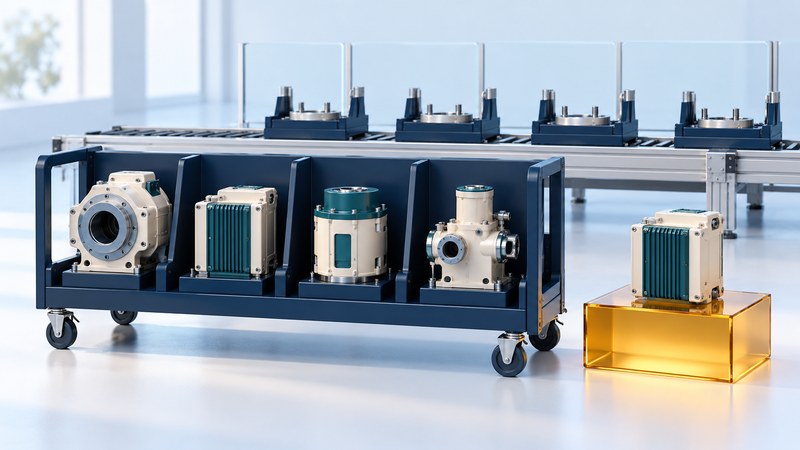
Sequential parts delivery brings the required variants to assembly in the required order. A complete rack with the right total quantity can still fail if one variant occupies the wrong position or belongs to an obsolete build sequence.
This guide helps supplier planners and systems owners define one route from a customer's sequence release to line-side acceptance. Start with the program's current supplier agreement, message specification, rack design, timing rules, and exception contacts. The fictional examples below describe a test approach; each customer's approved process governs production.
Define identity beyond a displayed sequence number
Record the customer, plant, line or supply area, order/build identity, sequence reference, variant, revision, and applicable time context. Document when sequence numbers reset and how replacements or cancellations are represented. A number repeated on a later date must not be mistaken for a replay of an earlier instruction.
SAP's sequence number profile guidance notes that customer sequence information influences delivery, packing, and often production, and discusses repeating number patterns. Its configuration is product-specific; the broader requirement is to establish an unambiguous identity agreed by both parties.
On a narrow screen, scroll the table horizontally. Keyboard users can focus it and use the arrow keys.
| Boundary | Required meaning | Recovery question |
|---|---|---|
| Release received | Program, destination, sequence, variant, revision and due context. | Is this new, repeated, replaced, cancelled, or invalid? |
| Pick/manufacture | Applicable release, eligible component identity and status. | What happens when the required variant is unavailable? |
| Rack loading | Rack/load identity, position, part/lot/serial as required, orientation. | How is a wrong position detected and reverified? |
| Dispatch and receipt | Contents manifest, destination, sequence range and acknowledgement. | Who approves a late change or resequencing action? |
Keep receipt of a message, acceptance of its business meaning, completion of picking, and acceptance at the line as separate events. SAP's external JIT/JIS replenishment process is an example of completion tied to physical supply-area and stock-transfer steps. Agree on your own endpoints explicitly.
Make rack position and unloading order visible
Specify how positions are named, which end is loaded first, how the rack is oriented at delivery, and the order in which assembly consumes the parts. Photograph or draw the approved arrangement in the controlled work instruction. Test the arrangement with the people who load, transport, and unload it.
For each position, compare the actual part with the applicable release. Capture the identity required by the program and preserve the association with the load. An unreadable identifier should create an owned exception with an approved verification method. A manual override needs the reason, authorizer, and evidence of the final contents.
The historically published ZF Global Logistics Directive, version 2018/4 describes JIS as arranging different part numbers on a carrier in a predetermined order for assembly. It is a dated illustration of the logistics concept, not the current contract for a particular supplier program.
Test a late change while the rack is held
For a rack already dispatched, use the customer's agreed escalation and resequencing process. Define who can authorize a change, how the receiving team learns about it, and what must be reverified. Timing matters because the same message may require different action before picking, during loading, or after line-side receipt.
Make recovery part of acceptance
Test duplicate and out-of-order messages, a sequence reset, a missing variant, a wrong position, an unreadable identifier, a late cancellation, and a restart during loading. Recover the last confirmed physical state from preserved records and reconcile every open position. Verify that old instructions cannot silently return as current work.
Measure on-time acceptance, position/variant errors, time to resolve holds, and the age of unanswered changes. Record denominators such as racks, positions, or calls so the measures can be compared. Keep actual program timing and freeze rules in the controlled interface contract.
Use material visibility for location and quantity tracking and mobile transport planning for the physical route. Sequence control connects those functions to the exact build order.
Use the working record
Download the editable sequence delivery test record. Save a copy, complete the actual requirements and evidence fields, and review open issues with the responsible owner. The plain-text record includes instructions, units where needed, the fictional example, and source references.