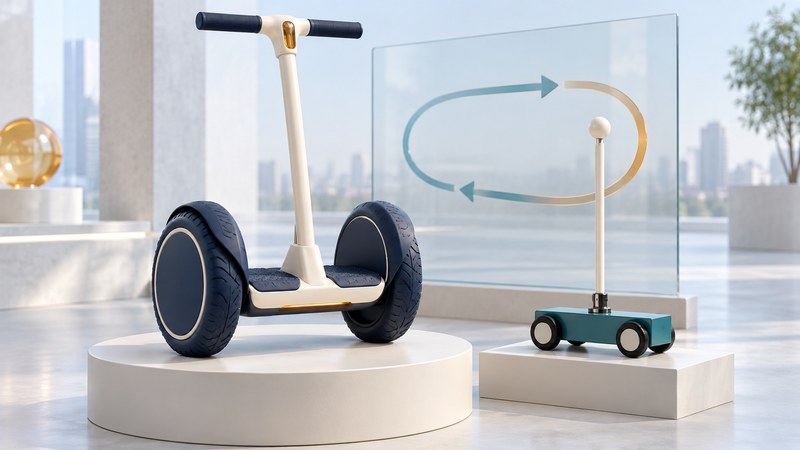
A Segway stays balanced fore and aft by sensing its orientation and driving its wheels to keep support beneath the rider. The visible machine is simple; its useful behavior comes from a continuous loop of measurement, calculation and motor action.
This is an engineering explanation of the side-by-side, two-wheeled Segway Human Transporter and later Personal Transporter family. It is not a riding lesson. For operation, identify the exact model and follow its manufacturer manual and training.
Start with an upright pendulum
Imagine balancing an upright stick on a small cart. If the stick begins falling forward, moving the cart forward can bring its support back beneath it. The right movement depends on both the angle and how quickly the angle is changing. A controller must keep observing and correcting as the system moves.
The analogy captures the central idea of a balancing transporter. The rider and machine form a coupled moving system. Tilting changes the relationship between their mass and the wheel contact patches. Wheel forces change the motion, which changes the measured state, which informs the next correction.
Segway's i2 SE and x2 SE user manual, under “How the Segway PT Works,” describes this as dynamic stabilization. The later PT manual is a concrete reference for the principle; its model-specific details should not be transferred automatically to the original 2001 HT.
Separate the sensor, controller and actuator
On a narrow screen, focus the table region and use the arrow keys or swipe to read all columns.
| Part | Job | Useful distinction |
|---|---|---|
| Orientation sensing | Provide information about tilt and angular motion. | A measurement describes the state; it does not itself supply the balancing force. |
| Controller | Use measurements and operating logic to command motor behavior. | A control rule must cope with a changing rider-machine system. |
| Motors and wheels | Apply torque and interact with the ground. | The commanded correction needs available power and traction. |
| Feedback | Observe the result and update the next command. | Balancing is a repeated process, not a single initial adjustment. |
The cited SE manual identifies five angular-rate sensors and two tilt sensors in its balance-sensor assembly and describes the controller boards and wheel motors. The important conceptual point is the division of labor: the sensors measure, the controller decides, and the wheels act. Small solid-state gyroscopes are sensors here; a large spinning flywheel is not holding the vehicle upright.
Turning adds another task. The side-by-side wheels can be driven differently to change heading. Steering interfaces vary across generations, so a diagram of one handlebar should not become a universal instruction for another model.
Trace a correction before thinking about speed
Keeping a system upright and making it travel at a chosen speed are related control problems. A system also has to manage transitions, disturbances and limits. A headline about a fast processor or many sensor readings says little by itself about the behavior of the complete controller.
The ground and the rider remain part of the physics
The SE manual explicitly distinguishes active fore-aft balancing from side-to-side stability. That distinction matters: a self-balancing label describes a particular capability, not automatic protection against every fall. The available wheel force also depends on contact with the ground.
To interpret a mobility claim, ask which conditions were established. A smooth demonstration floor tells you about that floor. A slope, an obstacle, changing traction or a different load asks something different of the system. Device limits, warning behavior and shutdown procedures belong to the exact model's user materials.
For a classroom analysis, draw the loop on paper and add the environment around it. Put “traction” between the wheel and ground, “power” beside the motor, and “measurement quality” beside the sensor. This makes it easier to see why changing one component cannot guarantee performance everywhere.
Read a self-balancing claim with better questions
- Which direction or degree of motion is actively stabilized?
- What quantity is sensed, and which component creates the corrective force?
- What operating conditions does the supporting test represent?
- What happens as power, traction or a required sensor becomes unavailable?
- Is the evidence about a demonstration, a particular model or a whole product family?
The 2001 public launch made this mechanism widely visible. Ginger, IT and the Segway launch examines the different question of adoption: what people and places needed before the device could become useful in routine travel. Dean Kamen's invention and education work puts the machine in a broader career of engineering projects.