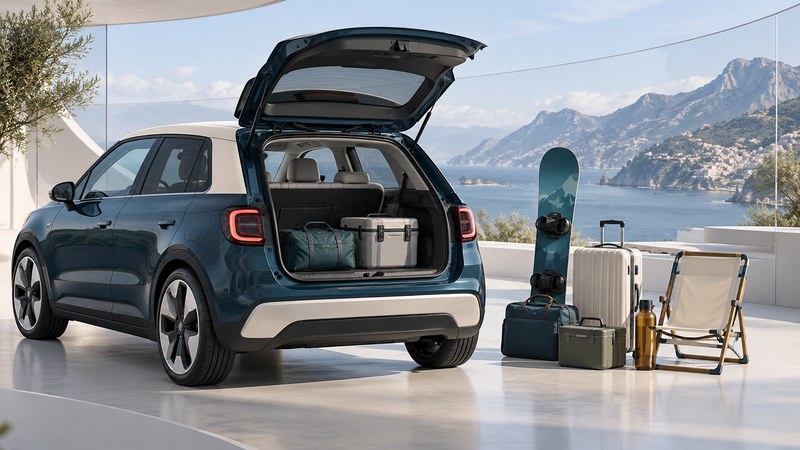
Scion Exile starts with a lifestyle question: how could one vehicle support an adventurous day around Los Angeles? Reading the concept through that question reveals the connection between a story, a vehicle's proportions and the space reserved for its user's equipment.
A CALTY entry for Design Los Angeles
Exile appeared among the ten entries in the January 2006 Design Los Angeles competition, credited to Scion's CALTY team. The theme was an LA adventure; the organizer named GMC PAD as the winner. This places Exile in the history of a design competition and its presentation work. Source: Los Angeles Auto Show announcement, January 2006.
The entry is best approached as a proposal expressed through drawings and a narrative. Those materials establish the design idea; production specifications and a delivered vehicle would be different kinds of evidence.
Read the day, then the vehicle
The CALTY presentation board stages an imagined future day in three settings: snow, surf and the city. Its text emphasizes an individual and their equipment, and describes moving the engine forward while keeping the occupants forward to make rear cargo room. A rear-access sequence connects that packaging idea to use. View the original CALTY board, reproduced by ScionLife.

Notice the order of the argument. The adventure gives the vehicle a purpose. The equipment gives the designer a volume to accommodate. The proportions give the proposal its character. The opening sequence then explains how a person might use the space. Together, these views communicate more than a single dramatic exterior rendering.
Turn an activity into a design requirement
The examples below are our own design analysis inspired by the brief. They are questions for developing a vehicle concept, rather than additional claims about Exile's equipment.
On a narrow screen, scroll the table sideways. Keyboard users can focus the table region and use the arrow keys.
| Activity | Space or access question | A useful design test |
|---|---|---|
| Mountain morning | Where can a long board and damp clothing travel? | Draw the actual equipment at the same scale as the cargo area. |
| Beach afternoon | Can sandy or wet items be separated from clean belongings? | Trace loading, storage and removal as three distinct actions. |
| City evening | How does the opening work in a confined parking space? | Draw the open panel and the person standing beside it. |
Try a three-stop brief
Choose a day you know well and write three stops on a sheet of paper. At each stop, list the people, objects and transitions involved. Include the awkward items: wet shoes, a bag needed halfway through the trip, or equipment too long to turn inside the opening.
Next, sketch a top view and a side view at a shared scale. Assign space to people and objects before refining the exterior. Draw one opening fully open, with a person using it. Finally, name a tradeoff your design makes: cargo volume, passenger space, visibility, overall length or ease of loading.
That tradeoff is the most useful outcome of the exercise. A concept becomes easier to discuss when its attractive shape can be connected to a specific use and a specific compromise. Continue with concept-car design and development.
Explore Autos: vehicle guides, technology and design · Cars: buying, maintenance and ownership