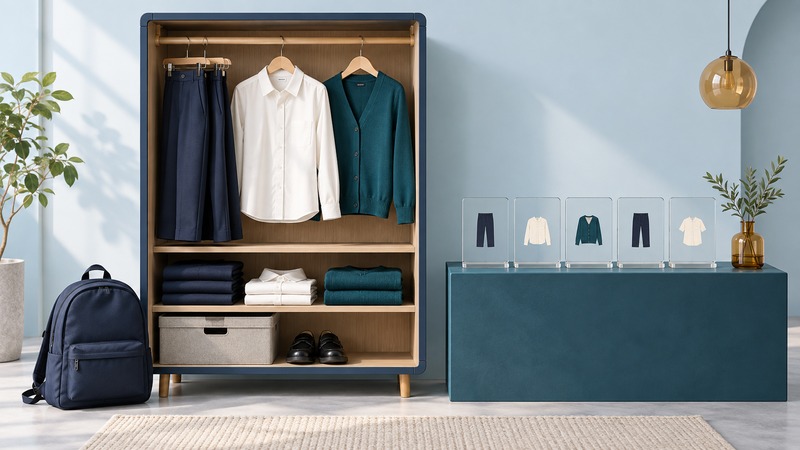
Start with the next ordinary school week. List what the student already wears comfortably, check the school requirements, then buy only the missing pieces. This guide helps families and students turn a crowded closet or an empty shopping list into a workable clothing rotation.
Read the requirements before shopping
Find the current handbook on the school or district website and note its school year. Record any uniform colors, footwear requirements, PE kit, outerwear rules and special clothing for practical classes. Ask the school about an unclear requirement before paying for an item that may be unsuitable.
For an example of where this information lives, Fairfax County Public Schools publishes its Student Rights and Responsibilities resources centrally. Use the policy for the student's own school; this example is a lookup method, not a dress code for other districts.
Include the student's preferences and sensory needs. A garment that meets the written rule but has an irritating seam or difficult fastening may sit unworn. Decide together which features are essential and which can vary.
Count usable clothes, then identify gaps
Try on the clothes intended for school. Make three piles: ready to wear, repair or adjust, and outgrown or unsuitable. Count only the first pile as available. Give a repair a date so it does not remain an imaginary spare.
Test a complete outfit while sitting, reaching, walking and wearing the usual backpack. Check cuffs, waistbands, zips and layers. For younger students, include whether they can manage the fastenings themselves. Use actual fit rather than assuming an age label will match.
Write the planned laundry day and allow for drying time. Five school days might call for five clean tops plus a spare if a fresh top is needed each day; a student who changes after sport may need more. Reuse of trousers or layers depends on cleanliness, activity and preference. Treat quantities as a starting calculation, then adjust after observing a real week.
A worked shopping plan
| Item | Needed in this example | Usable now | Gap |
|---|---|---|---|
| Daily tops | 6 | 4 | 2 |
| Trousers or equivalent bottoms | 3 | 2 | 1 |
| Warm layer | 1 | 1 | 0 |
| PE kit sets | 2 | 1 | 1 |
Rank the missing essentials before choosing optional extras. Compare the total cost after shipping and alterations, and check whether the school has a uniform exchange or assistance program. Buy a small initial set when sizing or comfort is uncertain; expand after the first week confirms what works.
Choose clothes that fit the care routine
Read the care instructions before purchasing. A useful U.S. reference is the FTC Care Labeling Rule, which explains how regular washing or drycleaning instructions and necessary warnings are supplied for covered apparel. The care directions for the whole garment matter more than a guess based on its main fiber.
Compare two similar items by asking where and when each will be cleaned, whether it needs separate treatment, and whether it will dry before it is needed again. A low purchase price can be a poor fit for a household that cannot support its care routine.
After two weeks, record what repeatedly ran out, what stayed unworn and what needed repair. Adjust that specific gap. Keep a small seasonal list for later weather instead of buying every possible layer at the start of term.
Keep a working copy
School wardrobe planner (plain text). Save a copy in a text editor and fill in the fields. The file includes instructions, assumptions and a link back to this guide.