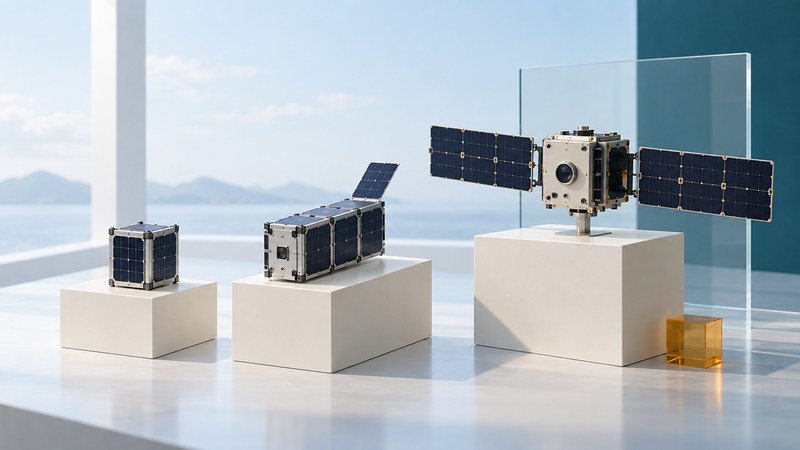
A small satellite is a complete spacecraft built within tight mass, volume, power and operating constraints. A CubeSat adds a standardized form-factor approach that helps with integration and deployment. The useful question is what observation or service the mission must deliver—and whether the whole system can support it.
Separate size, form factor and capability
SmallSat categories often refer to mass; CubeSat sizes refer to units of a standardized physical envelope. A 1U CubeSat is based on an approximately 10-centimeter cube, and larger formats combine units. Exact dimensions, rails, allowable mass and deployment interfaces come from the applicable deployer requirements.
NASA's Small Spacecraft Technology introduction explains that CubeSats can span more than one mass category. It also describes how evidence of technology readiness depends on the relevant environment and integrated configuration. A component that has flown elsewhere still needs assessment for the proposed mission.
Describe the payload separately from the spacecraft bus. The payload performs the observation, experiment or communication service; the bus supplies structure, power, thermal control, pointing, computing and links. A small enclosure alone tells you little about the useful data it can return.
Trace the mission through six linked budgets
Scroll the table horizontally on small screens. Keyboard users can focus the table region and use the arrow keys.
| Budget | Question | Evidence to request |
|---|---|---|
| Payload and pointing | What signal or image must be collected, for how long, and at what pointing stability? | Measurement requirements, exposure plan and pointing error allocation. |
| Power | Can generation and storage support every operating mode? | Sunlit/eclipsed energy balance, peak loads and end-of-life assumptions. |
| Data | Can observations be stored and returned on time? | Daily data volume, contact schedule and useful downlink rate. |
| Thermal | Can components stay within their permitted temperatures? | Hot/cold cases, power dissipation and thermal test evidence. |
| Mass and deployment | Does the integrated spacecraft meet its launch interface? | Mass properties, deployer interface and verification record. |
| Operations | Who can command, monitor and recover the mission? | Ground access, staffing, fault responses and end-of-mission plan. |
Budget these together. Adding an instrument can consume power, generate heat, increase data storage and require longer downlink sessions. Extra solar area may affect deployment and pointing. Improving one subsystem can therefore shift the bottleneck elsewhere.
Work an energy example before choosing hardware
NASA's power chapter treats generation, energy storage and power management as parts of the spacecraft's electrical system. Account for eclipse periods and for the difference between instantaneous watts and accumulated watt-hours.
The example is deliberately simplified. Use it as a consistency check while developing the detailed array and battery requirements. Use time-tagged operating modes to reveal simultaneous peaks and verify them against the flight design.
Calculate what reaches the ground
A mission succeeds when usable results reach the intended user. NASA's small-spacecraft communications chapter covers the radio or optical link, antennas and ground-side constraints. Contact duration, antenna pointing, link margin and ground scheduling matter alongside a modem's advertised rate.
For an invented 100 MB daily dataset, a useful downlink rate of 1 Mbps needs 800 seconds, or 13 minutes 20 seconds, of successful transfer. One ten-minute contact carries at most 75 MB at that useful rate. Acquisition time, outages and retransmissions reduce what is delivered. Compression helps only if the scientific or operational requirement tolerates it.
Track data age as well as volume. A larger batch delivered tomorrow can be less useful than a smaller timely product for a time-sensitive task.
Read constellation promises carefully
More satellites can create more opportunities to observe or communicate, but “revisit” needs a definition. Ask whether the number refers to a geometric opportunity, a cloud-free optical image, successful downlink or a processed product delivered to a user. Latitude, swath, pointing constraints and the target area change the answer.
Request a worked service case with the target coordinates, observation conditions, processing delay and expected gaps. For communications, ask how coverage, handover and capacity are achieved at the intended location. Avoid turning one successful demonstration into a claim of continuous service.
Write a one-page mission brief
Use the small-satellite mission worksheet to record the reader or customer, required result, payload, orbit assumptions and six budgets. Identify which numbers are measured, modeled, vendor specifications or placeholders.
Review the brief when the payload, orbit, launch interface or ground service changes. For interpreting the data, continue with satellite imagery comparisons; for computing reliability, see radiation-tolerant FPGAs.
Sources and further reading
Source links reviewed September 28, 2026. Check current service terms, equipment documents and operational notices when applying the guide.