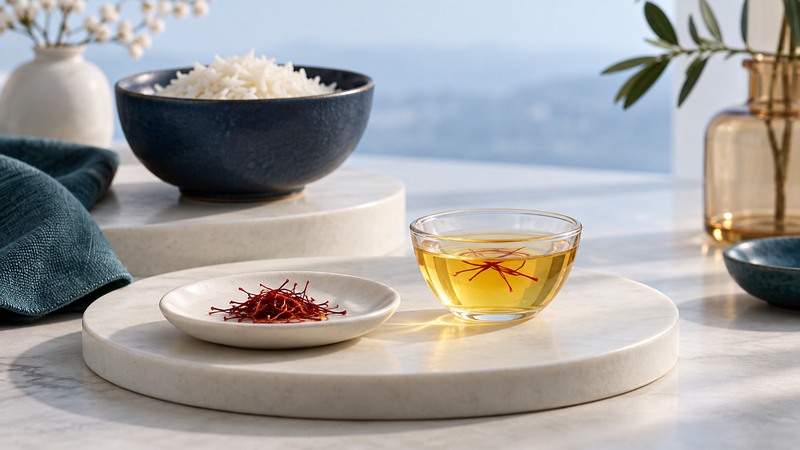
Saffron supplies an aroma as well as a golden color. Start with a small, traceable supply of threads, steep the recipe’s quantity in a little of its liquid, and add both liquid and threads to the dish. Measuring and recording the amount makes the next batch easier to adjust.
Buy information as well as threads
Saffron consists of the dried stigmas of Crocus sativus. Separating these delicate floral parts is labor-intensive. The University of Vermont’s post-harvest guidance follows the crop through separation, drying, storage and lot records.
Choose a seller that identifies the ingredient, net weight, origin and a lot or harvest reference where available. Compare prices by the same unit of mass. A tiny jar can make a low package price look more economical than it is.
On a narrow screen, scroll the table sideways. Keyboard users can focus it and use the arrow keys.
| Question | Why it helps | Limit |
|---|---|---|
| Are the contents listed as saffron only? | Distinguishes the spice from a seasoning mixture. | An ingredient list is a claim, not independent authentication. |
| Is there a lot or supplier reference? | Supports questions and traceability. | A harvest date alone does not establish storage quality. |
| Threads or powder? | Threads preserve visible structure; powder disperses easily. | Appearance alone cannot establish purity. |
| Is a test report supplied? | A report tied to the actual lot can add evidence. | Check laboratory, sample identity and what was actually tested. |
Color-release tricks at home are observations, not proof of authenticity. UVM describes standardized laboratory quality testing; a cup of colored water cannot supply the same information. If a batch seems suspicious, retain its package details and ask the supplier for documentation instead of trying to certify it by taste.
Bloom within the recipe’s liquid allowance
Blooming means steeping saffron in liquid before it joins the main dish. The Spice House’s saffron-rice guidance describes crushing a small pinch and steeping it in a little warm water or hot broth for 5–10 minutes. Different recipes use different steeping methods; follow the one written for your dish.
- Measure the saffron specified by the recipe. For tiny gram quantities, use a scale whose range and resolution can actually measure them.
- Crush gently in a clean small mortar or between clean fingers if the recipe calls for it.
- Take the blooming liquid from the total liquid already measured for the recipe.
- Steep as directed, then add the infusion and threads. Rinse the small bowl with a little of the remaining recipe liquid to transfer the residue.
A household scale that measures only whole grams is unsuitable for confidently measuring a tenth of a gram. Use the recipe’s own thread or pinch measure when a suitable scale is unavailable, and accept that the quantity will be less repeatable.
Account for liquid in a rice dish
For an original small flavor trial in a suitable rice recipe, ⅛ teaspoon loosely measured threads offers a modest starting quantity per cup of dry rice. It is not a mass conversion or a kitchen-tested recipe. Follow the chosen recipe’s cooking instructions and evaluate the cooked result before changing the next batch.
Record the saffron lot, quantity, steeping method and dish size. Compare aroma and flavor after cooking, not simply the depth of the infusion’s color. Too much saffron can become overwhelming; start with less when exploring an unfamiliar supply.
Protect a small supply
UVM recommends airtight glass storage protected from light. Keep moisture out, use dry utensils and close the container promptly. Buy an amount that fits how often you cook with saffron, and keep the lot information when transferring it to another jar.
A replacement should be chosen by the dish’s purpose. Turmeric can color rice but gives a different aroma and taste. If saffron’s flavor defines the recipe, choose another recipe when it is unavailable. For dishes combining pepper flavor with saffron, choose paprika by heat and smoke so it complements the result.
Explore all seasoning and ingredient guides · Food, cooking and meal planning