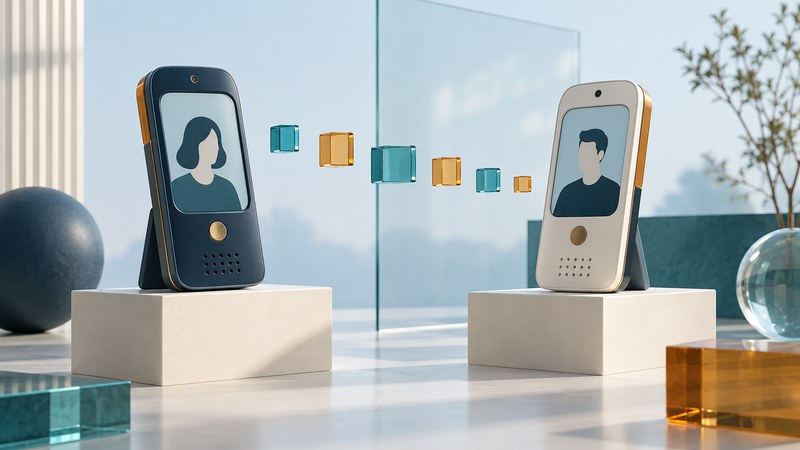
A convincing mobile video call needs enough usable capacity in both directions and media that arrives in time to play. A radio's headline speed describes only one part of that path. Evaluate the camera, codec, network, timing, and receiving device together.
Early dual-network video-phone proposals make this distinction especially clear. They combined cellular service, local wireless access, and ambitious promises about moving between them. Their history provides a useful way to read any claim of smooth, high-quality video.
Read the Calypso C1250i as a development story
In the early 2000s, Calypso promoted the C1250i as a handset combining cellular and Wi-Fi operation with its ASNAP switching technology. A later company annual filing, under “The Company's Products and Services”, states that it abandoned development of the dual-mode handset in 2006 to concentrate on software-based mobility. The filing also described prototype demonstrations and a pre-production research-and-development business.
That record supports a history of development and changing plans. It leaves consumer availability and the outcomes of individual announced trials to be established separately. A patent, a prototype, a planned trial, and a shipping product represent different kinds of evidence; place each claim at the stage its documentation supports.
For an early video-phone story, ask what ran on the cellular connection and what required local wireless access. Then ask whether the same active session survived a change of network. Those questions are more informative than a single comparison between advertised link rates.
Measure the experience at the receiving end
| Measure | What it describes | Useful evidence |
|---|---|---|
| Usable throughput | Data delivered over time after the path's constraints. | Results in both sending and receiving directions. |
| Delay | Elapsed time through capture, coding, transport, buffering, and display. | A stated measurement method and endpoints. |
| Jitter | Variation in packet arrival timing. | A time series or comparable reports, with units. |
| Loss and late arrivals | Media missing from its useful playback window. | Loss reports together with freezes, gaps, and recovery. |
| Media settings | Resolution, frame rate, codec, and bitrate. | Actual negotiated settings during the call. |
The IETF's RTP specification, RFC 3550, defines sequence numbers, timestamps, and reporting of reception quality, including packet loss and interarrival jitter. These provide evidence about media delivery. The protocol itself supplies neither reserved network capacity nor a universal video-quality guarantee.
A bigger playback buffer can absorb some variation while adding delay. A lower video bitrate can ease capacity pressure while changing picture detail. Record those changes: a call that remains connected by adapting its picture is a different result from one that maintains the original settings throughout.
Work through a capacity claim
Hypothetical uplink budget
Suppose a test path delivers 1.5 Mb/s of usable uplink throughput. Assume video consumes 1.2 Mb/s, audio 0.08 Mb/s, and the remaining protocol traffic is budgeted at 0.12 Mb/s. The assumed total is 1.40 Mb/s, leaving 0.10 Mb/s.
That small margin motivates a sustained test under changing load. It supplies no guarantee that a short capacity dip, competing upload, or encoder burst can be absorbed. The numbers are invented for arithmetic, not recommended codec settings or measurements of the C1250i.
Repeat the calculation for the other direction using its own available capacity. Then inspect timing and loss: even a positive arithmetic margin leaves questions about when packets arrive. A download-speed result alone cannot answer those questions for an interactive call.
Ask for a repeatable demonstration
Record handset or computer models, software versions, access networks, media settings, and the duration of each trial. Include ordinary conversation with movement in the camera view, rather than judging only a still scene. Note whether an apparent recovery changed resolution, frame rate, or the audio path.
For a network-transition claim, define success before testing: did the session remain established, how long was media interrupted, and what did each participant experience? Preserve an event log with the transition time and relevant statistics. A screenshot of two connected endpoints cannot show continuity across the transition.
Compare claims only under stated conditions. A successful laboratory trial is useful evidence for that setup; field use adds changing radio conditions, competing traffic, and devices with different capabilities. This approach turns a broad promise into questions a demonstration can actually answer.
For everyday call setup and troubleshooting, see video-phone guidance. For the separate problem of moving between networks, read mobile IP and network mobility, or explore the Telephone library.