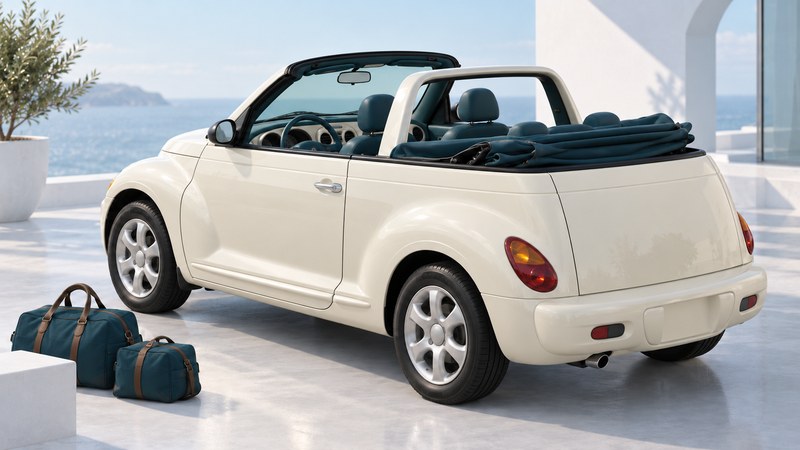
A PT Cruiser Convertible needs three checks: its engine and gearbox, the evidence behind any special-edition claim, and whether its roof and seating layout suit your use. Keep those questions separate so an attractive paint scheme does not stand in for mechanical or practical suitability.
This guide covers the US 2005 convertible, including Dream Cruiser Series 4. Bring the VIN, factory-equipment evidence, service invoices and the matching convertible manual. Take the people and typical luggage you expect to carry when arranging a viewing.
Identify the turbo version and the edition
Chrysler’s 2005 PT brochure distinguishes the 150-horsepower 2.4-liter engine, a 180-horsepower turbo offered on Convertible Touring, and the 220-horsepower high-output turbo used by Convertible GT and Dream Cruiser Series 4. All are 2.4-liter engines, so displacement alone leaves the version unresolved.
The August 2004 Chrysler Series 4 announcement describes a Getrag five-speed manual or optional four-speed automatic with AutoStick. Its edition details include Deep Lava Red paint, a coordinating cloth roof, Light Pearl Beige leather with maroon accents and distinctive 17-inch wheels. Use these as comparison details alongside VIN-linked factory evidence and original paperwork.
On a narrow screen, scroll the table sideways. Keyboard users can focus the table region and use the arrow keys.
| Configuration or claim | What to establish | Useful evidence |
|---|---|---|
| Engine and gearbox | Naturally aspirated, turbo or high-output turbo; exact installed gearbox. | VIN-linked equipment information, labels and inspection. |
| Dream Cruiser Series 4 claim | Factory edition identity and original equipment. | Original sales/build documents tied to the VIN; period brochure for comparison. |
| Current appearance | Replacement paint, roof, seats, wheels or badges. | Repair invoices and a physical condition assessment. |
| Roof and windows | Complete permitted operation and alignment with the roof closed. | Demonstration using the 2005 convertible handbook, plus specialist findings. |
| Passenger and luggage fit | Usable access, occupied seats and cargo arrangement. | Trial with intended passengers and representative bags. |
Watch a complete parked roof demonstration
Use the manufacturer’s 2005 convertible handbook, pages 62–72, in this archived copy. It calls for a complete stop and the specified transmission position, a clear top-storage area and the appropriate latch and boot-cover sequence. Have the owner demonstrate using the full instructions; keep people and objects clear of the moving mechanism.
Observe lowering, raising, latching and window behavior, then examine the closed roof, glass and seals. Note pauses, uneven movement, poor alignment or evidence of water entry. Stop a malfunctioning demonstration and obtain diagnosis instead of forcing the mechanism. Keep a roof repair invoice with the observed result after the repair.
Check each front door and window together, watching the glass movement and its fit against the closed roof. Ask a workshop to assess any inconsistent result and the condition of the seals.
Try the convertible’s seating and luggage arrangement
The brochure specifies a 50/50 split folding-and-tumbling rear seat and a pass-through for the convertible. It describes different seat arrangements for the PT wagon. Use the convertible handbook for latches and seating operation.
Set the front seats for the regular occupants and try rear access with the roof raised. Check the intended child-restraint installation against the vehicle and restraint instructions where relevant. Then load your representative bags with the passenger seats required for the trip still available.
Repeat the luggage trial with the planned roof position and any boot cover stored as instructed. Keep the roof-storage area clear. Record which seat positions each cargo arrangement consumes; an expanded cargo arrangement may reduce the seating available for that trip.
Inspect the car beneath the edition details
Ask for an independent check of the engine and cooling system, gearbox, brakes, tires, body and underside, plus roof and window operation. Chrysler’s 2005 convertible technical specifications identify belt-driven camshafts. Ask the workshop to reconcile timing-belt service evidence with the matching maintenance schedule and the installed engine. Record completed work, work due and unknown history separately.
Check the VIN through NHTSA’s recall lookup and ask the manufacturer for campaign and completion records. NHTSA explains that VIN results omit completed recalls and may omit recalls more than 15 years old. Save the dated result alongside repair evidence.
Keep an edition-and-fit record
Fictional viewing. A seller describes a red convertible as a Dream Cruiser Series 4, but the factory paperwork is missing. Its turbo configuration is verified and its roof demonstrates correctly. Record the edition claim as unresolved, assess condition and passenger fit on the evidence available, and request VIN-linked factory information before assigning value to the special-edition identity.
Download the PT convertible edition-and-fit record. For a different two-seat layout, compare the separate Pontiac Solstice guide.
Explore Autos: vehicle guides, technology and design · Cars: buying, maintenance and ownership