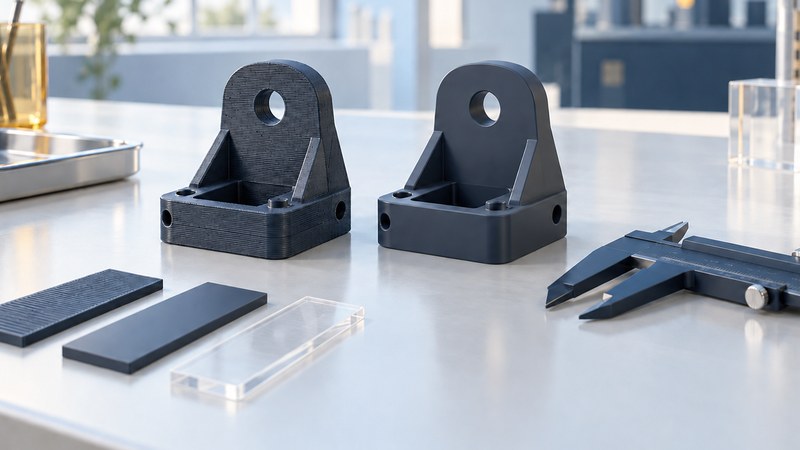
A printed plastic prototype provides evidence about a defined question. It can reveal a clearance problem or compare two design variants, while a production-strength or lifetime claim needs evidence representative of the final material and manufacturing route. Write the intended conclusion before ordering the prototype.
Keep material identity and process together
PC-ABS blends polycarbonate and acrylonitrile butadiene styrene. A printed PC-ABS part and an injection-molded PC-ABS part share a material-family name, but grade, processing, structure and orientation still matter. Specify the exact supplier grade for each route.
The Stratasys PC-ABS data sheet reports test conditions and orientation-dependent properties, identifies FDM parts as anisotropic, and presents typical values for comparison rather than design allowables or quality-control limits. Read the specimen and method alongside any number you use. A coupon result becomes relevant to a part only through a justified relationship between its loading, geometry and process.
Choose a question the prototype can answer
On a narrow screen, scroll the table horizontally. Keyboard users can focus it and use the arrow keys.
| Question | Useful prototype evidence | Follow-up to plan |
|---|---|---|
| Does the part fit? | Measured datums, clearances and assembly access | Production tolerances, shrinkage and assembly variation |
| Which geometry is stiffer? | Matched print route, fixture and load with individual deflections | Production-grade parts under representative loads |
| Will a latch survive repeated use? | Observed failure locations and comparative screening | Representative material, surface, processing and cycle test |
| Will heat or chemicals change function? | Defined exposure with dimensions and function checked before and after | Actual service duration, conditioning and production construction |
Measure critical features before testing. Otherwise, a thickness or hole-position difference may be mistaken for a material effect. Keep print orientation, layer settings, internal structure and support-contact surfaces in the record.
Use a paired comparison
Hold geometry, fixture, load application and measurement method constant when investigating one process variable. Test several independently made samples, retain every result and photograph the deformation or failure. Separate damage caused during support removal from damage caused by the test.
Fictional bracket screen: under the same 50 N fixture load, three orientation-A samples deflect 0.8, 0.9 and 1.0 mm. Orientation B gives 1.1, 1.3 and 1.4 mm. With a project screening limit of 1.2 mm, all three A samples and one B sample pass. The result flags orientation sensitivity in this setup. It supplies neither a molded-part rating nor a fatigue-life prediction.
Use that finding to decide the next experiment: repeat the weak orientation, examine the failure location, or compare production-representative parts. If geometry changes, preserve the old revision and explain which earlier conclusions still apply.
Include preparation and the working environment
Condition parts consistently and record age, moisture exposure, cleaning and temperature. Follow the exact printer/material instructions for support removal. For the workspace, use NIOSH's guide to safe 3D printing to assess emissions and controls for the actual printer and feedstock. An office-sized machine still requires that assessment.
Finish with a claim ledger: supported now, provisionally supported, or awaiting production evidence. State sample count and test conditions beside each conclusion. The rapid-prototyping guide helps choose the broader prototype route; this material/process comparison determines how far its evidence can travel.
Use the working record
Download the editable printed plastic evidence plan. Save a copy, complete the actual requirements and evidence fields, and review open issues with the responsible owner. The plain-text record includes instructions, units where needed, the fictional example, and source references.