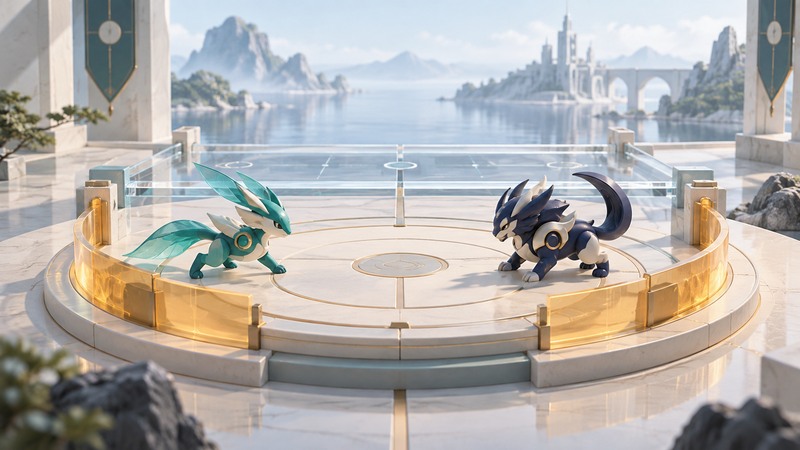
Your first goal in Pokkén Tournament DX is to recognize the phase, control distance, and choose an appropriate attack. A short practice session built around those three skills is more useful than memorizing a long combo you rarely get to start.
Start with the correct game and content
Pokkén Tournament DX is the Nintendo Switch edition released September 22, 2017. It builds on the earlier Wii U game. The Pokémon Company's DX overview describes the base game and the separate Battle Pack, which adds Blastoise and Aegislash as playable fighters along with additional support content.
Start with the fighters already available to you. Optional content expands the choices; it is not a prerequisite for learning the basic systems. Confirm the edition and included content on your regional store before purchasing. For Switch 2, check Nintendo's current compatibility information and the game's listing.
Update the software before comparing move behavior with a guide. Nintendo's DX update history records balance changes and fixes. Use the in-game move list for your selected fighter and current controller layout.
Read the phase before pressing a combo
In Field Phase, fighters can move around the arena. Certain attacks trigger a shift to Duel Phase, where movement follows a two-dimensional plane and the available attacks change. The official Pokémon overview explains this transition. Watch the phase indicator and camera change, then reassess your spacing.
On small screens, swipe the table sideways. With a keyboard, focus the table and use the arrow keys.
| Phase | First skill | Practice check |
|---|---|---|
| Field | Move around attacks and recognize approach distance. | Move, guard and attempt one familiar approach without random button presses. |
| Duel | Recognize the reach and recovery of a simple attack. | Land one short sequence from the move list, then return to defense. |
| Phase shift | Reset your expectations when the rules of movement change. | Name the new phase aloud and reposition before attacking again. |
Training success means you can repeat the action deliberately. If an input works only occasionally, slow down and check the phase, distance and controller mapping before adding another move.
Use the attack triangle as a starting rule
Nintendo's DX combat guide describes the basic relationship: normal attacks beat grabs, counters beat normal attacks, and grabs beat counters. Grabs also threaten a guarding opponent.
Timing and range still matter. A theoretically favorable choice can miss if it starts too far away or arrives late. Learn the interaction with simple moves first; specific attacks and properties add detail as you progress.
A focused 20-minute first session
- Minutes 0–4: tutorial and controls. Confirm movement, guard, normal attack, grab and counter for your controller. Pick a fighter whose movement and basic reach feel understandable.
- Minutes 4–8: phase recognition. Repeat a simple exchange and watch when the phase changes. Practice moving and guarding in both phases.
- Minutes 8–12: three-way interaction. Use training options or a cooperative partner to test normal attack, counter and grab at a consistent distance.
- Minutes 12–16: one reliable sequence. Learn a short move-list sequence and a safe return to defense. Add a support call only after the sequence is repeatable.
- Minutes 16–20: short matches and notes. Play with the goal of recognizing one opponent habit. After each match, write one missed cue and one successful decision.
This is a suggested practice structure, not a game requirement or a guarantee of improvement. Repeat the hardest block in the next session rather than replacing your fighter after every loss.
Give support and Synergy a clear job
Support Pokémon perform different functions, and Synergy Burst provides a temporary powered state. Read the selected options in-game and choose a simple purpose: create space, interrupt an approach, or support an offensive turn. Save experiments with many combinations until the basic controls feel natural.
When reviewing a loss, separate three causes: you chose the wrong action, chose a reasonable action at the wrong distance, or failed to execute the intended input. Each suggests different practice. One replay observation is more actionable than a general verdict that a fighter is “bad.”
For couch play, check the exact controller arrangement in the game's help and Nintendo's listing. For network play, check current service requirements and availability. The Switch setup guide explains how to distinguish same-system, local-wireless and online multiplayer.