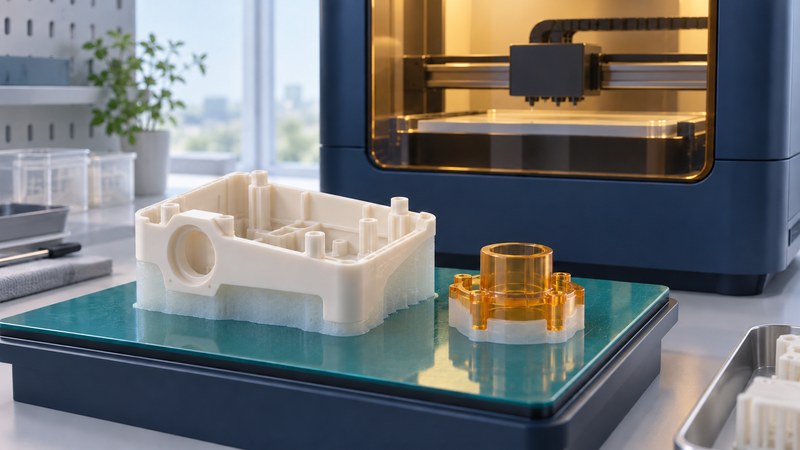
Photopolymer material jetting builds a part by depositing small amounts of resin and curing them with light. For a prototype buyer, the useful specification describes the finished geometry, surface and function, together with the work needed to remove support and inspect the part. Start with the prototype's purpose and a revision-controlled model.
Separate detail from dimensional accuracy
Layer height describes a build increment. Feature resolution concerns which details the process can reproduce; accuracy concerns how measured dimensions compare with the intended values. A small layer height alone supplies neither a tolerance for an assembled part nor proof that a small enclosed passage can be cleaned.
Mark the dimensions and surfaces that decide acceptance. Include datums, required clearances and the method used to measure them. Tell the supplier whether the part is for a visual presentation, assembly check or a defined functional experiment. Ask for a representative sample where the decision depends on delicate features or appearance.
Plan orientation and support access together
The Stratasys PolyJet design guide explains how support contact affects finish and why enclosed spaces need removal access. Apply its guidance to the relevant system and confirm current material-specific instructions. A pleasing view of the CAD model can conceal a difficult cleaning path.
On a narrow screen, scroll the table horizontally. Keyboard users can focus it and use the arrow keys.
| Feature | Planning question | Acceptance evidence |
|---|---|---|
| Enclosed channel | How will support leave and cleanliness be checked? | Accessible inspection or a justified functional flow check |
| Thin rib or fine detail | Can it survive removal and handling? | Intact features after the complete finishing route |
| Cosmetic surface | Which faces touch support and require finishing? | Agreed lighting, reference sample and surface comparison |
| Mating feature | What clearance and measurement datum apply? | Measured dimensions and representative assembly trial |
A split part may improve support access, but adds joints and assembly variation. Record that tradeoff explicitly instead of treating a CAD split as an invisible preparation step.
Specify the finished material condition
Stratasys lists several PolyJet support materials with different compatibility and removal routes. Use the exact combination's instructions for cleaning, tools and chemicals. Record conditioning and any sanding, coating or polishing before inspection. Follow the supplier's handling guidance and establish appropriate workplace controls for printing and post-processing.
Describe resin age, exposure and the expected environment when evaluating functional behavior. Appearance, flexibility or a material's marketing name does not establish equivalence to a production thermoplastic. The printed-plastic evidence guide explains how to bound that comparison.
Judge the completed prototype
Fictional enclosure trial: finished hole-center spacing must be 40.00 ± 0.15 mm. Measurements of 39.92, 40.08 and 40.21 mm produce two conforming samples and one 0.06 mm above the upper limit. A nominal 0.016 mm layer height does not resolve that failure.
Check the measurement method, geometry revision, orientation and finishing history before changing the build. Repeat the relevant comparison and preserve individual results. Include damaged parts and support-removal labor when comparing quotations: the useful output is an accepted finished prototype with evidence, not simply a completed print.
Use the working record
Download the editable photopolymer jetting acceptance. Save a copy, complete the actual requirements and evidence fields, and review open issues with the responsible owner. The plain-text record includes instructions, units where needed, the fictional example, and source references.