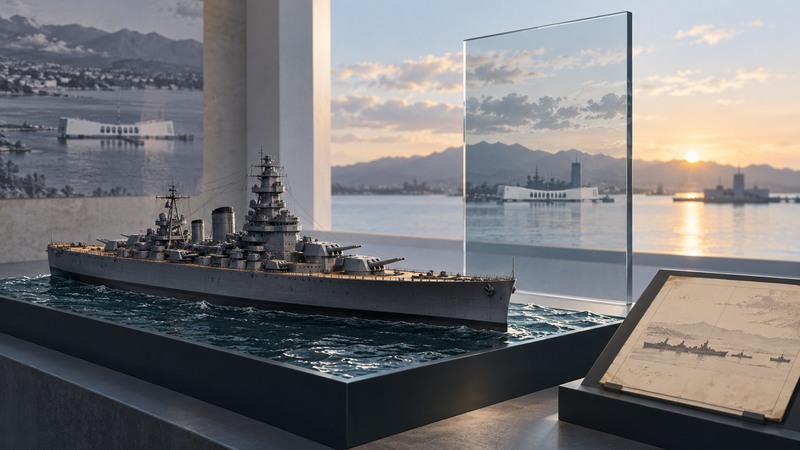
On December 7, 1941, Japanese naval aircraft attacked Pearl Harbor and other military installations on Oʻahu, bringing the United States into World War II. To understand the event, follow three connected stories: the decision to attack, what happened that morning, and how survivors and later generations remembered the losses.
The road to war in the Pacific
Japan's war in China and expansion into French Indochina deepened its confrontation with the United States. American economic restrictions, including the freezing of Japanese assets in 1941 and the resulting oil embargo, increased the pressure on Japanese leaders. Negotiations continued, but the governments' positions on the regional order remained far apart. The State Department's historical overview traces this diplomatic sequence.
Japanese leaders chose a wider war. The strike at Pearl Harbor aimed to cripple the U.S. Pacific Fleet while Japan extended its conquests elsewhere in Asia and the Pacific. Aircraft launched from carriers approaching north of Hawaiʻi targeted warships and airfields. The attack's scale becomes clearer when the harbor is placed alongside the air installations across Oʻahu. Hawaiʻi was then a U.S. territory.
December 7: warnings, attack and response
The times below use local Hawaiian time as reported in the historical sources. They are landmarks in a complex attack involving simultaneous events at different locations.
| Time | Event | Reading the evidence |
|---|---|---|
| 6:45 a.m. | USS Ward attacked a Japanese submarine near the harbor entrance. | This was a warning before the air raid; tracing how its report traveled is a separate question from establishing the encounter. |
| 7:02 a.m. | Operators at Opana detected approaching aircraft on radar. | The contact was interpreted at the information center as an expected American flight. |
| About 7:55 a.m. | The air attack on Pearl Harbor began. | Ships and airfields experienced different sequences within the opening assault. |
| About 8:54 a.m. | A second wave of Japanese aircraft arrived. | American defenders were now returning fire amid continuing rescue and damage-control efforts. |
| About 9:45 a.m. | The main air attack ended. | Rescue, medical treatment, recovery and assessment continued long afterward. |
Timeline sources: the U.S. Navy museum's Pearl Harbor educational chronology (PDF) and the National Park Service's Opana radar account.
Opana offers a useful case study in the difference between detection and response. Privates Joseph Lockard and George Elliott saw a large radar return and reported it. Lieutenant Kermit Tyler believed it represented expected B-17 aircraft. A working sensor supplied information; interpretation, communications and readiness determined what happened next. Compare this problem with the coordinated air-defense process described in the Battle of Britain guide.
Human losses and the work of recovery
The National Park Service's remembrance account records 2,403 service members and civilians killed and 1,178 injured in the attack. These totals combine military and civilian losses; they should be identified that way when reused. Individual ship, service and civilian lists answer more specific questions. The NPS remembrance page provides the overall figures.
All eight U.S. battleships in port suffered damage or destruction. The Pacific Fleet's aircraft carriers were away, and fuel storage and repair facilities largely survived. Salvage and shipyard work returned many damaged vessels to service. The NPS overview of Pearl Harbor's military consequences explains why a devastating immediate blow still left the United States with resources for a prolonged war.
When reading a damage list, distinguish a vessel sunk in harbor from a permanent loss. A ship's later return to service represents months or years of labor, technical decisions and risk. Photographs of damaged ships capture only one stage of that history.
From an attack to a declaration of war
On December 8, President Franklin D. Roosevelt addressed Congress and requested a declaration of war against Japan. Congress approved it that day. The National Archives presents the address and its transcript. Germany and Italy declared war on the United States on December 11, widening the American war; the Archives' legislative account places these events together.
The speech is evidence of the administration's immediate public response. Its descriptions reflect information available during an unfolding crisis, and its language served the political purpose of securing a declaration and mobilizing the country. Later operational histories can be compared with that first public account.
A simple source comparison
- Choose a small question. For example: what warning reached an information center, or what did a survivor experience aboard one ship?
- Identify the document. Record its creator, date, location, archive reference and whether it is a contemporary record or a later recollection.
- Separate observation from explanation. An eyewitness can describe smoke, damage or a message received; explaining the attack's planning usually requires additional records.
- Compare two kinds of evidence. Set a photograph beside a damage report, or a recollection beside a log. Preserve disagreements in times and descriptions until a source resolves them.
For a first exercise, compare Roosevelt's December 8 address with the timeline above. List the speech's geographic scope and its request to Congress. Then identify which details about the morning require the operational sources.
Remembering the people and visiting the place
National Pearl Harbor Remembrance Day falls on December 7; Congress established the observance in 1994. Memorials, names, survivor testimony and ceremonies preserve different relationships with the event. A commemorative address reveals how its own generation understood duty and loss, while a personal testimony can preserve the experience of a particular place and moment.
Begin a visit with the official Pearl Harbor National Memorial website. Use its current planning information for reservations, access, closures and the USS Arizona Memorial program. Check arrangements for each attraction you intend to visit. Leave time to read the names and accounts as well as to see the harbor.
Explore more documents, places and interpretations in Yenra History.