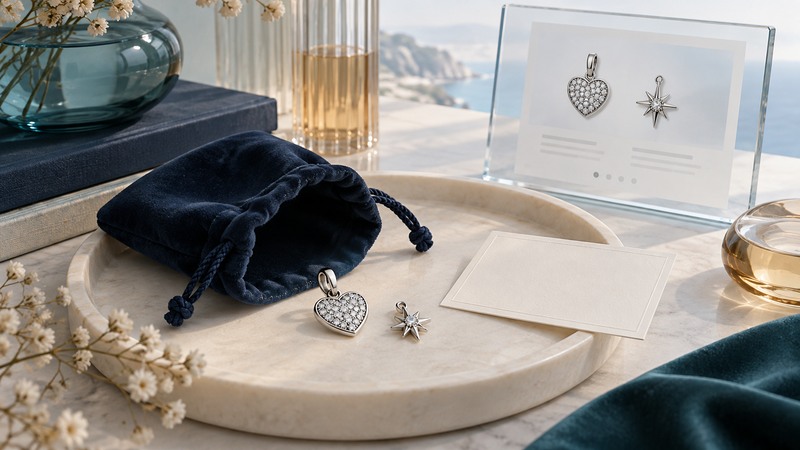
Paris Hilton's Amazon jewelry collection is a small, documented example of early celebrity e-commerce: affordable fashion-oriented pieces were presented alongside photographs, video, and a personal brand story. For someone researching an older pendant or bracelet, the useful questions are which period product is being claimed, what the records describe, and how the present object compares.
Place the collection in its 2004–2005 setting
Amazon's February 7, 2005 collection announcement describes a line launched the preceding September and an expansion with five designs. The release names a charm bracelet, pendant, dangle earrings, belly bar, and pet collar; it describes sterling silver and crystals with additional blue and violet colors.
That is a dated retailer account, including its own promotional assessment of sales. It establishes what Amazon announced and how the line was positioned at the time. Current availability, resale prices, and the identity of any individual secondhand piece need separate evidence.
For a more specific object description, Amazon's November 2004 holiday product announcement lists a sterling-silver and Swarovski-crystal heart pendant on a 16-inch satin cord by Paris Hilton. This is more useful for comparing an object than a seller's broad label such as “Paris-era heart necklace.”
Read the design as a combination of motif and construction
A heart or star is a widely used shape. What makes a comparison meaningful is the combination: the outline, stone arrangement, back construction, bail, dimensions, and the way the pendant meets its cord or chain. A strong motif can help you find a possible match; the smaller details help you test it.
The 2004 pendant listing also illustrates how the wearing format contributes to the design. A satin cord frames a small bright object differently from a metal chain. If an older pendant has been transferred onto another necklace, describe the pendant and its current suspension separately.
Scroll horizontally to see all columns.
| Record detail | What to inspect | How to record uncertainty |
|---|---|---|
| Named motif and product type | Outline, front and back, bail, and complete assembly. | “Similar motif” until the more specific details match. |
| Metal and crystal description | Marks and documented materials; examination when needed. | Separate the original product specification from an untested present object. |
| Cord, chain, or fastening | Current length, attachments, clasp, and replacement history. | Identify a known substitution without guessing when it happened. |
| Packaging and accompanying card | The actual packaging, its condition, and any connection to an invoice. | Record that it accompanies the piece; establish whether the pairing is documented. |
The online boutique was part of the presentation
The 2005 Amazon release describes photographs, behind-the-scenes video, a message from Hilton, and studio footage. It also describes navy velvet pouches and a keepsake card bearing her tiara logo. The retail presentation combined the object, a gift experience, and access to a celebrity's image.
That gives a researcher several categories of evidence. A studio image documents how the product was presented. A retail description records a specification. An invoice may connect a purchase to a buyer. A box or card adds context. Preserve the distinctions when building a history of one piece.
Packaging can outlive its original contents or be paired with another object. Give it space in the research file without allowing it to substitute for a detailed object match.
Investigate a secondhand listing in a repeatable order
- Save the listing and date, including the seller's exact attribution and photographs.
- Ask for the pendant or bracelet dimensions and clear photographs of marks, reverse surfaces, and attachment points.
- Locate the closest dated product description. Record the source, date, and which features actually match.
- List differences such as a replacement cord, missing element, altered clasp, or uncertain stone description.
- Ask what documentation ties the piece to the collection. Keep unsupported statements in an “unconfirmed” field.
- Discuss the return terms and any examination needed before committing to the purchase.
The printable collection research sheet helps keep that evidence together. Use it for a specific object, rather than compiling a list of attractive lookalikes.
Example: an apparent match with a replacement cord
Condition and materials matter more than a nostalgic label
Look for missing crystals, worn attachment points, damaged fastenings, and evidence of repair. Ask a jeweler to assess an uncertain setting or material before cleaning, polishing, or replacing parts. Care should suit the entire assembly, including any adhesive, coating, cord, or replacement component.
The FTC's precious-metal buying guide explains sterling-silver terminology. A seller's material claim should be specific and recorded in writing. For a monetary valuation, use the appraisal guide to define the purpose; a period retail price and today's asking price are different kinds of evidence.