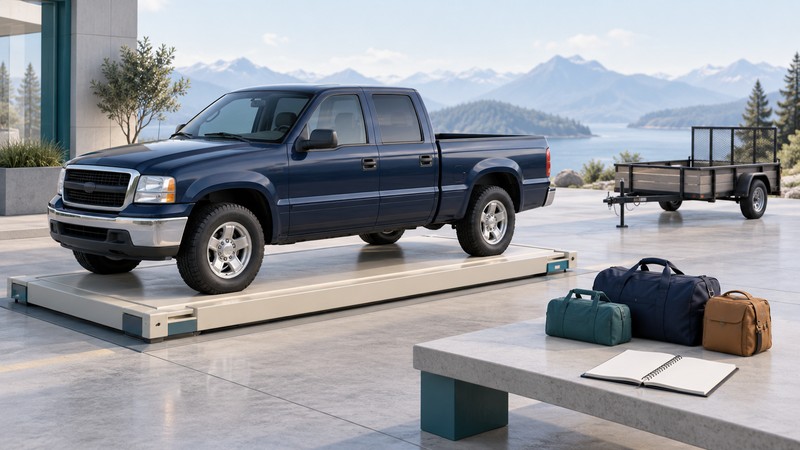
A useful Titan towing assessment starts with the particular truck, the loaded trailer and the people and equipment travelling with them. Build one evidence sheet that connects the vehicle’s identity, its documented limits and its measured operating weights.
This guide concerns the U.S.-market 2008 Nissan Titan. Use the original 2008 owner’s manual alongside the labels and equipment on the vehicle. A used truck may have acquired accessories, replacement tires or a different hitch since it left the factory.
Identify the configuration before choosing a rating
Record the VIN, model year, King Cab or Crew Cab, wheelbase/bed configuration, trim and two- or four-wheel drive. Ask a Nissan dealer to help confirm factory equipment when the original build information is missing. Photograph the vehicle certification and tire/loading labels legibly, keeping the VIN in your private records.
Nissan’s 2008 Towing Guide has separate Titan tables for trucks with and without the optional towing package, with further cab, wheelbase, trim and drivetrain distinctions. Match the complete row and its footnotes. A receiver, extended mirror or dashboard switch alone is insufficient evidence of the entire factory package.
Write down the actual receiver, ball mount, ball, coupler and trailer identification. Have a qualified towing installer reconcile their ratings and condition with the truck’s instructions, including any required braking and hitch equipment. A stronger replacement component does not establish a higher vehicle rating.
Keep the different weight checks separate
On a narrow screen, scroll the table sideways. Keyboard users can focus the table region and use the arrow keys.
| Check | Record | Question it answers |
|---|---|---|
| Occupants and cargo | Vehicle loading label; people, luggage, added equipment and trailer load carried by the truck. | Does the proposed load fit the truck’s allowance? |
| Whole truck and axles | GVWR, front/rear GAWR and scale measurements in the intended configuration. | Are total and individual axle loads within their limits? |
| Truck and trailer together | Applicable GCWR and combined loaded weight. | Does the complete combination fit the rating? |
| Trailer and connection | Loaded trailer weight, tongue load, vehicle limits and fitted-component ratings. | Is each part suitable for this trailer and load? |
The manual’s loading section identifies GVWR and GAWR on the certification label and counts trailer tongue weight among the truck’s load. Use the manual’s measurement guidance and a suitable scale; a payload subtraction on paper leaves axle distribution and the other limits unresolved. Include a bed cover, toolbox and other later additions in the load accounting, without counting an item twice.
A hypothetical payload budget
Illustration only: suppose a truck has a verified 1,400 lb occupants-and-cargo allowance. Its planned load contains 450 lb of people, 180 lb of luggage, 120 lb of accessories added after the label basis, 80 lb of hitch equipment and a measured 500 lb trailer tongue load.
450 + 180 + 120 + 80 + 500 = 1,330 lb. The remaining allowance is 70 lb. Adding a 100 lb item raises the load to 1,430 lb, exceeding that illustrative allowance by 30 lb.
These invented inputs are neither a Titan specification nor a trailer recommendation. Even the first total requires the axle, combined-weight, trailer and hitch checks above. If a trip fails a limit, revise the load or select a suitable vehicle/trailer combination and check it again. Preserve the trailer manufacturer’s required loading balance; casually moving cargo rearward to reduce tongue load is not a solution.
For a scale record, note who was aboard, fuel level, luggage, accessories, trailer contents and hitch setup. Those notes make the result reusable: you can see what changed before the next trip instead of treating an old weight ticket as permanent clearance.
Pair capacity evidence with an age-appropriate inspection
Give an independent technician the truck’s intended work and its records. Request written findings on structure and corrosion, brakes, tires and wheels, steering/suspension, cooling, drivetrain operation and the hitch mounting area. Ask which findings affect the proposed use and which require further diagnosis. Have undocumented suspension, tire or towing modifications assessed before relying on them.
Check NHTSA recall information and ask Nissan about VIN-specific history. The VIN lookup omits completed recalls and generally recalls more than 15 years old, subject to manufacturer coverage. Keep dated manufacturer responses and repair receipts with the inspection.
Finish with a decision you can explain
Use the Titan load-planning record to keep the rating source, actual measurement and unresolved question beside each other. Mark a rating as unknown until its configuration is verified. A useful result is a documented match for a particular trip, or a short list of missing evidence that must be resolved first.
For the wider purchase assessment, use the vehicle-inspection guide. For changes to the cargo area, include the equipment’s weight and fit requirements in the custom-project brief.
Explore Autos: vehicle guides, technology and design · Cars: buying, maintenance and ownership