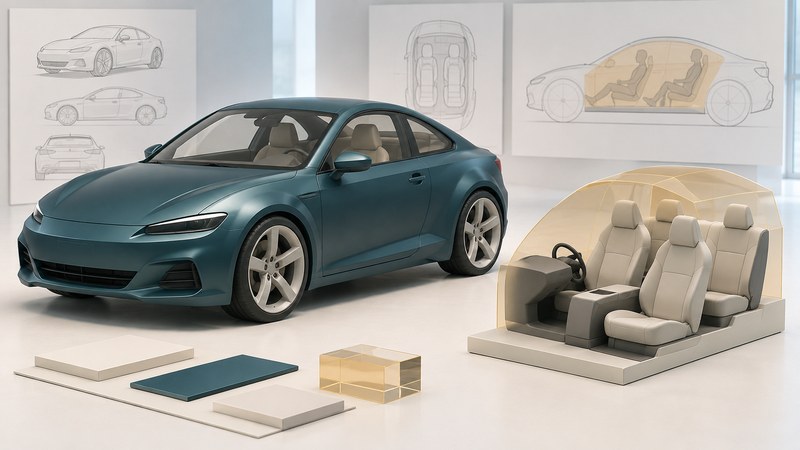
A concept car can make a design argument without resolving every question a production car must answer. Nissan's AZEAL is a compact example: a coupe aimed at young buyers, with a strong visual stance and a cabin that gives the front occupants priority. Its value as a case study is in connecting those choices to the proposed audience.
Start with the intended buyer
Nissan introduced AZEAL for the 2005 Detroit show as the first concept from Nissan Design America's Farmington Hills, Michigan, studio. The manufacturer's January 2005 introduction described an entry-level, performance-oriented coupe intended to be affordable and expressive. Treat affordability as part of the design brief: the announcement does not supply a retail price or production-cost demonstration.
Translate that brief into questions before evaluating the styling. How often would the intended buyer carry rear passengers? What everyday objects should fit? Which visual features would still matter if the wheel size or material specification changed? These questions expose priorities that a dramatic show image can leave unstated.
Connect the visible choices to their purpose
Nissan's AZEAL overview describes short overhangs, broad shoulders, a sloping rear roofline and a glass roof. The 2+2 interior favors the front seats; rear seats fold with a ski pass-through. The studio also connected its metal, leather and glass treatment to architectural influences. Those are the documented choices; the questions below are a way to assess their implications.
On a narrow screen, scroll the table sideways. Keyboard users can focus the table region and use the arrow keys.
| Priority | AZEAL design cue | Question for a production study |
|---|---|---|
| A strong visual stance | Short overhangs and wide-looking shoulders | Would the proportions remain convincing with ordinary road wheels and required packaging? |
| Front-seat experience | Front-focused 2+2 cabin | What rear-seat access and comfort would the intended buyer accept? |
| Light and openness | Glass roof | How would shade, heat control and interior space be resolved? |
| Everyday flexibility | Folding rear seats and ski opening | Which actual objects fit through the openings, with which seats occupied? |
| Distinctive character | Contrasting materials and architectural references | Which details convey the idea, and which would be expensive to manufacture? |
Read “2+2” as a packaging description, not proof that four adults will travel comfortably. Likewise, a pass-through suggests one way to carry a long object, but its presence alone supplies no dimensions. A convincing evaluation would use an object list and occupant positions rather than treating the feature name as the answer.
What the concept specifications establish
Nissan described a turbocharged 2.5-liter four-cylinder engine, a six-speed manual transmission and 19-inch wheels in the introduction; the overview identifies front-wheel drive. Those specifications help explain the proposed character. They do not establish acceleration, durability, production availability or ownership cost.
Keep three columns in your notes: published specification, visible design feature and unanswered question. A stated powertrain belongs in the first column. A photographed roof shape belongs in the second. A proposed purchase price remains in the third unless a dated source actually provides one.
This distinction also applies to design lineage. Resemblance to another Nissan is an observation that can prompt research. It is not sufficient evidence that AZEAL directly became that production car. A lineage claim needs a documented connection, rather than a confident arrow drawn between two similar silhouettes.
Test the priorities with a small scenario
Imagine a design review for a fictional buyer who usually travels alone, occasionally carries two friends and takes a bulky sports bag. That scenario can justify prioritizing the front seats, but it also reveals an unresolved task: show how the bag fits when both rear seats are occupied. Folding-seat flexibility is less useful on the trip when those seats are needed.
Next, change just one assumption: the buyer regularly carries an adult in the rear. The same attractive roofline now needs a more demanding rear-seat assessment. The design has not suddenly become good or bad; the user requirement has changed. Record which part of the brief each proposed alteration would improve and which part it might weaken.
Finally, identify one feature that should survive cost reduction because it carries the concept's identity. Describe the intended effect, such as a strong shoulder line or an open cabin impression, before prescribing the exact material. That keeps the discussion about the design purpose while leaving room to investigate manufacturable solutions.
Write a brief that can be challenged
Use the AZEAL design-brief record to connect audience, design cue, tradeoff and missing evidence. A useful conclusion names what the concept communicates and what remains to be demonstrated. For a different approach to passenger priorities, compare the Infiniti Kuraza concept guide.
Explore Autos: vehicle guides, technology and design · Cars: buying, maintenance and ownership