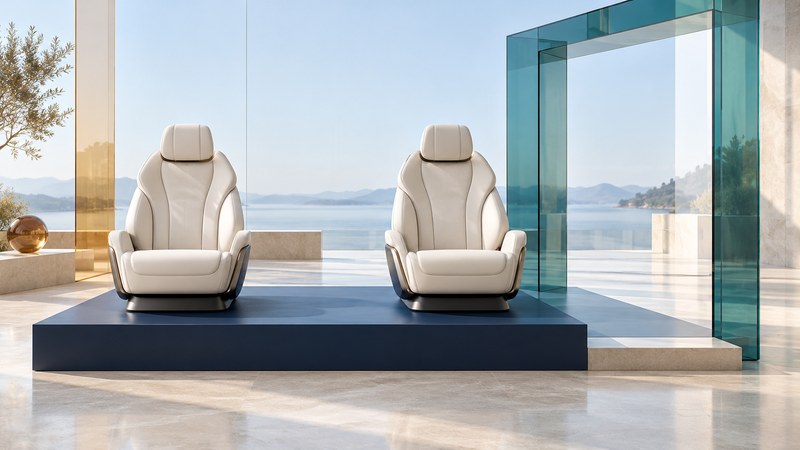
Infiniti's Kuraza concept asks a useful design question: what would an SUV-like cabin become if the people in the second and third rows mattered as much as those in front? Read it as a proposal about passenger experience, then test its priorities against a specific journey.
The January 3, 2005 Infiniti press kit describes six individual seats, six doors and a brief centered on six adults sharing an outing. The concept deliberately placed less emphasis on luggage and everyday utility. Its value as a case study lies in that clear choice, not in treating it as a production vehicle you could order.
Read the design through its intended passengers
Kuraza used rear-hinged rear doors and an opening without a pillar between the second and third door sections to address access. Raised rear seating and a stepped, glazed roof addressed outlook. A central console with folding portions allowed movement across the rear cabin. These are the manufacturer's descriptions of its concept, not measured accessibility or crash-test results.
The design also used Japanese clothing and interior-art references to express hospitality through materials and display. Those references explain the designers' intent. Whether a passenger finds the result comfortable or welcoming requires observation, not the vocabulary of the press release.
Turn an idea into an evaluation question
On a narrow screen, scroll the table sideways. Keyboard users can focus the table region and use the arrow keys.
| Design priority | Question to test | Evidence needed |
|---|---|---|
| Equal attention to rows | Can each intended occupant sit, see and converse comfortably? | Try each position with actual people, using the front positions they would normally need. |
| Independent access | Can rear occupants enter and leave without an awkward sequence? | Observe the complete access route and the clearance needed beside the vehicle. |
| Outlook and light | Does the rear passenger have a useful view without uncomfortable glare? | Compare seating positions and lighting conditions; a glass roof alone is not a result. |
| Movement within the cabin | Does a console or folded section create useful space for the intended stop? | Review the parked configuration; movement while travelling is a separate safety question. |
| Shared outing | Where do bags, coats and mobility aids go when all places are occupied? | Use the complete passenger and luggage list, including the journey home. |
These questions are an evaluation framework, not a report that Yenra tested Kuraza. A concept description can establish an intended feature, but it cannot supply measurements or user trials that were never provided.
The tradeoff is part of the idea
A passenger-centered brief can be sensible for one trip and incomplete for another. Six friends travelling a short distance to dinner may care most about conversation, outlook and easy entry. Six people going to an airport also need to store suitcases. The second trip changes the design problem even though the passenger count is identical.
Door count is not a complete access measure. An opening can look generous in an exhibition and still need a real-world assessment of parking clearance, step height, reach and the passenger's own movements. Similarly, six comfortable-looking chairs do not establish equal comfort. Front-seat adjustment, foot space, visibility and the ability to enter and leave all matter.
When applying the questions to a production car, use its own handbook, seating and load limits. Do not infer approved restraint arrangements, wheelchair access, safe door operation or roadworthiness from a concept's design story.
Worked example: change the trip, then reconsider
Fictional design exercise: a team sketches a six-place cabin for an evening outing. The brief includes six adults and light coats, with no overnight bags. The team gives every row a good view and prioritizes direct access.
Now change the brief to a weekend away with six cases. Ask where the cases go without removing an occupied seat or blocking access. If the sketch cannot answer, the correct finding is “successful for the original social outing, unresolved for the weekend load.” It need not be dismissed as a failed concept, but it must not be presented as a solution to the second task.
A further variation—one traveller needs assistance entering—creates another specific test. Ask that person what movements and support work for them, and assess an actual vehicle with their agreement. Broad claims such as “easy access for everyone” hide the evidence that matters.
Use the passenger-space worksheet
Download the passenger-space design review. Start with the journey, list the people and luggage, and record which design questions are answered by a document, a measurement or an actual observation.
For a concept-to-production comparison, see Mazda MX-Crossport and the CX-7. For a practical passenger-and-luggage trial across older production cars, use the Chrysler convertible comparison. Kuraza supplies a way to ask better questions; each vehicle needs its own answers.
Explore Autos: vehicle guides, technology and design · Cars: buying, maintenance and ownership