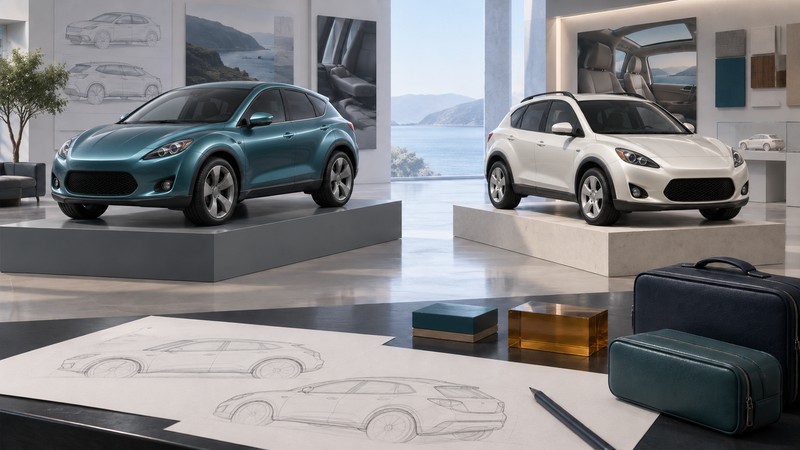
Mazda’s MX-Crossport is best understood as a design proposal that led to the CX-7. Follow the dated documents to see which ideas carried forward, where the packaging changed and which mechanical claims require their own evidence.
The useful comparison is the concept previewed in December 2004 for the 2005 Detroit show and the initial US 2007-model-year CX-7. Keep announcement dates, show dates and model years separate. The name “MX-Crossport” belongs to the concept stage of this story.
Follow the concept into production
- December 15, 2004: Mazda’s concept preview describes a North America-oriented crossover design and space for four adults, with a January 2005 Detroit presentation planned.
- May 26, 2005: Mazda confirms production as the CX-7, retaining many design themes and planning production in Japan in 2006, initially for North America.
- Initial US production specification: the 2007 CX-7 specification deck dated February 8, 2006 identifies Sport, Touring and Grand Touring configurations, five passenger places, and front-wheel drive or optional all-wheel drive.
This sequence supports a direct design lineage. It also shows why a concept announcement alone cannot establish the exact equipment of a production car.
Compare design, packaging and powertrain separately
On a narrow screen, scroll the table sideways. Keyboard users can focus the table region and use the arrow keys.
| Topic | What the documents establish | How to interpret it |
|---|---|---|
| Design direction | The production announcement explicitly connects CX-7 with the concept’s design themes. | Compare dated photographs for shape and proportion; record the view and vehicle stage. |
| Passenger packaging | The preview describes space for four adults; the US production specification lists five places. | A clear change in stated seating; actual comfort still requires an individual fit check. |
| Cargo flexibility | The US specification lists a 60/40 split-folding rear seatback. | Describe the production feature without assuming the concept used the same hardware. |
| Engine and drive | The US deck lists a 2.3-liter turbocharged four-cylinder, six-speed automatic, and FWD or optional AWD. | Identify the production configuration independently of sports-car styling language. |
Mazda’s 2007 CX-7 release, PDF pages 1–4, discusses the swept windshield, prominent fenders, cabin layout and production powertrain. These are different kinds of evidence. A recognizable fender treatment can show family resemblance; it cannot prove a shared engine, chassis or interchangeable component.
Read a design claim at the right level
Start with a narrow question such as “Did the production car retain the concept’s seating arrangement?” Give each source a date, market and stage, then record the relevant statement or visible detail. Use your own words and keep a page reference so another reader can retrace the conclusion.
For exterior comparisons, choose similar camera angles. A low front-quarter photograph emphasizes the wheel arches differently from a high side view. Note that limitation before treating an apparent difference as a design change. The illustration above is a conceptual design-study scene; use the manufacturer’s dated photographs as historical evidence.
For mechanical claims, look for an identified component, layout or specification. A phrase about sports-car character expresses a product intention. Establishing engineering commonality requires a more specific source. If your evidence only supports resemblance, keep the conclusion at that level.
Turn the production specification into a useful fit check
If your interest is a used CX-7, first establish its actual model year, market, trim and driveline. The initial US specification is a reference for that configuration, not a description of every later CX-7. Add any changes documented on the particular vehicle.
For a seating-and-cargo trial, set the front seats as the intended occupants need them, then determine which rear positions must remain usable. Bring representative bags, record their dimensions and try the permitted seat arrangement with the owner. Follow the matching handbook’s folding, loading and restraint instructions.
Write down the compromise you actually observed: which seat section was folded, which occupants remained and where the luggage fitted. A count of five passenger places does not answer whether five particular people and their belongings will suit your journey. For a broader method, see Automotive Design.
Keep a concept-to-production comparison
Download the MX-Crossport to CX-7 comparison record. Use one sheet per feature, separating the historical conclusion from any present-day vehicle trial.
Explore Autos: vehicle guides, technology and design · Cars: buying, maintenance and ownership