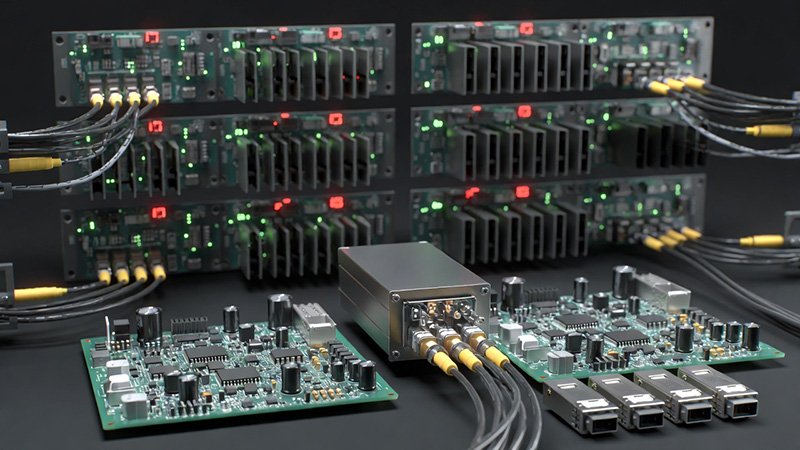
SONET, the Synchronous Optical Network, was introduced in the 1980s and standardized in North America through the American National Standards Institute (ANSI). Its international counterpart is SDH, the Synchronous Digital Hierarchy, standardized by ITU-T. Together, SONET and SDH created a common optical transport framework for carriers that needed reliable, manageable, high-capacity transmission across fiber networks.
SONET is now a mature and often legacy transport technology, but it remains important historically and operationally. It carried voice trunks, private lines, Internet backbone traffic, cellular backhaul, enterprise circuits, and early data services for decades. Many modern optical and packet transport systems inherited SONET's expectations for timing, performance monitoring, protection switching, and carrier-grade operations.
Why SONET Was Created
Before SONET and SDH, carriers used many incompatible digital transmission systems. Multiplexing, management, timing, and vendor interoperability were difficult. SONET gave service providers a standardized way to multiplex lower-speed signals into higher-speed optical carriers, monitor performance, and protect traffic when fiber or equipment failed.
The result was more than a faster fiber link. SONET was an operational system: framing, overhead bytes, alarms, performance counters, synchronization, multiplexing hierarchy, add/drop multiplexers, cross-connects, and ring protection all fit together.
Framing And Rates
The base SONET electrical signal is STS-1, and the corresponding optical carrier is OC-1. The STS-1/OC-1 line rate is 51.84 Mbps. Higher SONET rates are multiples of that base rate, such as OC-3 at 155.52 Mbps, OC-12 at 622.08 Mbps, OC-48 at about 2.488 Gbps, OC-192 at about 9.953 Gbps, and OC-768 at about 39.813 Gbps.
SONET frames repeat every 125 microseconds, matching the 8 kHz timing rhythm of traditional voice networks. This made SONET well suited to carrying DS1, DS3, and other TDM services while also providing a structured way to transport packet data and concatenated payloads.
SONET Layers
SONET is commonly described through layers:
- Path: end-to-end payload transport and performance monitoring for the carried service.
- Line: transport between multiplexing nodes, including functions such as protection switching.
- Section: transport across an individual optical section between adjacent devices.
- Photonic: the optical signal, fiber, wavelength, power, and physical transmission behavior.
This layered overhead was one of SONET's strengths. Operators could diagnose whether a problem affected a section, a line, or an end-to-end path instead of treating the optical network as a dark pipe.
Protection And Rings
SONET became famous for protected ring designs. In a UPSR or BLSR design, traffic could survive many fiber cuts or equipment failures by switching to an alternate path around the ring. Protection switching targets were often discussed in terms of fast restoration, commonly around 50 milliseconds for suitable failures.
That protection model shaped carrier expectations. Modern MPLS fast reroute, Ethernet ring protection, optical restoration, and packet-optical protection schemes are different technologies, but they are judged against the same operational desire: failures should be contained quickly and predictably.
SONET, SDH, And Payloads
SONET and SDH are closely related but use different naming conventions. SONET uses STS and OC rates, while SDH uses STM rates. For example, SONET OC-3 aligns with SDH STM-1 at 155.52 Mbps. The technologies were harmonized enough to support global optical transport, even though regional terminology and hierarchy details differed.
SONET carried many payload types over time: TDM voice, DS1, DS3, ATM, packet over SONET, Ethernet over SONET, storage traffic, and private-line services. It was a transport wrapper for whatever the network needed to carry, provided the payload could be mapped and managed appropriately.
Packet Over SONET
As Internet traffic grew, carriers used packet over SONET and related techniques to carry IP traffic over SONET links. This let routers connect directly to optical transport while preserving SONET's framing, performance monitoring, and protection. Later, Ethernet over SONET and GFP-based mappings made packet services more flexible.
Packet over SONET was a bridge between TDM-era optical transport and IP-centric networks. It worked, but it also showed the inefficiency of carrying packet traffic through too many legacy layers when Ethernet and IP were becoming the dominant service model.
Why SONET Declined
SONET declined for new builds because traffic shifted from voice and TDM circuits to packet data, Ethernet, cloud connectivity, and high-capacity optical wavelengths. DWDM multiplied fiber capacity. OTN added a newer digital wrapper for optical transport. Carrier Ethernet gave customers familiar handoffs. MPLS and IP provided scalable service control. Packet-optical platforms integrated switching, routing, and optical transport more efficiently than traditional SONET shelves.
SONET did not disappear overnight. Carriers and enterprises had long-lived private lines, mobile backhaul, utility networks, government circuits, and legacy voice infrastructure. Many networks still carry SONET/SDH services or emulate them over newer transport systems. The practical question is often how to migrate cleanly, not whether SONET was useful.
Modern Replacements
SONET's old roles are now handled by several technologies:
- OTN: optical transport network framing, forward error correction, multiplexing, and operations for modern optical networks.
- DWDM: many wavelengths over the same fiber, each carrying high-capacity optical channels.
- Carrier Ethernet: Ethernet private line, Ethernet virtual private line, and multipoint Ethernet services.
- MPLS and segment routing: packet transport, VPNs, traffic engineering, and fast reroute.
- Packet-optical platforms: systems that combine packet switching, OTN, coherent optics, and service management.
- Coherent pluggables: router-hosted or transponder-hosted optics for high-capacity metro and long-haul links.
Legacy Operations
If SONET remains in a network, operations teams should preserve the details that make the service understandable:
- Document OC rate, payload mapping, protection type, timing source, and demarcation points.
- Track path, line, and section alarms separately.
- Monitor bit errors, loss of signal, loss of frame, pointer events, and protection switches.
- Confirm whether traffic is native SONET, packet over SONET, Ethernet over SONET, or SONET emulation over OTN or packet transport.
- Plan migration by service dependency, not just by circuit speed.
- Test timing, failover, and performance monitoring after moving a legacy SONET service to a newer transport layer.
SONET's lasting contribution is operational discipline. It showed how optical transport could be standardized, synchronized, monitored, protected, and multiplexed at carrier scale. In 2026, most new growth is in Ethernet, IP, OTN, coherent optics, and packet-optical transport, but the expectations SONET created still shape how reliable networks are designed and judged.