
An intelligent optical switch is a fiber-network device that changes where optical signals go. Unlike a normal Ethernet switch with optical transceivers, an optical circuit switch can steer light from one fiber path to another without converting every signal into electronics, buffering packets, and transmitting the data again. That distinction matters: an Ethernet switch makes packet-by-packet forwarding decisions, while an optical switch usually creates physical or wavelength-layer light paths.
Optical switching has always been attractive because light can carry many protocols and bit rates transparently. A circuit may carry Ethernet, Fibre Channel, SONET/SDH, RF over fiber, video, test signals, or wavelength-division multiplexed traffic without the switch needing to understand the payload. The tradeoff is that optical circuit switching is not a drop-in replacement for every packet switch. It is strongest when traffic can be grouped into stable flows, protected paths, lab connections, wavelength routes, or high-bandwidth cluster links.
What Makes an Optical Switch Intelligent
The intelligence is not only the mirror, prism, liquid crystal, MEMS array, or wavelength-selective element that moves the light. It is the control layer around the optics: monitoring, path setup, attenuation, alarms, inventory, automation, and integration with higher-level network software.
- Transparent switching: Many optical switches pass signals without optical-electrical-optical regeneration, which reduces latency and avoids dependence on a single line rate or protocol.
- Any-to-any connectivity: A switch fabric can connect input fibers to output fibers for restoration, test automation, service turn-up, or dynamic capacity changes.
- Optical monitoring: Power-level measurement, loss alarms, and channel monitoring help operators find dirty connectors, failing optics, fiber cuts, and degraded spans.
- Variable attenuation: Built-in attenuation can equalize optical power and prevent receivers or test systems from being overdriven.
- Remote operations: Software control lets operators reconfigure fiber paths without sending technicians to move patch cords.
- Automation hooks: Modern systems may expose APIs, gNMI, NETCONF, SNMP, or controller integration so optical paths can be coordinated with packet, transport, or cloud workflows.
Where Optical Switching Is Used
The classic use case is transport networking. Reconfigurable optical add-drop multiplexers, or ROADMs, use wavelength selective switches to route individual wavelengths through metro, regional, and long-haul DWDM networks. This allows carriers to add, drop, reroute, or restore wavelengths remotely instead of manually repatching fibers at every node.
Another long-running use case is test and measurement. Optical labs use switches to connect instruments, devices under test, fiber spools, attenuators, splitters, amplifiers, and transponders in repeatable combinations. In that environment, the switch replaces a wall of manual patching and reduces the chance of connector wear or wiring mistakes.
Government, defense, broadcast, and mission-critical networks use optical switching where path control, isolation, low latency, and protocol transparency are more important than ordinary packet switching. Storage and high-performance computing environments have also used optical switches when high bandwidth and deterministic paths matter.
Why Data Centers Are Looking Again
AI clusters have revived interest in optical circuit switching. Training and inference systems move enormous east-west traffic between GPUs, accelerators, storage, and front-end networks. Conventional Ethernet and InfiniBand fabrics still dominate, but the power and scale pressure is pushing vendors to reduce optical-electrical conversions, shorten paths, and make high-bandwidth interconnects more efficient.
Lumentum, for example, describes its MEMS-based optical circuit switches as transparent any-to-any fabrics for AI and cloud networks, with current platforms reaching 64x64 and 300x300 ports. The company has positioned optical circuit switching as a way to reduce power and latency in large AI clusters. NVIDIA is pursuing a related but different optical direction with co-packaged optics: its silicon-photonics switches integrate optical engines close to the switch ASIC to reduce the cost, power, and complexity of pluggable transceivers. Co-packaged optics still belong to packet-switch systems; optical circuit switches create light paths.
Technologies Behind the Switch
- MEMS mirrors: Micro-electro-mechanical mirrors steer beams between fibers. They are widely used for large-port-count optical circuit switches because they can support protocol-transparent connections with low power.
- Wavelength selective switches: WSS modules route individual WDM channels rather than whole fibers. They are central to ROADM systems and modern wavelength-layer automation.
- Liquid crystal on silicon: LCoS-based WSS designs can provide flexible channel spacing and low-loss wavelength routing in metro, regional, and long-haul systems.
- Semiconductor optical amplifiers: SOA-based approaches can switch very quickly and are important in research and some specialized photonic systems.
- Silicon photonics: Integrated photonic chips are increasingly important for optical interconnects, co-packaged optics, and future high-density switching architectures.
Design Tradeoffs
Optical switching is powerful, but it is not magic. A circuit switch must decide when to create a light path and how long to keep it. If traffic changes faster than the optical fabric can reconfigure, packet switching may still be the better fit. Large OCS systems also require careful attention to insertion loss, return loss, polarization effects, power equalization, connector cleanliness, fiber management, and controller behavior during failures.
The most practical designs usually combine layers. Packet switches handle bursty traffic, queues, congestion management, and fine-grained forwarding. Optical switches provide high-capacity circuits, restoration paths, wavelength routing, or direct cluster connections where traffic patterns justify them. The result is often a hybrid network rather than an all-optical replacement for everything.
The 2006 Glimmerglass System 600
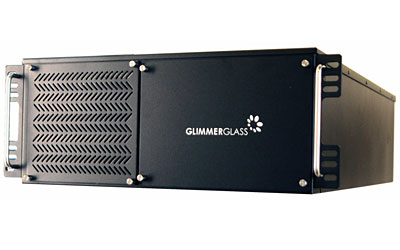 Half the height of the company's earlier product line, the Glimmerglass System 600 low-profile, high-density system was introduced for commercial networks and mission-critical government and defense systems that needed remotely controlled light-stream management.
Glimmerglass developed the System 600 for size- and power-constrained environments. Housed in a 4 rack unit chassis and described at launch as operating with less power than a light bulb, the system supported port configurations up to 160x160 with integrated optical power level monitoring, variable optical attenuation, photonic multicasting, and other light-path management features.
System operators in commercial networks, defense systems, advanced optical test facilities, and high-performance research networks used Glimmerglass intelligent optical switches to connect, monitor, and manage light streams on optical fibers. The key design point was low-loss, any-to-any fiber connection without regenerating the optical signal, allowing the system to carry 10 Gigabit Ethernet, SONET/SDH, RF, microwave, analog video, and digital video signals transparently.
What Changed Since 2006
The original System 600 story was about remote fiber-path control in telecom, defense, and lab environments. Those needs still exist, but the center of gravity has expanded. Optical switching is now part of several different conversations: ROADM automation in carrier networks, photonic test automation in labs, deterministic interconnects in high-performance computing, and power-efficient scale-out in AI data centers.
The port counts have also grown. A 160x160 optical fabric was notable in 2006. Current AI-focused OCS products are being discussed at 300x300 ports, while packet-switch vendors are pushing silicon photonics and co-packaged optics to support hundreds of terabits per second of switching bandwidth. The common theme is the same as it was in 2006: moving light more directly can save space, power, labor, and latency when the network is designed around that strength.
Buying and Planning Checklist
- Decide whether the requirement is packet switching, optical circuit switching, wavelength switching, or co-packaged optics. These are related but different technologies.
- Check port count, fiber type, connector format, wavelength bands, insertion loss, return loss, and power handling before selecting a chassis.
- Confirm whether the switch is protocol-transparent and what data rates or modulation formats it can pass without penalty.
- For ROADM and WDM networks, verify channel spacing, flexible-grid support, direction count, colorless/directionless/contentionless requirements, and optical channel monitoring.
- For AI or HPC clusters, model traffic patterns. Optical circuits help most when large flows or stable communication groups can use direct light paths.
- Plan the control layer. APIs, telemetry, authentication, rollback behavior, and failure handling matter as much as the optical hardware.
- Budget for fiber management, cleaning, inspection, and labeling. A dirty connector can erase the benefit of a very expensive optical fabric.
An intelligent optical switch is best understood as a controllable patch field for light, expanded with monitoring, attenuation, automation, and sometimes wavelength awareness. In 2006 that was a compact way to manage fiber paths remotely. In 2026 it is also one of the tools being reconsidered for the scale, power, and latency demands of the largest networks being built.