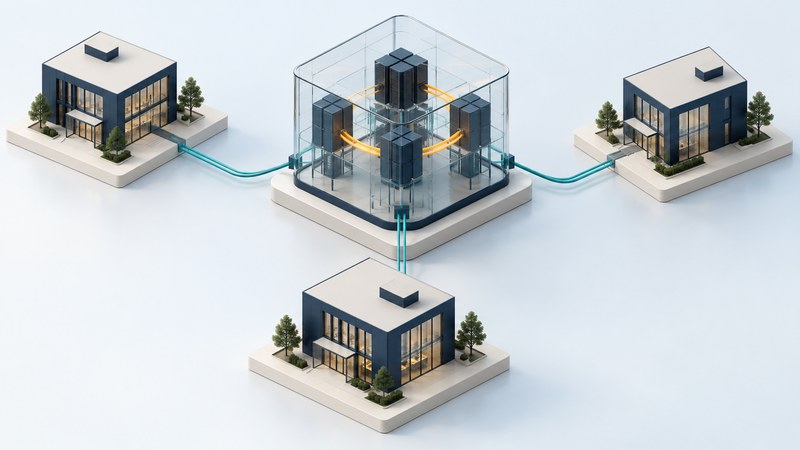
Frame Relay let a branch router reach several remote sites through logical circuits sharing one access connection. A three-site example reveals the distinction between the wire, the circuit identifier, and the service rate.
Read the physical and logical networks separately
Frame Relay is a legacy packet-switched WAN technology. A permanent virtual circuit (PVC) is a provisioned logical connection through the provider network. A data-link connection identifier (DLCI) identifies that circuit on a local access link. RFC 2427 specifies how multiple protocols, including IP, can be carried over Frame Relay.
| Logical connection | Branch identifier | HQ identifier |
|---|---|---|
| Branch A ↔ HQ | DLCI 100 on A's access interface | DLCI 201 on HQ's access interface |
| Branch B ↔ HQ | DLCI 100 on B's separate access interface | DLCI 202 on HQ's access interface |
Both branches can use 100 because these identifiers have local scope in this example. HQ distinguishes its two circuits with 201 and 202. For inventory work, write down the interface and endpoint alongside the number. Cisco's Frame Relay troubleshooting guide explains local DLCI significance and the role of the Local Management Interface (LMI).
With no direct branch-to-branch PVC, IP traffic from A to B must be routed through HQ in this example. That consumes resources on two virtual circuits and depends on HQ forwarding and policy. A physical drawing with three access links alone would hide this traffic path.
Distinguish access capacity from CIR
The access rate describes the physical connection's capacity. Committed information rate (CIR) describes a circuit's contracted traffic commitment under specified conditions. Burst allowances, measurement intervals, and discard behavior add detail. Use the actual service agreement and configured shaping values when interpreting a real circuit.
A slower remote access link can also constrain delivery even when a faster headquarters interface can transmit more. Cisco's configuration and troubleshooting guide discusses shaping and circuit behavior. Its commands are platform-specific historical examples; use the documentation for the actual equipment.
Read “up” at the right level
| Evidence | What it helps establish | Next question |
|---|---|---|
| Physical interface available | The local access has a working physical indication | Is LMI communicating, and is the intended PVC active? |
| PVC reported active | The provider reports circuit availability through the local management exchange | Are encapsulation, protocol mappings, addressing, routes, and remote configuration correct? |
| IP reaches the remote router | A tested IP exchange succeeds | Does the application work under representative load and in both required directions? |
| Congestion indications or drops increase | The observed traffic path is experiencing a relevant constraint | Do shaping, service commitments, burst behavior, and remote access capacity agree? |
FECN and BECN convey congestion information in different directions; discard eligibility concerns how frames may be treated under congestion. Interpret counters over a known interval and alongside traffic levels. Preserve the before-and-after readings when comparing changes.
Preserve the WAN's purpose
Frame Relay is most useful today as a historical explanation or an inherited-system topic. The enduring questions are where traffic goes, who manages the connection, which properties are committed, and how failures are detected.
For a replacement, first document branch-to-branch and branch-to-application flows. Identify legacy protocols, routing relationships, provider demarcation, performance needs, and security boundaries. A provider-managed IP VPN, Ethernet service, or encrypted Internet connection may answer different parts of that requirement. An SD-WAN overlay adds control across its underlying connections; evaluate the complete service.
- Map each PVC to its endpoints and the applications that use it.
- Record both-direction service rates, existing topology, and shared points of failure.
- Decide which traffic should continue through HQ and which should take a direct path.
- Validate routing, segmentation, encryption where required, MTU, loss, delay, and failover with representative traffic.
- Keep rollback and provider escalation available until the replacement is accepted.
RFC 4364 describes BGP/MPLS IP VPN architecture, a useful reference when comparing a managed routed service with the older virtual-circuit model. The relevant comparison is the service behavior, not whether two offerings both use the word “private.”