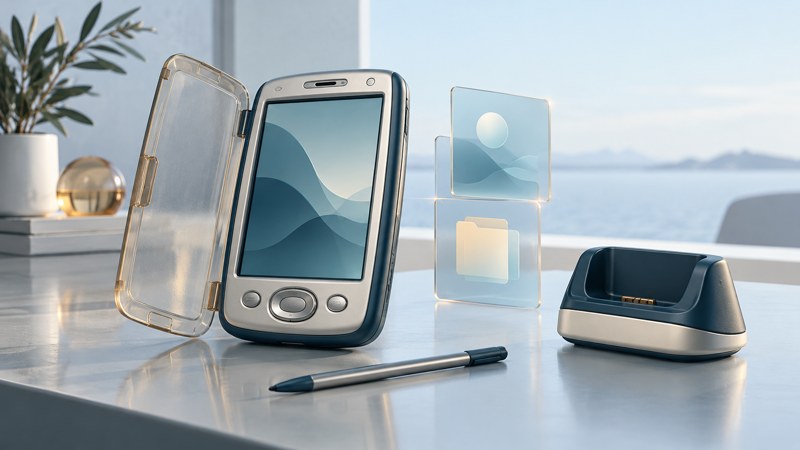
The Motorola A760 is a useful landmark in the early combination of a mobile phone, PDA functions and a Linux-based software platform. Its history is clearest when the operating system, application environment and user-facing tools are treated as separate layers—and when later Motorola models retain their own specifications.
What the contemporary sources say
In its March 19, 2003 announcement, MontaVista identified its Linux software as the operating system chosen for the recently announced A760 and described the handset as combining Linux and Java technology. The release listed PDA, camera, music, video, messaging and Bluetooth functions among the intended capabilities.
A February 2004 release about the successor A768 quotes Motorola describing the A760’s launch in China during the preceding fall. Together, these records distinguish the 2003 announcement from later evidence that the phone had launched. The detailed specification table in the 2004 release is for the A768; keep it attached to that model.
Why Linux and Java appeared together
On a narrow screen, scroll the table sideways. Keyboard users can focus the table and use the arrow keys.
| Layer | Role in understanding the phone | Research question |
|---|---|---|
| Operating system | Manages hardware and basic system services beneath applications | Which vendor build and device revision does the documentation describe? |
| Java environment | Provides an application execution environment with a defined set of capabilities | Which profiles, APIs and installation paths were actually supported? |
| PDA and media applications | Provide the functions a user sees, such as organizing information or playing media | Which functions are present in this model and firmware? |
| Communication and transfer | Connect the device to networks, peripherals or a computer | Which interfaces, software and services does each task require? |
Linux names a foundation; Java names an application technology. An application’s ability to run depends on the actual environment, APIs, resources and installation rules. Record those details before making a compatibility claim about software from another handset.
Read the PDA promise as a workflow
The useful historical question is how much of a person’s organizer, media player and communication work could move into one device. Evaluate one task at a time: enter a contact, find it again, preserve the record elsewhere, play a supported local file, or exchange data through a documented interface. A list of capabilities becomes meaningful when the steps and dependencies are visible.
For synchronization research, seek the A760’s exact manual, compatible desktop package and supported operating-system version. Record the direction of transfer and the data types handled. A successful connection cable or Bluetooth pairing is only one part of a successful contact or calendar transfer. Avoid borrowing the successor’s software list to fill gaps in the A760 record.
Build a reliable device-history record
- Identify the exact model, regional version and firmware from the artifact or documentation. Photograph labels and record document revision dates.
- Separate announced features from functions demonstrated on that particular unit. Keep a short “verified / documented / unresolved” list.
- Attach every technical detail to its model-specific source. Leave uncertain memory, processor, band or runtime-version claims unresolved until a matching source is found.
- For a demonstration, prefer local sample data and an isolated research setup. Check current carrier support independently before expecting any historic network feature to work.
- Describe the result as a historical workflow with its software and service dependencies.
The A760 helps explain how Linux entered phone platforms before today’s app ecosystems. For another approach to early mobile software and hosted services, compare the T-Mobile Sidekick history.