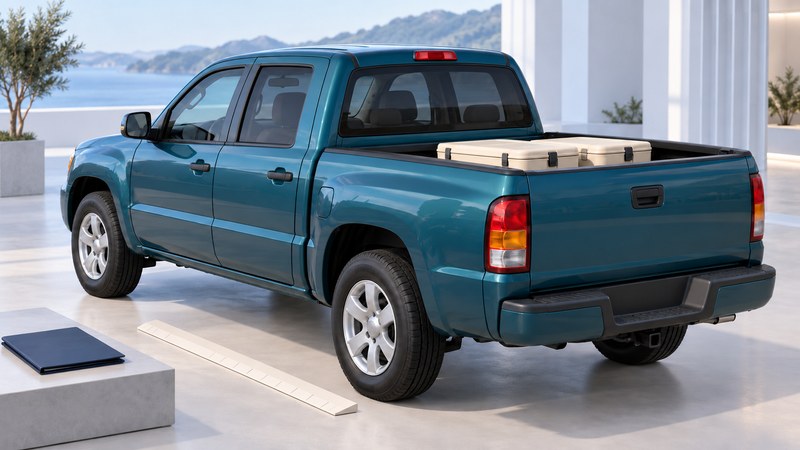
Choose a Mitsubishi Raider by matching its actual cab, bed and drivetrain to the job, then checking who can support that exact truck. Start with the people and cargo you carry most often. A higher trim level cannot compensate for an unsuitable rear seat or a load that exceeds the truck’s limits.
This guide uses the US-market 2006 Raider as its reference. Bring a passenger-and-cargo list, a tape measure, the VIN and the matching owner documentation. Photograph the truck’s labels and current equipment with permission.
Identify the cab and drivetrain before comparing trucks
Mitsubishi’s 2006 Raider introduction describes Extended Cab and Double Cab bodies, 3.7-liter V6 and 4.7-liter V8 engines, and two- and four-wheel-drive offerings. Its LS Extended Cab description lists a six-speed manual or four-speed automatic; the XLS Double Cab description pairs the V8 with a five-speed automatic and offers full-time AWD. Treat each combination as something to verify on the actual truck.
On a narrow screen, scroll the table sideways. Keyboard users can focus the table region and use the arrow keys.
| Configuration or claim | What to establish | Useful evidence |
|---|---|---|
| Cab and seats | Installed seating positions, rear access and room with the driver’s seat adjusted. | Physical trial with the people and restraints you intend to carry. |
| Bed and cargo | Usable length, width and height around liners, covers and toolboxes. | Measurements in one unit system and a trial with representative items. |
| Engine and transmission | Exact engine, manual or automatic, and factory configuration. | VIN/build information, labels and workshop identification. |
| Driven wheels | Two-wheel drive, selectable four-wheel drive or the specified AWD equipment. | Build record, actual controls and the matching handbook. |
| Load and towing limits | Limits applicable to this truck, its equipment and the intended load. | Vehicle labels, matching manufacturer instructions and measured loaded weights. |
Use the owner manual for the fitted four-wheel-drive system before a demonstration. Keep model-year and equipment details on parts inquiries; an advertisement’s generic “4x4” label leaves important questions open.
Test the everyday job with all the seats in use
Adjust the front seat for the regular driver, then assess the rear seating and door access. Bring the intended child restraint if relevant and check installation against both sets of instructions. Inspect the fitted belts and seating hardware as part of the professional inspection.
For cargo, measure the narrowest usable space and the actual loading opening. A toolbox can consume the space your longest item needs. Decide whether the tailgate must close and how the load will be secured. Check the vehicle’s load limits with occupants, accessories, luggage and any trailer tongue load included; use the exact manufacturer towing information before selecting a trailer.
Keep physical fit and permitted weight as separate results. The Frontier guide provides a useful comparison with another midsize truck, using that vehicle’s own documentation.
Verify parts support one job at a time
The manufacturer introduction identifies the Raider’s relationship to the Dodge Dakota. Use that history to ask better questions about parts. For an actual repair, request a catalog match against the Raider’s VIN, production details and installed equipment. Record the proposed part number, any supersession, supplier, availability and installer confirmation.
For example, a replacement exterior lamp must fit the Raider body and its connections. A drivetrain component must match the specific engine, transmission and driven-wheel arrangement. A general statement that “Dakota parts fit” leaves those details unresolved.
Ask the inspecting shop to list immediate work, planned maintenance and items needing diagnosis separately. Review frame and body condition, brakes, tires, steering, suspension and evidence of previous towing or modifications. Save the written findings with itemized service invoices.
There is a concrete reason to record the transmission: Mitsubishi’s SR-15-001 recall document covers certain 2006 manual-transmission Raiders and a clutch-interlock defect. Ask Mitsubishi to check applicability and completion by VIN; the document’s historical parts information is not a current availability promise.
Check the VIN through NHTSA’s recall lookup and ask the manufacturer for campaign and completion records. NHTSA explains that VIN results omit completed recalls and may omit recalls more than 15 years old. Save the dated result alongside repair evidence.
Example: shortlist for a real passenger-and-cargo task
Fictional comparison. A reader carries two adults, two rear passengers and two storage boxes. Candidate A has an Extended Cab and an installed toolbox; Candidate B has a Double Cab. Trial the rear seating with the front seat adjusted, measure the remaining bed space, then check each truck’s load limits. If A fails the passenger trial, its longer available cargo space does not resolve that requirement. Obtain a VIN-specific quote for any repair identified on B before deciding.
Keep a job-and-support record
Download the Raider job-and-support record. It keeps fit measurements, vehicle limits and parts inquiries together. Mark an unverified limit or part match as unresolved until the matching documentation is available.
Explore Autos: vehicle guides, technology and design · Cars: buying, maintenance and ownership