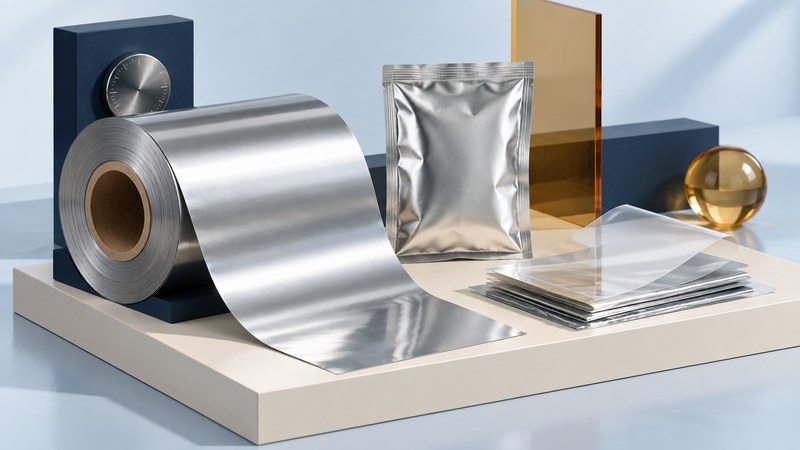
Metallized film combines a polymer substrate with a thin deposited metal layer. Evaluate it as part of a specified laminate and finished package. A meaningful comparison keeps oxygen and water-vapor transmission units, test conditions and sample construction visible, then checks what happens during conversion and use.
Identify the exact construction
Record the substrate, grade, total thickness, metallized side, surface treatment and intended laminate position. Add printing, adhesive and sealant layers to the description. Two shiny films can differ in substrate, metal-layer integrity, sealability and handling behavior.
Jindal Films' metallized-film overview separates grades by structure, thickness, barrier and converting properties. Use a selection chart to identify candidates, then request the current grade-specific data sheet and the basis of any guaranteed limits. A typical laboratory value needs a different purchasing interpretation from a contractual acceptance limit.
Keep the end use explicit: a moisture-sensitive dry product and an oxygen-sensitive product may place different demands on the same package. Define the product requirement before choosing which barrier value to optimize.
Put barrier data on a common basis
On a narrow screen, scroll the table horizontally. Keyboard users can focus it and use the arrow keys.
| Measure | Typical reporting basis | Comparison requirement |
|---|---|---|
| Film oxygen transmission, OTR | cm³/(m² day), also written cc/m²/day | Same method, temperature, humidity, oxygen conditions and construction |
| Film water-vapor transmission, WVTR | g/(m² day) | Same temperature and humidity conditions across the specimen |
| Whole-package transmission | Amount per package per day | Defined package, area, closure and preparation |
| Barrier after conditioning | Transmission measured after a specified treatment | Same flex, aging or distribution-conditioning procedure |
AMETEK MOCON's laboratory service descriptions distinguish film-area transmission from package transmission and distinguish dry from controlled-humidity oxygen methods. They also describe flex conditioning separately from the subsequent barrier measurement. Preserve these distinctions when requesting a laboratory quote.
If supplier A reports one temperature and humidity while supplier B reports another, ask for a common-condition comparison. An unqualified “less than” value also needs the reporting limit and method sensitivity. Record whether data describe bare film, the laminate or the final package.
Worked example: convert area without claiming package performance
Fictional screening estimate: a film has OTR of 0.50 cm³/(m² day) at specified conditions. A proposed package exposes 0.080 m² of that uniform film. Multiplying gives 0.50 × 0.080 = 0.040 cm³/day through the film area at those same conditions.
The calculation excludes seams, closures, conversion damage and changing conditions. Use it to understand scale and plan testing. A finished-package measurement and product trial are needed to evaluate the real system.
When a package contains several different surfaces, identify each area and its applicable data separately. Keep the gas-volume reference basis consistent. Record the uncertainty of estimates rather than presenting excessive decimal precision.
Follow the candidate through conversion
Retain samples before and after relevant printing, lamination, curing, slitting and forming steps. Compare representative roll positions and document aging before testing. If barrier worsens, this sequence helps locate the operation associated with the change.
Agree on flex or distribution conditioning that represents the intended route, then measure transmission again. Inspect seals and package integrity using the approved methods. A good film result and a leaking package point to different corrective work; preserve both findings.
For adoption, combine barrier results with machinability, seal performance, appearance and the product's storage trial. Make recyclability and food-contact suitability separate, construction-specific assessments supported by applicable evidence. For active oxygen removal as another design element, see building an oxygen budget for scavenger packaging.
Use the working record
Download the editable barrier film comparison. Save a copy, complete the actual requirements and evidence fields, and review open issues with the responsible owner. The plain-text record includes instructions, units where needed, the fictional example, and source references.