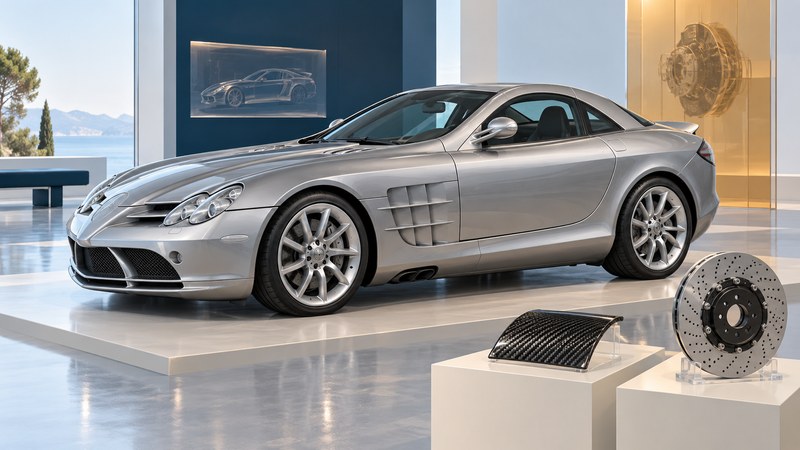
The original Mercedes-Benz SLR McLaren coupe combines a carbon-fibre structure, a supercharged V8 mounted well back in the nose, and coordinated mechanical and aerodynamic braking. Understanding those choices explains more about the car than a celebrity delivery story or a top-speed number.
Read it as a system: structure carries loads, engine placement shapes mass distribution, lubrication supports the engine, and brakes and airflow manage deceleration. This guide concerns the original closed coupe; later Roadsters and special editions require their own specifications.
Why the long nose matters
The September 2003 Mercedes-Benz launch release, reproduced by The Auto Channel, describes a front-mid-engine layout. The V8 sits behind the front axle, moving a substantial mass toward the center of the car while leaving the occupants behind it. “Front-mid-engine” describes the engine's position relative to the axle.
A supercharger compresses intake air using mechanical drive from the engine. It gives this V8 a different induction arrangement from an exhaust-driven turbocharger. The SLR also uses dry-sump lubrication, with oil stored in a separate tank. Mercedes explained that this packaging allowed the engine to sit lower. The system's oil-check and service procedures belong to its matching technical documentation.
The manufacturer coupe brochure, preserved by the XR793 archive, describes an AMG SPEEDSHIFT R five-speed automatic. Its automatic and manual selection programs were part of the road car's grand-touring design. A description of shift programs is useful historical context; actual operation and condition still need an appropriate demonstration and inspection.
Connect components to their jobs
On a narrow screen, scroll the table sideways. Keyboard users can focus the table region and use the arrow keys.
| Component | Engineering purpose | What to establish on a car |
|---|---|---|
| Carbon-fibre safety cell and body | Combine a stiff occupant structure with comparatively low structural mass. | Identity, accident history and specialist structural assessment. |
| Separate crash structures | Manage impact energy through engineered deformation or material breakdown. | Documented repair methods, parts and qualified inspection. |
| Front-mid-mounted V8 and dry sump | Position the engine mass inward and lower, with a dedicated lubrication system. | Matching service procedures and dated maintenance evidence. |
| Fibre-reinforced ceramic brake discs | Provide the friction surfaces for the wheel brakes. | Correct components and specialist condition measurements. |
| Airbrake and underbody aerodynamics | Use airflow to influence lift, rear-axle loading and braking behavior. | Correct hardware, diagnostic findings and documented repairs. |
Carbon fibre is a material used in several parts, each with a particular function. The brochure describes a carbon-composite body and monocoque, with aluminium used in the engine frame and suspension structure. A decorative carbon trim piece tells you little about the condition of those load-bearing parts.
For an ownership assessment, ask who performed any structural repair, which procedure governed it and how the finished work was checked. Photographs can help document a repair history; a specialist determines the inspection needed for the actual structure.
Separate the disc, control system and airbrake
The SLR's braking story has three layers. The ceramic discs are material components at the wheels. Sensotronic Brake Control, or SBC, is the electronically controlled electrohydraulic braking system. The movable rear airbrake works through airflow. Each needs its own explanation and its own condition evidence.
Mercedes' launch account describes the airbrake rising steeply during heavy braking, increasing aerodynamic resistance and supporting rear-axle loading. The effect depends on airflow and works alongside the wheel brakes. The brochure also describes the smooth underbody and rear diffuser as parts of the aerodynamic package.
Have an SLR specialist assess disc condition, braking-system diagnostics and airbrake operation using the applicable procedures. Record the method and findings. A road-speed experiment to reproduce a brochure claim adds risk and supplies poor maintenance evidence.
Compare design choices, then evidence
The Porsche Carrera GT guide offers a useful comparison: both cars employ carbon structures and ceramic-related technology, but the Carrera GT's ceramic clutch and the SLR's ceramic brake discs do different jobs. Name the component before comparing materials or service requirements.
Fictional research example: a seller describes an SLR as having “a full carbon chassis and ceramic technology.” Rewrite that into answerable questions: Which structural parts were inspected? Which brake components are installed? What documentation supports their condition? Then keep the answers beside the car's exact identity, service invoices and specialist report.
A strong explanation follows component, function, tradeoff and evidence in that order. It lets you appreciate the engineering while making a practical plan for checking a particular example.
Keep the component record
Download the SLR component and evidence record. Use it for reading, a museum visit or a specialist discussion. Mark manufacturer design descriptions separately from observations about an individual vehicle.
Explore Autos: vehicle guides, technology and design · Cars: buying, maintenance and ownership