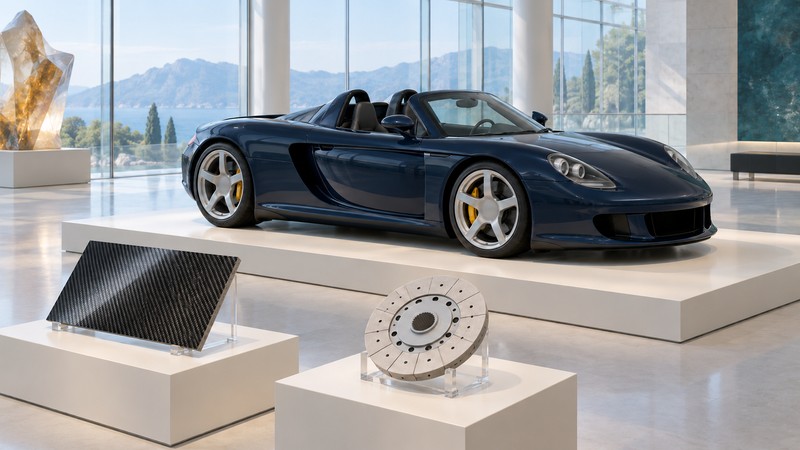
The Porsche Carrera GT becomes easier to understand when each headline material is attached to a component and a purpose. Carbon-fiber structure, a ceramic clutch and ceramic brake discs perform different jobs within the same car.
This guide explains the production Carrera GT of 2003–2006. It is an engineering reading guide: use it to interpret descriptions, museum labels and technical discussions. For operation, service or a particular vehicle’s condition, the applicable Porsche documentation and a qualified specialist are essential.
Keep the concept and production car distinct
Porsche’s 2020 historical account places the concept debut in Paris in September 2000 and the production debut at Geneva in 2003. It records the change from a 5.5-liter concept engine to the production 5.7-liter V10. Its production table gives 2003–2006 and 1,270 cars built at Leipzig.
Keep those stages attached to figures you quote. A launch proposal and a completed production total answer different questions. Likewise, record the source’s power unit: PS, kW and an unspecified “horsepower” label should not be silently exchanged when comparing specifications.
Connect each component to its task
On a narrow screen, scroll the table sideways. Keyboard users can focus the table region and use the arrow keys.
| Component | Documented feature | Purpose to keep in view |
|---|---|---|
| Monocoque and engine support | Carbon-fiber-reinforced plastic structure. | Structural support with low mass; assess it as an engineered composite assembly. |
| PCCC clutch | Compact ceramic two-plate dry clutch. | Transfers drive into the manual gearbox; its compact diameter supports a low powertrain position. |
| Brake discs | Ceramic discs. | Part of the braking system; a separate component and function from the clutch. |
| Underbody, diffuser and rear wing | Shaped underbody and diffuser with an extending rear wing. | Aerodynamic load depends on the complete airflow arrangement, not the wing alone. |
The structural, clutch and aerodynamic descriptions come from Porsche’s historical engineering account. Porsche Cars North America’s technician-training profile independently identifies the carbon-fiber monocoque, mid-mounted V10 and twin-disc ceramic composite clutch with manual transmission.
Why the clutch’s size matters
Porsche gives the clutch plate diameter as 169 mm and connects that compact package with a low position for the V10 and six-speed manual gearbox. This is a useful example of a design choice affecting more than the component itself: the available space influences where neighboring assemblies can sit.
In general mechanical terms, a clutch connects or separates the engine’s drive from the transmission, while brakes slow the vehicle through the wheels. Calling both components “ceramic” does not make their geometry, duty or inspection criteria interchangeable. In particular, the Carrera GT’s PCCC is a ceramic composite clutch; the carbon-fiber description belongs to other parts of its construction.
When reading a technical claim, follow this chain: identify the component, name the property being used, explain the packaging or performance consequence, and state what the source actually demonstrates. Stop short of adding a reliability or service-life promise that the evidence does not provide.
Read carbon-fiber and aerodynamic claims carefully
“Carbon fiber” alone is an incomplete description of a structural part. The useful questions concern the complete composite, its shape, the loads it carries and how it connects to surrounding parts. A visible woven finish can help identify a surface treatment, but a photograph alone does not establish the internal construction or condition of an assembly.
The same discipline helps with aerodynamics. A rear wing is easy to see, while underbody shaping is less apparent in a normal photograph. Ask which features the manufacturer describes as working together and under what circumstances. A claim about downforce is different from a drag figure; a top-speed number cannot by itself tell you either one.
For a museum label or comparison chart, keep the explanation modest and concrete. “The compact clutch helps package the powertrain low” conveys a causal relationship. A broad claim that an exotic material makes every aspect of a car better leaves the reader without a mechanism to evaluate.
Match technical curiosity with the right expertise
The 2020 Porsche Academy article describes model-specific technician instruction covering servicing, clutch replacement and removal of body panels and the engine. It illustrates why a component description is not a workshop procedure. The article is a dated account of training, not confirmation of today’s appointment availability or the condition of any customer car.
If investigating an actual vehicle, ask the proposed workshop about its Carrera GT experience, relevant equipment and the documentation it will use. Keep its findings distinct from historical specifications. An invoice should identify the work performed and the verification afterward; an engineering history cannot supply that evidence.
Build a component explanation you can verify
Download the Carrera GT component-and-purpose record. For a different Porsche engineering case, compare the 997 Turbo’s variable turbine geometry.
Explore Autos: vehicle guides, technology and design · Cars: buying, maintenance and ownership