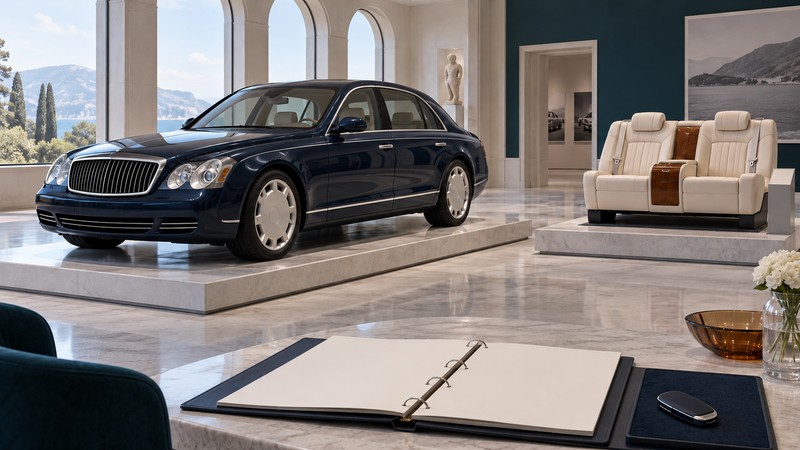
Assess a W240 Maybach by establishing its exact variant, recording the equipment actually installed and finding a workshop that can support that particular car. A long list of luxury features becomes useful only when you know which ones are present and what condition they are in.
This guide compares the Maybach 57 with the initial 57 S specification, then provides a practical equipment and support record. Keep the longer 62, later 57 S revisions and modern Mercedes-Maybach models separate; their names and features should not be merged into one checklist.
Begin with the factory identity
The Mercedes-Benz Public Archive identifies the Maybach 57 as type 240.078, W 240 E 55 LA, and the initial 57 S as type 240.079, W 240 E 60 LA. Its 57 S entry covers the initial production period ending in February 2010. Use those records as a starting reference, then match the VIN, build date, original market and factory specification of the vehicle under consideration.
On a narrow screen, scroll the table sideways. Keyboard users can focus the table region and use the arrow keys.
| Specification | Maybach 57 | Initial Maybach 57 S |
|---|---|---|
| Factory type | 240.078 | 240.079 |
| Engine displacement | 5,513 cm³ | 5,980 cm³ |
| Rated output in the archive | 405 kW / 550 PS | 450 kW / 612 PS |
| Basic drive arrangement | Rear-wheel drive; five-speed automatic. | Rear-wheel drive; five-speed automatic. |
| Vehicle-specific follow-up | Match the build record and installed equipment. | Confirm the production period before applying these figures. |
These are historical manufacturer specifications using the archive’s units, rather than a measurement of a particular engine today. Record cosmetic changes separately. Wheels, grilles or an added badge cannot replace the factory identity record.
Build an equipment list from the actual car
Bring the matching owner manuals and the factory equipment record to the viewing. Work through the cabin with the owner while parked, giving every fitted feature one of four statuses: demonstrated, fitted but not demonstrated, not fitted, or unresolved. This avoids treating an absent option as a failure or an untested feature as working.
- Seating and comfort: record the installed seat controls and have the owner demonstrate the permitted adjustments. Note heating, ventilation or other functions only if fitted and identified.
- Climate and shades: record each control’s response and any warning. A working front control does not establish every rear function.
- Audio, displays and communications: identify original equipment and later replacements. Test the sources and connections you actually intend to use.
- Interior fittings: note the condition and operation of fitted tables, compartments, trim and accessories. Photograph missing or damaged pieces with permission.
Write down the exact symptom and conditions rather than assigning a cause. “Rear display illuminates but no image appears from the demonstrated source” gives a workshop more to investigate than “electronics bad.” If the engine needs to run for a demonstration, use a suitable open-air location and follow the handbook.
Verify support for the questions you have
Before committing to the car, ask a workshop familiar with the W240 to identify what it can assess and service. Provide the VIN, equipment list, invoices and unresolved observations. Request a whole-vehicle inspection covering the powertrain, braking, suspension, tires, body and electrical systems alongside the cabin checks.
For a damaged or missing feature, ask for a specific proposed route: diagnosis, repair of the existing part, replacement, or an unresolved search. Request the applicable part identification, any compatibility or programming requirements, an estimate and the date of the availability information. Avoid assuming that a general willingness to service Mercedes-Benz vehicles confirms support for every W240 system.
A written estimate should distinguish confirmed work from work that depends on further diagnosis. Where a component or trim item has not been located, keep availability open rather than treating an advertised listing as a completed solution. Reconfirm the practical details close to the decision date.
Connect invoices with the current assessment
Sort service records by date and mileage. For each major job, identify the concern, work performed and subsequent verification. Ask the workshop to reconcile the paperwork with the car as presented, including alterations and any recurring issue.
Give everyday priorities their own column. Rear-seat comfort, reliable climate control and a particular audio source may matter more to your use than an unused entertainment feature. Rank unresolved items by their effect on your plans, then use the professional findings and support information to decide what must be resolved first.
Keep a vehicle-specific equipment and support record
Download the Maybach equipment and support record. Keep original documents with it and update unresolved items only when new evidence arrives. The Quattroporte provenance guide offers a related method for separating identity from condition.
Explore Autos: vehicle guides, technology and design · Cars: buying, maintenance and ownership