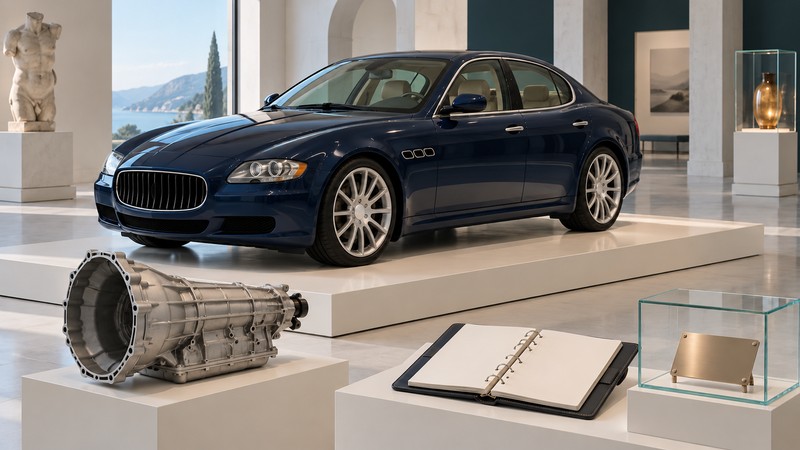
An early Maserati Quattroporte needs three separate records: which transmission it has, what work has been done, and what supports any special-edition claim. Establishing those facts turns an attractive advertisement into a vehicle you can assess.
This guide concerns the fifth-generation M139, especially the early DuoSelect cars. It also explains the later Automatica distinction and how to investigate a claimed Neiman Marcus edition. Use the VIN, original market and model year throughout; a registration year or seller’s generic “automatic” label is insufficient.
Identify the transmission before comparing cars
Maserati’s Quattroporte V history identifies the 2003 introduction, Pininfarina body and dry-sump V8 with transaxle layout. The period Maserati brochure, PDF pages 21 and 30, describes DuoSelect as a six-speed mechanical gearbox with electro-hydraulic operation and a dry twin-plate clutch. It can select gears automatically, but that operating mode does not make it the later transmission design.
Maserati’s January 8, 2007 Automatica announcement introduced a new six-speed hydraulic transmission developed with ZF. The announcement also says DuoSelect remained available in North America. Consequently, a 2007 date alone does not resolve which system a particular car uses.
On a narrow screen, scroll the table sideways. Keyboard users can focus the table region and use the arrow keys.
| Question | DuoSelect | Automatica |
|---|---|---|
| What identifies the design? | Mechanical gearbox and dry clutch with electro-hydraulic actuation. | Later six-speed hydraulic automatic developed with ZF. |
| What should the record contain? | VIN-linked specification, matching handbook and itemized clutch or actuation work. | VIN-linked specification, matching handbook and itemized transmission work. |
| What does “automatic” establish? | It may describe an available driving mode. | It may refer to the model name; confirm the installed system. |
| How should condition be assessed? | By a specialist familiar with this transmission and its applicable procedures. | By a specialist using information for the actual transmission and vehicle. |
Turn service history into a sequence of evidence
Arrange invoices by date and mileage. For each entry, write the reported concern, the parts or adjustments involved and the recorded result. Keep routine maintenance separate from diagnosis and repair. “Clutch done” becomes meaningful only when the invoice identifies the vehicle, date, mileage and actual scope of work.
Ask the inspecting workshop to assess the fitted transmission, relevant fault information and the quality of previous repairs. If it supplies a wear estimate or diagnostic reading, request the method, conditions and interpretation. Avoid translating an isolated percentage into a promised remaining mileage. Your decision needs the current assessment and the vehicle’s history together.
Record any warning exactly and explain when it appeared: during a cold start, after warming up, while selecting a gear or during the professional road evaluation. Leave the cause unresolved until the workshop has evidence. A viewing should also cover the engine, cooling, brakes, tires, suspension, body and cabin; transmission identity is the starting point of the inspection, not its entire scope.
Investigate a Neiman Marcus claim separately
For a car advertised as a Neiman Marcus edition, request the original sales or delivery paperwork and any manufacturer documentation tying that specification to the VIN. Save a dated copy of the seller’s claim. Photograph any identification plate with permission, then compare its details with the documents rather than treating the plate as self-authenticating.
Make an inventory of the paint, upholstery, trim, wheels and plate as they exist now. Mark each item as documented original, documented replacement or unresolved. A matching appearance is useful supporting evidence, but it cannot establish the whole delivery history. Missing paperwork leaves a provenance question even when the car is mechanically sound.
Keep edition authentication and condition in separate columns. A convincing original sales record does not demonstrate current mechanical health, and a recent service invoice does not authenticate a special edition. The same distinction is useful when reading the Bentley Mulliner specification guide.
Decide what still needs to be resolved
Before making a decision, list the evidence still needed, who can provide it and whether the unanswered question matters to your intended use. Request an itemized scope for any proposed work. A written conclusion such as “transmission identified; repair assessed; edition unverified” is more useful than a single overall label.
Keep a transmission and provenance record
Download the Quattroporte transmission and provenance record. Use the matching owner handbook for operation and a qualified workshop for testing. Update the record when evidence arrives, retaining earlier claims alongside the findings that confirmed or corrected them.
Explore Autos: vehicle guides, technology and design · Cars: buying, maintenance and ownership