A marine painting can show weather, travel, work and leisure within the same field of water. Édouard Manet’s sea pictures invite you to follow those relationships through viewpoint and paint. Start with the large arrangement, then examine the marks that hold it together.
Choose a painting and establish your viewpoint
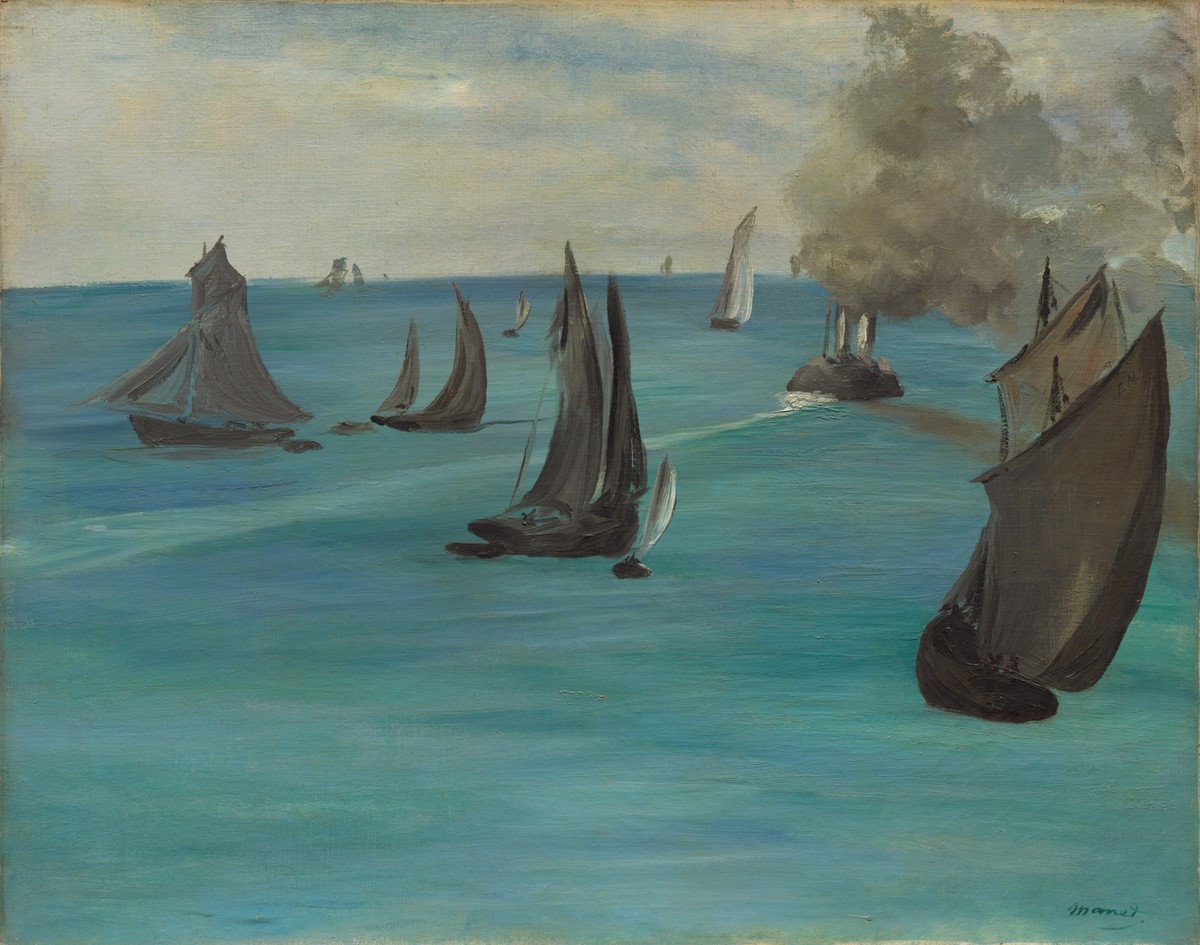
Begin with Manet’s Sea View, Calm Weather, 1864, in the Art Institute of Chicago, accession 1922.425. The museum’s older Manet and the Sea selection calls this same painting Steamboat Leaving Boulogne. Keeping the collection number with your notes helps connect the two titles. The museum identifies the vessel at right center as a side-wheel packet steamer; slower sailboats follow its wake.
Manet (1832–1883) and Claude Monet (1840–1926) are different artists. Their similarly spelled names become easier to remember when you compare specific works and keep the artist’s name with each title. This guide uses Monet as a comparison, while keeping Manet’s seascape as the starting point.
Give the whole image a minute before enlarging it. Where do sea and sky meet? How much space does each occupy? Which vessel attracts your attention first? Record the answers before reading an interpretation.
Use the horizon, vessels and empty water
The horizon establishes a large horizontal division. Masts, funnels, hulls and smoke introduce other directions. Trace those directions with your eyes and notice where they reinforce or interrupt one another.
- Locate the horizon. Estimate its height as a fraction of the picture, such as one-third or one-half from the top. The estimate is a looking aid, not a measured claim.
- Compare vessel sizes. Ask which appear near and far, and what supports that reading.
- Trace the wake or surface marks. Follow the routes they suggest, checking them against the boats’ positions.
- Notice open space. Look at what happens between the most recognizable objects. Empty-looking water can make a vessel feel isolated or give it room to move.
Now reduce the painting to five simple shapes in a thumbnail sketch. Leave out rigging and faces. If you can still recognize its overall arrangement, you have separated composition from detail.
Move from a boat to the painted surface
Enlarge a small region around a hull, then a region of water. Look for changes in stroke length, direction and contrast. At close range, a mark may seem separate from what it depicts; at normal viewing size, neighboring marks can join into a recognizable surface.
A reproduction provides useful evidence about arrangement and visible marks. Questions about pigment, underdrawing or changes beneath the surface need technical research. A museum’s collection record or conservation study can explain those findings. Read the image type before drawing a conclusion from an unusual color or texture in a technical view.
Compare Monet’s Beach at Sainte-Adresse
Open Claude Monet’s The Beach at Sainte-Adresse, 1867, accession 1933.439, in the Art Institute’s collection. Keep the artist, year and location beside your notes so the comparison remains precise. The museum identifies fishing boats and fishermen, along with a visiting couple at the water’s edge: a man using a telescope and a woman in a straw hat. Work and leisure meet in a single view.
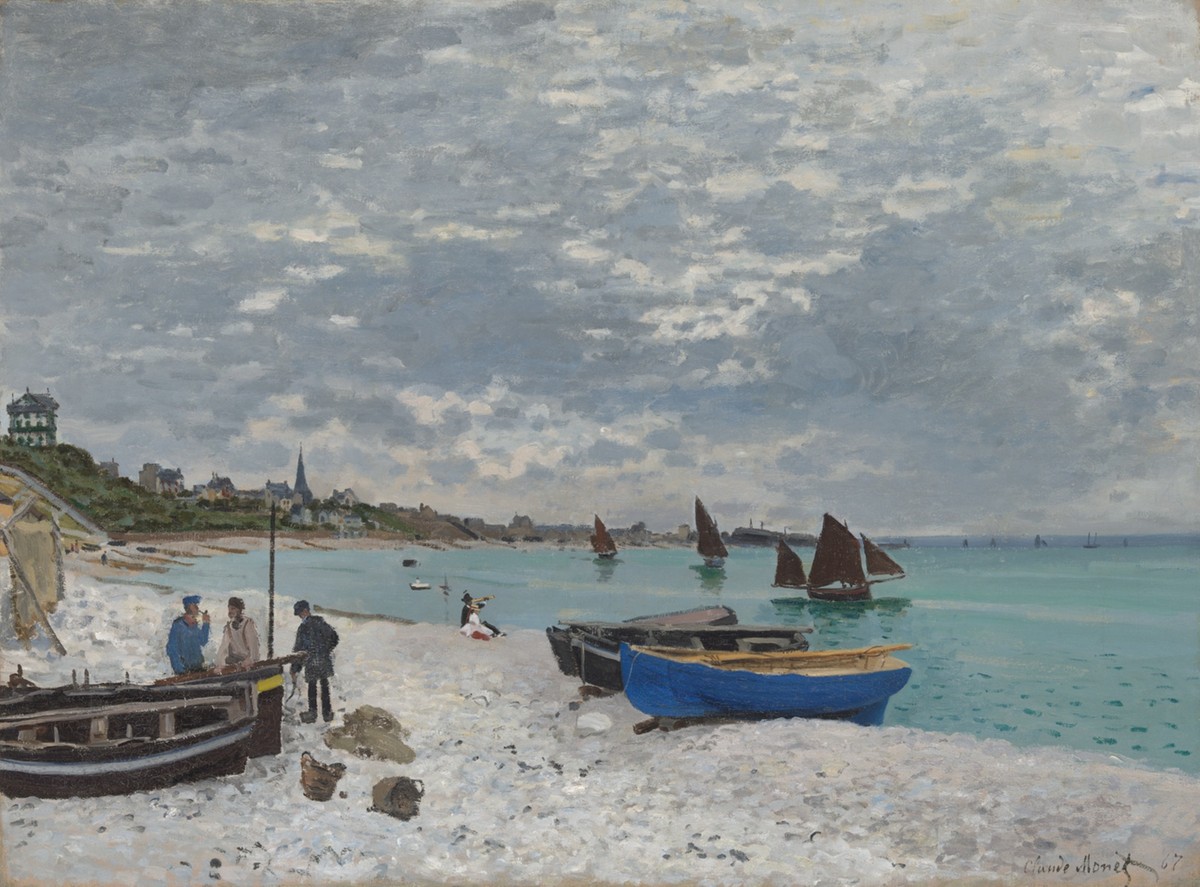
Compare the paintings one feature at a time. First, where is the viewer in relation to the shore and boats? Second, how much of the canvas is water, land and sky? Third, what human activity can you actually identify? Use visible evidence such as a vessel’s equipment or the placement of people before interpreting a scene as work or leisure.
Finish with a sentence that names both works and a concrete difference: “In the Manet, my attention first goes to ___ because ___; in the Monet, it goes to ___ because ___.” This is more useful than declaring one artist looser or more modern on the strength of a single pair.
Use exhibition history as a route into looking
The Art Institute’s Manet and the Sea exhibition ran from October 20, 2003, to January 19, 2004. Its archive remains a useful selection of related works, including other artists. Read those pages as an exhibition record, and check the holding museum’s current information before planning a visit to a particular painting.
For a ten-minute gallery visit, spend two minutes on the whole arrangement, three on a detail, three comparing it with another work and two recording a question. If a title supplies a place or event, ask which parts of your interpretation come from that title and which you could establish by looking alone.
Save your notes with the close-looking worksheet. For a landscape constructed through pen marks, continue to Van Gogh’s drawings; for another painted surface, explore Seurat’s La Grande Jatte.
Explore all seven artist guides · Browse the broader art library