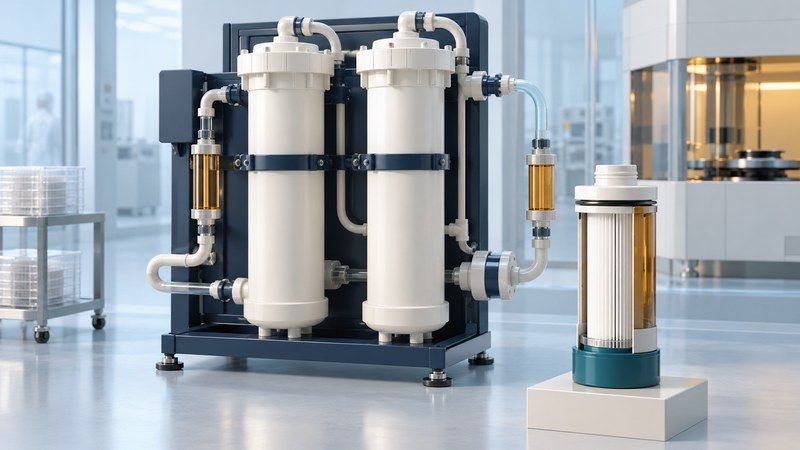
Evaluate a microelectronics liquid filter as part of a chemical delivery process. Specify the fluid, contaminants, flow and acceptance evidence before comparing a retention rating. The useful result is a trial that shows whether the selected construction supports both the cleanliness requirement and the actual process conditions.
Describe the fluid and the contamination problem
Name the chemical mixture and concentration, temperature range, process point and required flow profile. Identify the contamination being investigated and the analytical method used to observe it. Particles, gels and dissolved metals may call for different removal mechanisms and measurements.
Entegris' contamination-control FAQ explains the roles of membrane structure, chemistry, wetting, surface area and cleaning in filter performance. It also distinguishes size-based retention from adsorption. A nominal size alone leaves these factors unspecified.
Ask the supplier for the test basis of the retention claim: challenge material, liquid, conditions and reported efficiency. Compare like evidence, including the exact filter grade and form factor. Define the housing, seals and other wetted parts in the compatibility review, because they are also part of the fluid path.
Compare flow at matched conditions
Request the applicable pressure/flow information and the allowable operating conditions for the complete assembly. Entegris' Torrento X specifications, for example, identify construction, extractables and pressure limits with temperature conditions. Use the exact variant's data and supplier review for the proposed chemistry.
Fictional readings: at 2.0 L/min, upstream pressure is 180 kPa and downstream pressure is 140 kPa. Differential pressure is 40 kPa.
Later, at the same flow and fluid temperature, readings of 190 and 130 kPa give 60 kPa, an increase of 20 kPa. Check instrument behavior, fluid conditions and the complete flow path before assigning a cause. Compare against the approved operating and replacement criteria.
These invented values illustrate subtraction and comparison; they are not equipment ratings or recommended operating pressures.
Record where each pressure is measured. If fittings or other components lie between the measurement points, the result includes their contribution. Keep that geometry consistent through the trial.
Separate conditioning from process performance
On a narrow screen, scroll the table horizontally. Keyboard users can focus it and use the arrow keys.
| Stage | Evidence | Decision |
|---|---|---|
| Compatibility review | Fluid, materials, seals and operating limits | Approve the candidate and installation route |
| Conditioning | Applicable preparation procedure and completion measurements | Determine readiness for the process trial |
| Cleanliness trial | Defined sample points, blanks and particle/chemical analyses | Compare to the stated contamination requirement |
| Process trial | Representative wafer and defect evidence | Determine suitability for the intended operation |
Use the supplier's preparation instructions and the site's approved chemical-handling procedure. Preserve sample identity, collection times and analytical blanks. State the method's detection limits so a result below detection is interpreted within its measured scope.
Retain a comparator and track concurrent changes in chemical lot, tool condition and sampling. A lower particle count is one piece of evidence; connect it to the defects or process results that motivated the trial.
Release a documented operating envelope
Record the approved assembly, chemistry, conditioning route, acceptance evidence and change triggers. Define who reviews an adverse pressure trend or a contamination excursion. Use actual supplier and process limits to establish replacement criteria.
This guide concerns liquid filtration. Process-gas purification requires its own equipment, compatibility and qualification information. Within the liquid route, use process-control context to associate measurements with the correct lot and operation, and wafer identity validation to keep downstream evidence traceable.
Use the working record
Download the editable microelectronics filter trial. Save a copy, complete the actual requirements and evidence fields, and review open issues with the responsible owner. The plain-text record includes instructions, units where needed, the fictional example, and source references.