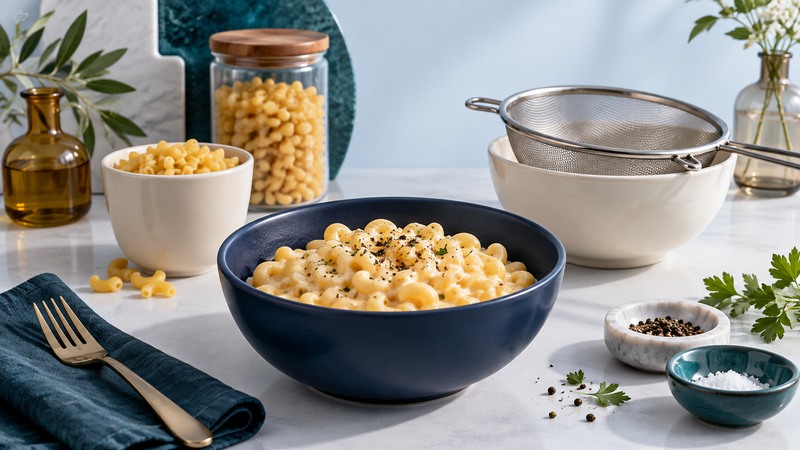
Weigh macaroni while it is dry, taste it near the package’s cooking time and have the sauce ready when you drain. These three habits make a repeatable meal. Elbows vary in size and thickness, so the package time is a starting point for that product.
Choose a portion for the whole meal
As a household planning example, allow 56 g dry pasta for a side or 85 g for a more substantial pasta-centered plate. Appetite and accompanying beans, vegetables, meat or sauce change the amount you need. These are planning choices, not individual nutrition prescriptions.
Scroll the table sideways. With a keyboard, focus the table and use the arrow keys.
| People | 56 g side portion | 85 g larger portion |
|---|---|---|
| 2 | 112 g | 170 g |
| 4 | 224 g | 340 g |
| 6 | 336 g | 510 g |
A nominal 454 g box supplies eight 56 g portions, with about 6 g left, or five 85 g portions, with about 29 g left. Scoops measured by volume differ across shapes; use the scale if comparing packages or calculating nutrients. Apply the nutrition panel to the dry amount before adding sauce.
Cook to the texture the dish needs
- Set a colander securely in the sink and prepare the sauce. For 170 g dried elbows, use a pot large enough for about 2 quarts water with room for boiling; follow any different package requirement.
- Bring water to a full boil. Add salt if desired, then pasta. Stir immediately and again during the first few minutes to separate pieces. Keep an active boil without overflowing.
- Begin tasting near the lower end of the package’s range. A cooled sample should be tender with the resistance you prefer and no hard, chalky core for immediate serving.
- Before draining, reserve a cup of cooking water with a heat-safe measuring jug. Drain carefully and combine promptly with hot sauce.
For example, Barilla’s US Classic Blue Box elbows lists 7–8 minutes and advises against oil in the cooking water. Other elbows, whole-wheat pasta and gluten-free products can behave differently.
For a baked dish, use the recipe’s shorter pre-cook instruction because pasta will absorb more liquid in the oven. For pasta salad, follow the salad recipe’s cooling and rinsing method. Treat an instruction for hot sauced pasta as specific to that use.
A small stovetop cheese sauce
For 170 g dry elbows, about two larger portions: 1 tablespoon (14 g) butter, 1 tablespoon (8 g) all-purpose flour, ¾ cup (180 ml) milk and ¾ cup (about 85 g) freshly grated cheddar. This is Yenra’s small-batch roux-sauce formulation; it has not been kitchen-tested by Yenra.
- Melt butter in a small saucepan over medium-low heat. Stir in flour and cook, stirring, for about one minute.
- Whisk in milk gradually until smooth. Bring to a gentle simmer, stirring along the bottom, and cook until it lightly coats a spoon, roughly 2–3 minutes.
- Remove from heat, wait for bubbling to stop, and stir in cheese a little at a time. Combine with drained pasta. Loosen with reserved pasta water one tablespoon at a time; taste before adding salt.
A vigorous boil after adding cheese can produce a grainy sauce. Grate a block for easier control, and add liquid gradually: the aim is a coating that flows around the elbows. Barilla’s cream-based mac-and-cheese recipe also uses an off-heat cheese addition. The flour-thickened formulation above is a separate method intended for immediate stovetop serving.
Troubleshoot and store
Pasta clumps: stir early in the water and combine promptly after draining. Sauce disappears: hot pasta keeps absorbing liquid; add a little warm water or milk before serving. Pasta is too soft: next time begin tasting earlier and include any time it spends simmering in sauce. Adding more dry pasta to the finished dish cannot undo overcooking.
Keep dried pasta sealed in a dry cupboard and follow package quality guidance; discard it if moisture, mold or pests appear. Refrigerate cooked macaroni promptly within two hours in shallow containers at 40°F or below; use within 3–4 days and reheat to 165°F. See USDA’s leftover guidance.