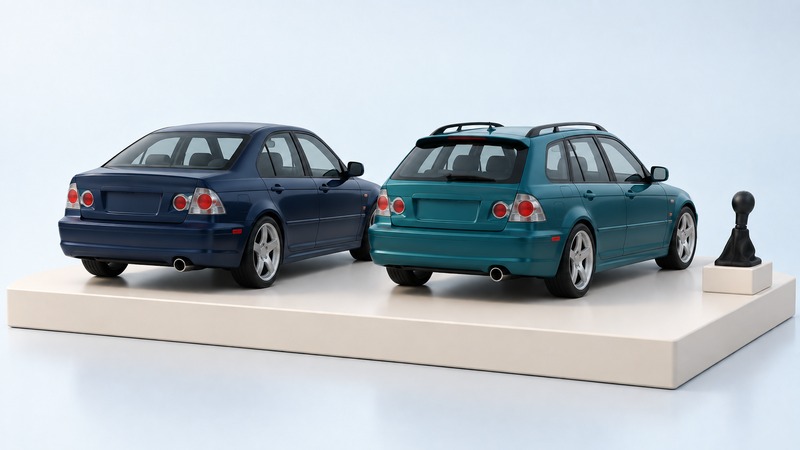
For a first-generation IS 300, compare the car’s identity and condition before its advertised upgrades. Establish the body style, transmission and original equipment, then inspect any changes and maintenance evidence. The early IS 300 and SportCross discussed here differ from later cars carrying the IS 300 badge, and market-specific documents are essential when comparing examples.
Separate body style, transmission and market
Lexus’s 2004 Canadian IS-series specification document (PDF) lists an automatic sedan, manual sedan and automatic SportCross. It describes a 3.0-liter inline-six and rear-wheel drive, with five-speed transmissions in those configurations. Use that document for its stated Canadian scope, and obtain the original market’s equipment record for the vehicle you are buying.
On a narrow screen, scroll the table horizontally. Keyboard users can focus its region and use the arrow keys.
| Choice | What it changes for you | What to verify |
|---|---|---|
| Sedan or SportCross | Cargo opening, folding arrangements and everyday load access | Try your real load; inspect the actual seats, hatch and included cargo accessories. |
| Manual or automatic | Driving preference, service needs and the inspection brief | Factory configuration, installed hardware and any conversion records. |
| Original or modified | How closely the car follows its factory specification | Parts, installation quality, supporting changes and relevant documentation. |
Lexus’s SportCross retrospective explains its combination of compact-sedan character and wagon utility. Try the packaging yourself: loading height, aperture shape and passenger space can decide suitability more directly than a published cargo figure.
Verify the options that influence your decision
Distinguish traction control, stability control and a limited-slip differential. They perform different jobs, and a model name alone establishes none of their exact fitment. The Canadian 2004 equipment sheet illustrates package-dependent availability of features such as VSC and a limited-slip differential. Ask for build or equipment evidence and have a technician identify the installed components where necessary.
Record wheel and tire sizes at both axles and compare them with the appropriate documentation. In particular, a staggered setup uses different front and rear sizes and needs its own tire-service plan. Check the spare and wheel-lock key as well. Changes to wheel diameter, offset or suspension require a fit and condition assessment; appearance alone cannot establish clearance or alignment.
Document modifications as a complete system
For a modified car, make a dated list covering engine, transmission, differential, suspension, brakes, wheels, lighting and electronics. Ask who installed each change, which parts were used and what supporting work was done. Keep tuning and calibration records with the hardware record. A brand-name component provides only one piece of that history.
For a transmission conversion, ask the inspector to check the completed installation, controls and relevant electronics, as well as the gearbox itself. For added engine performance, establish what is installed and whether the documentation and local registration, inspection and emissions requirements are satisfied. Refer jurisdiction-specific questions to the relevant authority; a seller’s “street legal” claim needs applicable evidence.
Read the service history with the correct schedule
Confirm maintenance against the actual year and market. The U.S. 2004 Lexus maintenance supplement (archived PDF) includes a timing-belt interval of 90,000 miles or 108 months. Preserve the last replacement invoice and compare both date and mileage. Other years, markets and modified engines require their own applicable information.
Have an independent inspector assess the structure, corrosion or previous repairs, fluid leakage, cooling system, driveline, suspension, brakes and tire condition. Request a road test appropriate to the transmission and reported symptoms. Record shift behavior and noises under the conditions in which they occur; leave internal diagnosis to the technician.
Choose a car you can explain and support
Check the VIN through NHTSA’s recall resources and the manufacturer. Because the VIN lookup generally excludes recalls more than 15 years old and completed repairs, preserve manufacturer completion evidence as well. For an imported vehicle, use the support and regulatory routes appropriate to its market and registration.
Make the decision from four records: identity, service history, modification history and inspection findings. Separate your desired future upgrades from the work needed to make the purchased car sound and usable. A cleanly documented, suitable example is easier to assess than one whose specification has to be reconstructed from an advertisement.
Save a working record
Download the First-Generation Lexus IS 300 working record (plain text). Open it in a text editor, save a private copy and fill in the relevant prompts. Record unknowns explicitly and attach the evidence that supports each conclusion. The file includes instructions, source links and this article’s address.