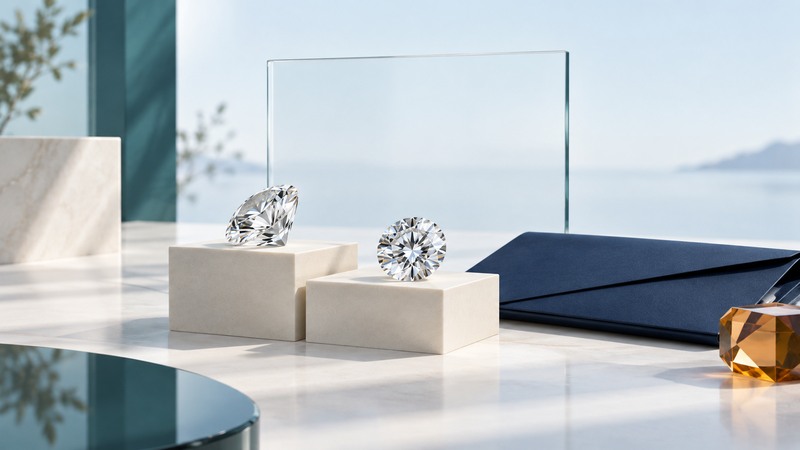
A lab-grown diamond purchase involves three separate checks: what the stone is, what its report says, and what the seller promises. Verify all three for the particular stone and setting. This gives you a sounder comparison than a large discount or an unexplained “sustainable” label.
Start with material identity and growth origin
Laboratory-grown diamonds have diamond's essential chemical composition and crystal structure. Their formation is manufactured, commonly through high-pressure, high-temperature growth or chemical vapor deposition. Diamond simulants, including cubic zirconia and moissanite, are different materials that can resemble diamond. The gemology guide explains how laboratories separate these questions.
The distinction should appear clearly wherever you make the buying decision: product description, invoice, and laboratory document. In the United States, the FTC's consumer guidance on diamond descriptions explains why disclosure of laboratory-created or simulated origin matters. An attractive photograph or a familiar brand name cannot substitute for the actual description.
A lab-grown stone can have inclusions, differences in color, and variable cutting quality. Ask for the report and images of the specific stone. For a mounted piece, establish which claims concern the center stone, which cover the smaller stones, and which describe the whole article.
Read the laboratory's current reporting system
Reporting check: September 15, 2026. Laboratories currently use different approaches. Compare the document's issuer, service, date, and scope before comparing its quality labels.
Scroll horizontally to see all columns.
| Document | What the service describes | How to use it |
|---|---|---|
| GIA Laboratory-Grown Diamond Quality Assessment | An overall Premium or Standard assessment for eligible loose colorless to near-colorless lab-grown diamonds. | Read the assessment criteria and stone details. Keep this service distinct from GIA's natural-diamond reports and its colored lab-grown service. |
| IGI Laboratory Grown Diamond Report | Lab-grown identity and diamond characteristics using 4Cs reporting; scope differs between loose stones and jewelry. | Read color, clarity, cut information where supplied, measurements, and comments. Check any limitations imposed by mounting. |
GIA introduced its revised service on October 1, 2025; see the current GIA lab-grown service descriptions and dated announcement. IGI documents its approach on the lab-grown diamond report page. An older report may legitimately look different. Confirm its record with the issuer rather than assuming its format is current.
- Enter the report number through the laboratory's own website. Open its verification tool from the official service page.
- Compare the returned record with the seller's document: shape, measurements, carat weight, comments, and any inscription details.
- Ask the jeweler to show how that record corresponds to the physical stone, using the inscription and other identifying characteristics where available.
- Clarify whether growth method or post-growth treatment information is included. An omitted field should prompt a question, not an assumption.
- Keep a copy of the report and the invoice identifying the purchased stone. Report lookup confirms a database record; the physical match remains a separate check.
Compare the whole purchase
Carat describes weight. Measurements describe size. Shape describes the outline and cutting style. Cut quality concerns how effectively the stone's facets work together. A bigger carat number alone tells you little about the appearance you will prefer on the hand.
Compare stones under similar lighting with similar image scale. Ask for a neutral view as well as the store's spotlight view. Inspect the actual stone or use a return period that allows independent examination. A report organizes observations; the wearer still judges brightness, pattern, color appearance, and comfort in the finished setting.
Get an itemized total that identifies the stone, setting, metal, side stones, sizing, delivery, and applicable taxes or fees. Read return, repair, upgrade, and buyback terms separately. Ask whether resizing or engraving changes the return policy and whether a buyback commitment is written, conditional, and transferable.
For insurance or an independent value opinion, use the jewelry appraisal workflow. A grading or assessment report documents characteristics; it supplies no universal future resale promise.
Ask what a sourcing claim actually covers
Laboratory-grown describes how the diamond formed. Broader environmental or labor claims require additional evidence. The FTC's diamond-marketing warning specifically discusses the difficulty of substantiating broad environmental benefit claims.
- Boundary: does the claim cover crystal growth alone, or also cutting, treatment, setting manufacture, and transport?
- Metric and period: what was measured, in which facility, and during which year?
- Energy evidence: does “renewable” refer to facility electricity, purchased certificates, or another arrangement?
- Verification: who checked the claim and can you read the method and scope?
- Traceability: what records connect this stone or batch to the claimed facility or standard?
Save the evidence that matters to your choice with the purchase documents. If it is unavailable, record that uncertainty and decide how much weight to give the claim. You can still choose a stone for appearance, price, or personal meaning while being precise about what its documentation establishes.