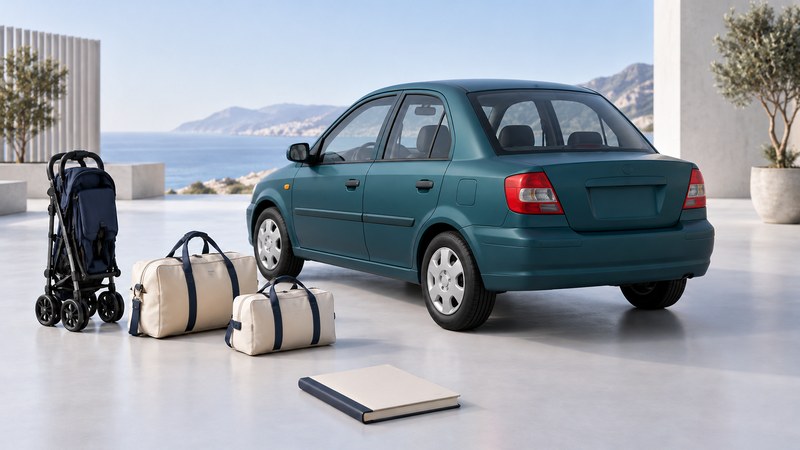
An older Kia Rio deserves a careful shortlist even when the asking price is modest. For a US 2006 car, establish the body, gearbox and actual equipment, then try the people and luggage it must carry. Service evidence and a written initial-work estimate make the comparison more useful than a list of launch promises.
Establish the actual equipment
Kia's US launch material described the redesigned 2006 Rio sedan with a 1.6-liter engine rated at 110 hp, a five-speed manual or available four-speed automatic, and six standard airbags. It identified ABS as optional. Air conditioning and power steering were among the LX additions, so do not infer those features from the Rio name alone. See Kia's US 2006 Rio introduction.
The five-door Rio5 is a separate body choice. The manufacturer's 2006 Rio5 specification sheet lists the same engine and transmission choices and distinguishes standard rear drums from the rear discs supplied with ABS. Confirm the individual car's build information and installed equipment; a launch release does not establish what survives on a twenty-year-old vehicle.
On a narrow screen, scroll the table sideways. Keyboard users can focus the table region and use the arrow keys.
| Configuration or claim | What to establish | Useful evidence |
|---|---|---|
| Sedan or Rio5 | Which opening and seat arrangement suit your load? | Actual bag trial with regular passengers and seats positioned normally. |
| Manual or automatic | Which gearbox is fitted, and does it suit the driver? | Build record, controls, service invoices and inspected operation. |
| ABS and airbags | Which equipment was fitted, and is its condition unresolved? | VIN-linked specification, correct warning-lamp behavior and qualified inspection. |
| Comfort equipment | Does this car have the features you need, and do they work? | Demonstration of air conditioning, steering assistance, locks and windows. |
Test a normal day with the car
Bring the largest item you regularly carry: a stroller, work bag, mobility aid or shopping container. Measure the opening if the item will not be present. Try loading and unloading without forcing trim or leaving loose objects near the driver. A cargo photograph with the rear seat folded may not represent a trip with rear passengers aboard.
Set the driver's seat first, then ask a rear passenger to assess entry and knee space. If you use a child restraint, check its fit and installation against both the restraint instructions and the exact car's manual. During a permitted drive, assess visibility, pedal reach, gear selection and the noise level on a representative road. Record your observations rather than calling every unfamiliar sound a model fault.
Turn a service file into a work list
Obtain the manual and maintenance schedule for the actual market and engine. The 2006 Kia Rio owner manual separates normal and severe-use schedules and includes timing-belt maintenance. Ask a technician to reconcile the applicable schedule with dated, mileage-bearing invoices. “Belt done” needs clarification: identify the part and work performed instead of assuming it means the engine timing belt.
Make three groups: work supported by records, work due under the matching schedule, and work whose status is unknown. A recent oil change does not resolve the third group. Ask for an independent assessment of corrosion, tires, brakes, leaks and warning lights, along with any concern noticed on the drive. Use the vehicle-inspection guide to organize the appointment.
Have the shop separate urgent work, scheduled maintenance and optional comfort repairs in its written estimate. Historic warranty language in a brochure is not evidence of remaining coverage. Keep expected initial work alongside the asking price; use used-car valuation evidence only after identifying a comparable configuration and condition.
Example: compare readiness, not just price
Fictional shortlist: a sedan carries your two usual bags but has no clear timing-belt invoice. A Rio5 accepts the larger stroller with the rear seats occupied and has a more complete maintenance file. Neither is automatically the better purchase. Request a schedule-based estimate for the sedan and an independent condition check for both. If the sedan's unknown work cannot be priced, leave that field unresolved instead of entering zero.
Decide which everyday requirement is essential before negotiating. More convenient luggage access may matter more to your routine than a cosmetic feature; an undocumented equipment claim should remain a question until verified.
Keep the shortlist evidence together
Download the Rio shortlist record for fit checks, service evidence and initial work. Run the VIN through NHTSA's recall search and ask Kia about older or completed campaigns that the public search may not show.
Explore Autos: vehicle guides, technology and design · Cars: buying, maintenance and ownership