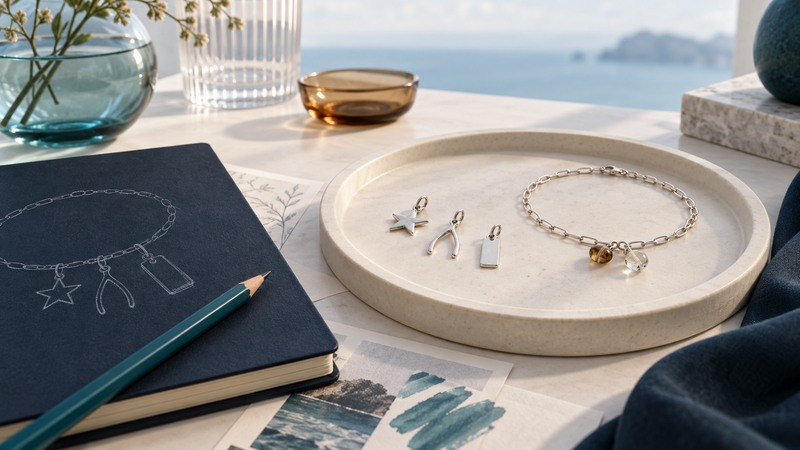
Paula Abdul's QVC jewelry paired recognizable charms and wearable pieces with messages of encouragement. A useful account of the collection begins with her documented design explanation, then distinguishes the collection's story from the evidence needed to identify a particular older piece.
The QVC collection was established by 2006
In a May 19, 2006 Larry King Live interview, Abdul discussed jewelry already being sold through QVC. She described creating encouraging pieces for American Idol contestants, including a star-engraved bracelet, a wishbone, a dog tag, and a lightning-bolt motif. The interview also mentions bangles and cuffs and an upcoming QVC appearance.
A separate contemporary record, Getty Images' May 22, 2006 event caption, documents Abdul presenting the collection during a QVC broadcast in Los Angeles. Together, the interview and event record provide a firm period anchor without relying on later biographical summaries.
The interview is particularly useful for understanding the design intention because Abdul explains it herself. Treat her sales comments as her statements in that interview; a precise order count or sell-through claim would need its own sales record.
How a small object carries an encouraging idea
The design approach has several components: a familiar symbol, words or an association that give it meaning, and a form that fits into everyday wear. A star is easy to recognize; a personal story determines what that star means to the recipient.
Abdul's account connects the jewelry with performers facing an uncertain outcome. The lasting design question is how to make encouragement tangible without requiring a large or elaborate object. That question can help you appreciate the collection or articulate a personal commission.
Scroll horizontally to see all columns.
| Design element | What to look at | Question for the wearer |
|---|---|---|
| Symbol | The actual outline and how clearly it reads at normal size. | Does this shape have a meaning you welcome? |
| Words or inscription | Exact wording, legibility, location, and wear. | Would you prefer the message visible or private? |
| Wearable form | Charm, bracelet, cuff, tag, or another construction. | Will the movement, weight, and fastening suit your daily use? |
| Personal association | The occasion or relationship attached to the gift. | How would you explain its story in your own words? |
These are questions for interpreting a design, not a catalogue of every Paula Abdul product. A common symbol or a motivating inscription can appear in many makers' work. Attribution needs more specific evidence.
Research an older piece before assigning a collection name
- Describe what is present. Record the object type, dimensions, color, motifs, exact wording, and visible marks. Photograph both sides and any clasp or attachment.
- Find the item-level record. Look for a dated QVC item description, product number, original invoice, or other contemporary documentation that describes the actual design.
- Compare details together. Match the motif, proportions, construction, wording, and materials. A star charm by itself is a broad resemblance.
- Document changes. Note added charms, shortened chains, replaced fastenings, missing elements, or repairs, and identify which changes are supported by records.
- State the conclusion narrowly. Use “documented by this invoice,” “consistent with this product record,” or “attribution unresolved,” according to the evidence.
Save the source image or description with its date and URL. A current marketplace listing can lead you to evidence, but repeated identical wording across sellers may trace back to the same unsupported description.
The collection research sheet provides separate spaces for the seller's claim, observed details, source matches, and remaining questions. It is especially useful when a bracelet contains charms acquired at different times.
Example: a bracelet assembled over time
Enjoy the piece while preserving its record
Check attachment rings, clasps, and moving parts before wear. For uncertain metal, coatings, stones, or repairs, ask a jeweler what examination and care are suitable. Record the piece before restoration, agree on the work, and keep a note of replacement parts.
For a new piece inspired by a meaningful symbol, begin with the recipient's preferred message, dimensions, wearing habits, and budget. The jeweler design-brief guide helps turn those preferences into an agreed design. The singles-ring discussion explores why a wearer's explanation is central to the meaning of personal jewelry.
For collecting, enjoyment and historical interest are worthwhile reasons to keep a piece. Any claim about rarity, resale demand, or value needs separate evidence appropriate to that question.