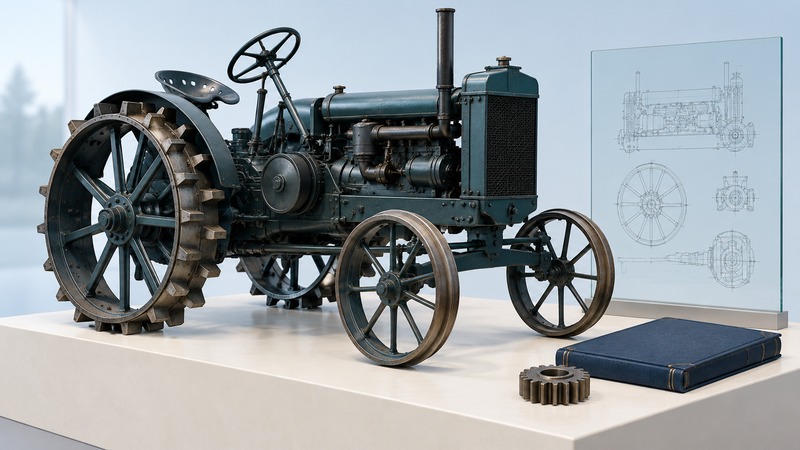
John Deere's early tractor history connects experimental engineering, the purchase of an established manufacturer and the development of a lasting product line. The Dain All-Wheel Drive, Waterloo Boy and Model D occupy different places in that sequence. Studying them together explains how an agricultural machine became both a working tool and a historical object.
Three names, different stages of development
The company's move into tractors involved more than the invention of a single machine. Deere developed experimental designs while assessing the market, acquired the Waterloo Gasoline Engine Company in 1918, and introduced the Model D in 1923. A model's introduction date, a particular tractor's manufacturing date and the date a museum acquired it answer separate questions.
| Name | Place in the story | Useful distinction |
|---|---|---|
| Dain All-Wheel Drive | Experimental work in the 1910s led to a limited production program. | A technically ambitious design with changing prototypes and incomplete production evidence. |
| Waterloo Boy | An existing tractor line acquired with the Waterloo company in 1918. | Its history began before Deere's ownership; the Model N belongs to that line. |
| Model D | Introduced in 1923 as the successor to the Waterloo Boy. | A new model under the John Deere name, following earlier two-cylinder Waterloo tractors. |
Deere's Plowshare issue 37 (PDF) outlines the Waterloo models and the Model D transition. It dates the Waterloo Boy Model R to 1914 and the two-speed Model N to 1918. These distinctions make broad claims about the company's “first tractor” easier to evaluate: first experiment, first acquisition, first model under a name and first large production success are different milestones.
Dain's design was tested and revised
Joseph Dain's work aimed at an all-wheel-drive tractor suitable for demanding field conditions. Deere's archival account in The Plowshare, Fall 2017, issue 46 (PDF, pages 6–11) follows successive prototypes, transmission changes, field trials and debate over manufacturing cost. It describes a development process in which performance, durability and an affordable selling price had to be considered together.
A particularly useful detail is the difference between simulated drawbar testing and plowing in a field. The archival narrative reports different pulling results under those conditions. Soil, speed and the implement matter when interpreting a performance figure. A number separated from its test conditions is a poor basis for comparing machines.
The same 2017 account reported two complete surviving Dain examples and parts of others. Keep that statement tied to its publication date. Survivor counts depend on identification and documentation; they should be rechecked before being used as present-day claims.
The broader lesson is to follow a design through its revisions. A photograph of one prototype cannot establish the features of every tractor that later carried the same name.
Worked example: the Smithsonian's Model N
The Smithsonian's Waterloo Boy Model N Traction Machine record, nmah_857021, identifies a tractor made in 1918. Its description records a two-cylinder kerosene engine, two forward gears and one reverse, and working use around Kloten, North Dakota. The credit line records a gift from Deere and Company through George F. Neiley.
Read the record as several kinds of evidence. The model and manufacturing date locate the object in a product history. Fuel and gearing explain aspects of its operation. Its working locality and donor connect the machine to a life beyond the factory. The museum record establishes these details for this object; general claims about an entire model line need additional evidence.
The record also demonstrates why careful reading matters. Its structured location fields include both Kloten and Waterloo, while the narrative distinguishes working use. Preserve those roles in your notes rather than treating every location label as the place of manufacture. Ask the holding museum when a catalog inconsistency affects your research.
A useful one-sentence description would identify the year and model, its documented working region, and the museum record number. That gives another reader a route to check the object behind the description.
Connect the machine to the work it had to do
A tractor's significance becomes clearer when the farm task is specified. Pulling a plow, powering stationary equipment and cultivating between crop rows impose different demands. The Smithsonian's account of tractors and American farming connects the machine to changing farm practices and the wider business of agriculture.
For a historical comparison, ask a set of practical questions: what implement was used, what ground was worked, what fuel was available, and who could maintain the engine and transmission? Then look for period manuals, test reports, sales literature and farm accounts that answer them. Sales literature establishes what a manufacturer promised; a dated working account may reveal how ownership actually went.
These questions also prevent hindsight from flattening the story. Features that appear ingenious in a museum had to justify their cost and complexity to an owner. Adoption depended on a whole working arrangement, including implements, labor, maintenance and finance.
Keep the object and its documentation together
- Identify the machine: record model, serial information where documented, manufacturing date and repository reference.
- Date each source: distinguish a contemporary manual, later company history, restoration account and current catalog entry.
- Track alterations: look for evidence of replaced components, repainting or reconstruction before treating appearance as original.
- Compare like with like: retain the conditions and units behind any claimed performance.
- Write the limit: say which claims concern the individual object and which concern a model or company.
For a more detailed method of combining photographs, drawings and written records, continue with Industrial Archaeology. Museum catalogs and historical publications are useful research tools; current displays and access should be checked with the institution before a visit.
Explore more documents, places and interpretations in Yenra History.