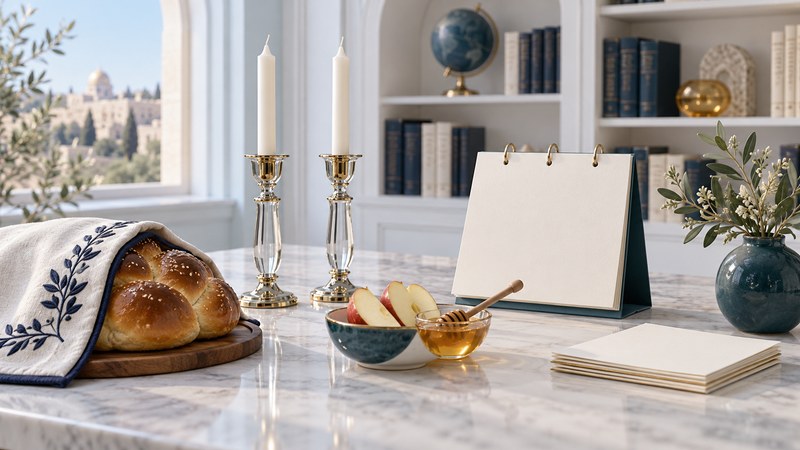
Jewish holidays connect memory, worship, meals, study, rest, and community. Understanding their calendar helps you recognize an observance, plan an invitation, and ask useful questions about someone’s needs. Start with the holiday’s meaning, then check the dates and the practices of the people involved.
Read the calendar in two steps
The Jewish calendar follows lunar months while keeping the annual cycle aligned with the solar seasons through leap years that add a month. Jewish days begin in the evening. A civil-calendar entry may therefore need an evening-before start, and the end of an observance may be marked at nightfall. A date alone does not supply local candle-lighting or ending times.
- Select the year and calendar setting. Use a maintained resource such as Hebcal’s Jewish holiday calendar. Check whether its schedule is for Israel or the diaspora.
- Check the person’s or community’s observance. Some festivals are observed for different numbers of days in different settings and communities. Ask which evenings and days affect the actual event.
For a work or school calendar, record the start evening and end date explicitly. For local religious times, use the correct location and the community’s guidance. A city selected by a website’s default setting may be hundreds of miles from the event you are planning.
Recognize the rhythm of the year
Shabbat provides a weekly rhythm. Annual observances bring different themes and practices; Hanukkah is one part of that larger cycle. This overview describes common associations. Individuals and communities vary in observance, and the planning column gives questions to ask rather than assumptions to impose.
| Observance | Meaning and familiar practices | Planning consideration |
|---|---|---|
| Shabbat | The weekly Sabbath, from Friday evening to Saturday night; rest, prayer, meals, and community. | Ask about travel, work, and technology expectations for an invitation. |
| Rosh Hashanah | The Jewish New Year; reflection, prayer, and the sounding of the shofar. | Check both festival days and the preceding evening. |
| Yom Kippur | The Day of Atonement; repentance, prayer, and fasting for those who observe the fast. | Offer a different day for a meal-centered or demanding event. |
| Sukkot | A harvest festival associated with dwelling or eating in a sukkah, a temporary shelter. | Ask about festival days and the intermediate days separately. |
| Shemini Atzeret and Simchat Torah | Observances following Sukkot; Simchat Torah celebrates the cycle of Torah reading. | Check the community’s calendar rather than treating the end of Sukkot as the end of all observance. |
| Hanukkah | Eight nights remembering the Temple’s rededication, marked by a growing number of lights. | Confirm evening plans; work restrictions differ from those of major festivals. |
| Purim | The story of Esther; reading the Megillah, gifts of food, giving to people in need, and celebration. | Ask about local events and dietary needs for food gifts. |
| Passover / Pesach | The Exodus and liberation; a seder, matzah, and distinctive food practices. | Ask before bringing food; ordinary kosher food may not meet Passover needs. |
| Shavuot | A festival associated with the giving of Torah, study, and harvest traditions. | Check festival days and whether an overnight study gathering affects availability. |
| Tisha B’Av | A day of mourning associated with the destruction of the Temples and other tragedies. | Ask whether fasting or communal observance affects participation. |
For fuller accounts, explore the Pluralism Project’s Keeping Shabbat, Rosh Hashanah and Yom Kippur, and Passover resources. Hebcal’s holiday pages provide links and calendar context for the broader annual cycle. Our Hanukkah guide explains its dates and customs in more detail.
Ask about practice without asking someone to represent everyone
Jewish identity includes religious, cultural, familial, and communal dimensions. Knowing that someone is Jewish does not tell you their schedule, diet, or level of observance. A useful planning question is narrow and optional: “Are there dates or food arrangements we should take into account?”
- Invitations: check the evening as well as the daytime date. Offer a workable alternative when possible.
- Food: ask what the guest can eat and whether a particular caterer or packaged item would help. Let the guest describe what works.
- Participation: describe the activity clearly so someone can choose whether and how to join.
- Greetings: use a greeting suited to the observance and relationship. A warm wish for a meaningful day often works better than assuming every occasion is celebratory.
- Privacy: collect only the planning information needed. A person can request a scheduling accommodation without explaining their beliefs.
When visiting a synagogue or joining a family celebration, ask the host about arrival, clothing, seating, photography, and the order of the gathering. Local instructions are more useful than trying to infer a community’s practice from a broad label.
Example: plan a meal invitation
Illustrative situation: you are arranging a Friday evening meal with a Jewish colleague. Begin with the time and practical details: “Would Friday evening work for you? We can choose another day. If it does, what food arrangements would be easiest?”
If the colleague suggests a different day, use that answer. If they suggest a venue or offer to bring something, clarify the arrangement. The successful outcome is a comfortable invitation, not a demonstration that you have mastered someone else’s observance.
For a group event, keep a short record of the selected calendar year, location, start/end window, and agreed arrangements. Recheck when the event date or venue changes.
Follow a holiday into its sources
Choose one observance and read a community explanation alongside a historical or academic introduction. Note which statements concern a text, a historical event, a religious interpretation, or a present-day custom. Then ask how the observance is lived in a particular home or congregation.
Continue with Jewish American heritage and ways to learn, modern Jewish literature, or the religion library.