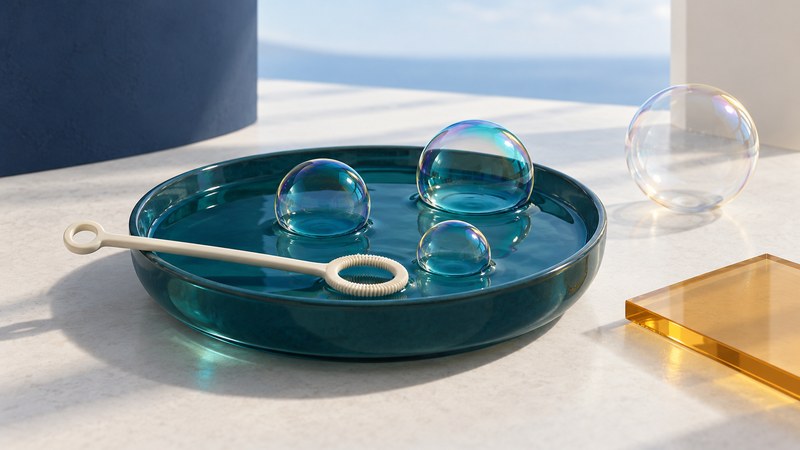
Zubbles turns a familiar toy into an interesting invention problem: how do you give a bubble a strong body color while preserving its thin, fragile film and dealing with the colored liquid left when it bursts? Those are related design requirements, each needing its own evidence.
The work associated with Tim Kehoe and dye chemist Ram Sabnis is documented in patent applications for colored bubbles and color-changing compositions. Reading those documents alongside ordinary bubble optics reveals why coloring the liquid in a bottle is only the beginning.
Ordinary bubble colors come from the film itself
A soap bubble is a thin liquid film enclosing air. Light reflected from the front and back surfaces can reinforce or cancel at different wavelengths. As the film's thickness and viewing angle change, the reflected colors change too. The Exploratorium's explanation of bubble colors connects the moving bands to this interference.
A dye adds another mechanism: selective absorption of light by a colorant in the film. The interference colors can still be present. To understand a demonstration, ask whether you are seeing a changing rainbow reflection, a persistent body tint, or both.
The path light travels through a bubble wall is much shorter than its path through a bottle of solution. A liquid that looks richly colored in bulk can therefore make a surprisingly pale film. Film drainage and the distribution of ingredients add further complications. A convincing product has to work in the stretched film, not just in its container.
Three requirements compete
On a narrow screen, focus the table region and use the arrow keys or swipe to read all columns.
| Requirement | Evidence to look for | What remains to test |
|---|---|---|
| Visible film color | A bubble viewed against more than one background under documented lighting. | Whether the tint remains useful as the film drains and changes shape. |
| Usable bubble formation | Repeated formation with the intended wand and solution. | Variation among attempts and after normal storage. |
| Manageable residue | Observations after bursting on specified, permitted test surfaces. | How material, elapsed time and cleaning conditions affect the result. |
These requirements explain why an attractive photograph is a beginning. It may establish that one bubble appeared colored at one moment. A useful evaluation asks how repeatable that result is, how long it lasts and what the user experiences afterward.
What the invention documents actually describe
The application Composition and Method for Producing Colored Bubbles, US20060004110A1, names Kehoe and Sabnis and describes combinations of surfactants and colorants intended to produce color around a bubble's surface. Its discussion distinguishes uniform coloration from color collecting unevenly in the film. That is a formulation problem as well as an optics problem.
A separate application, Novelty Compositions with Color Changing Indicator, US20060236470A1, names Sabnis, Kehoe and Robert Balchunis. It describes several color-changing approaches and applications, including bubbles. Among them are indicators whose visible state depends on the chemical environment. Changing that environment can change which wavelengths the material absorbs.
That supports a more useful explanation than saying color simply vanishes. A visible change can result from a change in the colorant's chemical state. The composition and conditions matter. These applications cover multiple formulations and proposed uses; they do not identify the exact contents of every commercial bottle or establish performance on every household surface.
Use the documents as evidence of what was disclosed, then look separately for product-specific testing and instructions. A patent application is neither a consumer safety certificate nor a promise that every described example became a product. This guide deliberately leaves out chemical recipes: observing a commercial bubble toy requires different knowledge and controls from formulating one.
A simple observation exercise
You can investigate the optical distinction using an ordinary, labeled bubble toy according to its instructions. Choose a suitable location, keep solution away from eyes and mouths, and manage slippery spills. No added dye or other chemical is needed.
- Observe a bubble in diffuse daylight against a light background and then a darker one.
- Watch how the bands and reflections move as the film changes. Record the background, lighting and approximate time since formation.
- If photographing it, keep exposure and white balance consistent. Reflected surroundings can strongly affect the apparent hue.
- Write a narrow observation: for example, “The reflected bands shifted from blue to yellow as this film drained.” Separate that from an explanation of the mechanism.
If you have a labeled colored-bubble product, compare it only within its instructions and surface restrictions. Record its identity and conditions. A colored liquid, a colored reflection and a colored film are different observations. Color fading on one allowed surface supports a claim about that trial; it does not establish universal cleanup behavior.
The invention lesson: design the whole experience
Zubbles is useful to study because the desired effect lasts only briefly, while the user's experience includes the bottle, wand, bubble and aftermath. Improving the visible effect can create a new problem elsewhere. The same pattern appears when a quieter speaker produces an inconvenient listening zone or a compact device becomes difficult to service.
For your own design study, make a three-column note: desired effect, unwanted consequence, and test that would reveal the consequence. Keep observations, mechanisms and product claims separate. The invention-evidence worksheet provides a reusable structure for that exercise.