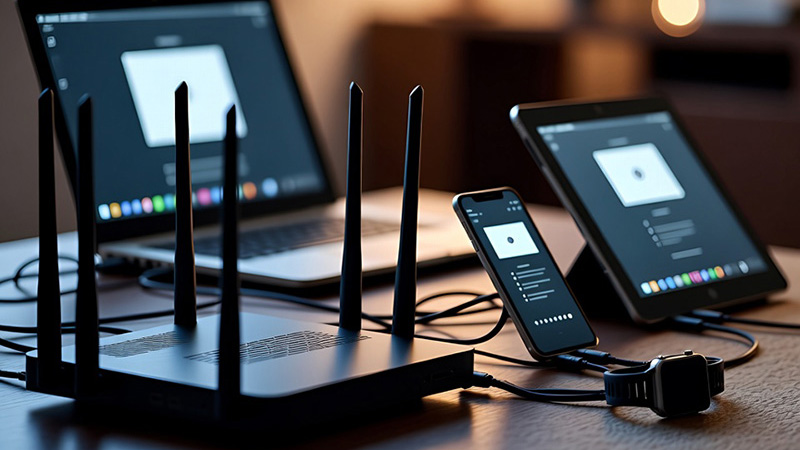
Instant networking describes the goal of building useful connectivity with minimal cabling, manual configuration, and field engineering. In 2003, Firetide introduced its HotPoint wireless mesh router at DEMOmobile as a way to "unwire" LAN backhaul and create a self-configuring, self-healing wireless network. Firetide called the result a Wireless Instant Network: an IP network using IEEE 802.11-compliant radios, multi-hop routing, point-to-point links, multicast support, and nodes that could be brought online by plugging them into AC power. Once deployed, those networks still need wireless network management.
The phrase was optimistic, but the problem was real. Wireless LANs were often described as wireless even though every access point still needed Ethernet cabling back to the network. In hotels, airports, convention centers, warehouses, schools, housing complexes, municipal deployments, and temporary venues, cabling could be the slowest and most expensive part of the project. A wireless mesh promised faster deployment and less construction, much like MoCA and powerline networking reuse existing in-building media.
The Firetide Idea
The original HotPoint concept separated wireless access from wireless backhaul. Access points could connect into mesh routers, and the mesh routers would form redundant paths back to the wired network. If one path degraded or failed, routing could shift through another node. That self-healing behavior made mesh attractive for places where trenching, conduit, rooftop fiber, or building cabling was impractical.
Firetide later became known for private wireless mesh infrastructure in public safety, video surveillance, transportation, industrial, and municipal networks. UNICOM Global acquired Firetide in 2014, describing the company as a wireless broadband and mesh-networking specialist with AutoMesh software and deployments in critical infrastructure and public-sector environments.
What Wireless Mesh Does Well
Wireless mesh is useful when the network needs to cover an area quickly and wired backhaul is limited. Common use cases include:
- Temporary networks: events, construction sites, emergency response, fairs, pop-up clinics, and field operations.
- Outdoor coverage: parks, campuses, transportation yards, ports, parking areas, and municipal corridors.
- Video and sensor backhaul: cameras, environmental monitoring, traffic systems, industrial telemetry, and security devices.
- Hard-to-wire buildings: warehouses, historic structures, multi-tenant properties, and facilities where opening walls is expensive.
- Resilient local connectivity: networks that need alternate paths when a single wired uplink is unavailable.
The best mesh deployments are engineered, not merely sprinkled around a site. Radio placement, channel planning, link budget, interference, antenna choice, power, mounting height, weather, and backhaul capacity all decide whether the network feels instant or fragile.
The Limits Of Wireless Backhaul
Wireless mesh is not magic bandwidth. Each hop consumes airtime, adds latency, and competes with other traffic on the same or adjacent channels. A network may work well for a few devices and then collapse under video, dense client loads, or too many hops. Mesh also has to contend with changing RF conditions: new walls, vehicles, foliage, weather, temporary structures, nearby access points, and interference from non-Wi-Fi equipment.
For that reason, the most reliable wireless designs still use wired backhaul wherever possible. Mesh is best treated as a tool for coverage extension, rapid deployment, redundancy, or difficult paths rather than a universal replacement for Ethernet or fiber. If an access point can be wired economically, wiring it usually improves capacity and predictability.
Standards And Consumer Mesh
IEEE 802.11s, published as a mesh-networking amendment, defined how WLAN devices could interconnect in a mesh basic service set. Separately, Wi-Fi Alliance EasyMesh created a certification program for controller-and-agent style multi-access-point Wi-Fi networks, aimed especially at managed and interoperable home and small-business deployments.
Consumer "mesh Wi-Fi" products often focus on ease of setup, client steering, band steering, app management, and whole-home coverage. They may use proprietary coordination methods, dedicated backhaul radios, Ethernet backhaul, or standards-based features. The word mesh therefore needs context. A consumer mesh kit, an 802.11s research mesh, a public-safety wireless mesh, and a carrier-managed EasyMesh deployment are related ideas but not interchangeable designs.
Instant Networking In 2026
Today, instant networking is broader than wireless mesh. It includes several operational patterns:
- Zero-touch provisioning: switches, routers, access points, and SD-WAN devices automatically download configuration after being powered on and authenticated.
- Cloud-managed networking: administrators claim devices, assign templates, monitor health, and push policy without local controllers at every site.
- SD-WAN: branch devices establish encrypted overlays and choose paths across broadband, MPLS, LTE, 5G, and Internet links.
- Identity-based access: users and devices receive policy based on identity, certificate, posture, role, and risk.
- Automation APIs: configuration, inventory, firmware, alerts, and compliance checks integrate with IT service management and security tooling.
- Cellular backup and private wireless: sites can come online before a wired circuit arrives or continue operating during an outage.
The modern version of instant is not "no design required." It is repeatable design encoded into templates, enrollment workflows, identity controls, and monitoring. The field installer should be able to mount, power, scan, and verify, while the engineering team has already defined the policy.
Security Considerations
A network that deploys quickly can also fail quickly if onboarding is weak. Instant networking needs secure defaults: authenticated device enrollment, unique credentials, certificate-based trust where possible, encrypted management, firmware validation, role-based administration, logging, and clean decommissioning when a device is lost or retired.
Wireless mesh adds RF-specific concerns. Links can be observed, jammed, spoofed, or degraded from outside the building. Outdoor nodes may be physically accessible. Cameras and sensors may sit in public spaces. Backhaul encryption, management-plane isolation, tamper monitoring, and segmentation are therefore as important as signal strength.
Design Guidance
For a practical instant-networking deployment, start with the outcome rather than the product label:
- Define whether the priority is speed of deployment, low cabling cost, resilience, temporary coverage, or centralized operations.
- Use wired backhaul for high-capacity or permanent access points whenever feasible.
- Limit mesh hop count and validate throughput at the farthest node under realistic load.
- Plan power, mounting, weatherproofing, antennas, and physical security before installing outdoor nodes.
- Separate user access, management, cameras, IoT, guest traffic, and backhaul control traffic.
- Test failover paths instead of assuming self-healing will behave correctly during an outage.
- Automate configuration, but keep human-readable documentation of topology, credentials, ownership, and support paths.
- Monitor RF health, uplink quality, device inventory, firmware, and client experience after launch.
The Firetide HotPoint story remains useful because it framed networking as a deployment problem, not only a protocol problem. In 2003, the promise was a wireless mesh that could be installed in hours instead of months. In 2026, the best instant networks combine wireless, wired, cellular, cloud management, automation, and security policy so new sites can come online quickly without becoming unmanaged.