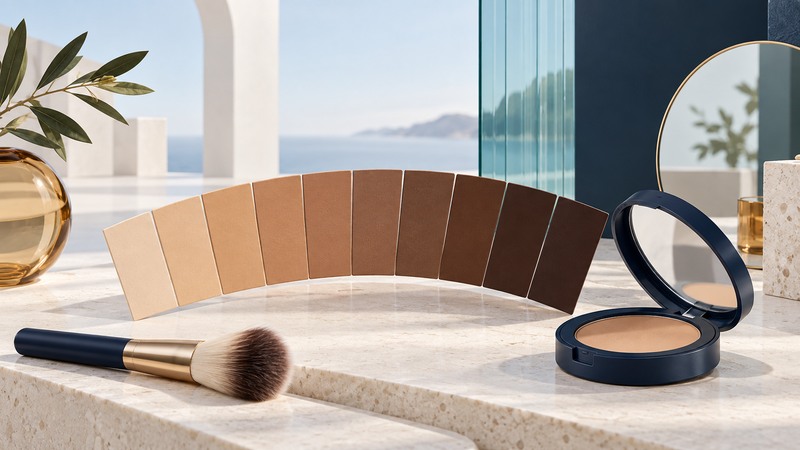
IMAN Cosmetics connects beauty history with a practical question: can a shopper find complexion makeup that fits their own skin? Approach that question through depth, undertone, coverage and finish. A useful match is individual, even when a brand’s history speaks to a much broader group.
The problem Iman set out to address
In a 2011 CNN interview, Iman described arriving at modeling work where suitable foundation was unavailable, then experimenting to find a match. She said she created IMAN Cosmetics in 1994 and explained that she wanted the brand to serve women across multiple ethnic backgrounds. Her account makes the founding purpose concrete: access to suitable complexion products and a wider conception of the customer.
That history offers a useful way to evaluate any shade range today. Ask whether it gives you viable neighboring options and enough information to compare them. A long list of colors is most helpful when the formula, undertone descriptions and trial options let you identify a satisfactory match.
Describe your match in four parts
On a narrow screen, scroll the table sideways. Keyboard users can focus the table region and use the arrow keys.
| Part of the match | What you are assessing | A useful request |
|---|---|---|
| Depth | The overall lightness or darkness of the applied color beside your skin. | “Can I compare the neighboring lighter and deeper options?” |
| Undertone | The color tendency at a similar depth, using the formula’s own shade descriptions. | “This depth is close, but this option looks too pink on me. What other undertones are available here?” |
| Coverage | How much of your underlying color you want to remain visible. | “Can we compare a light application with coverage built only where I want it?” |
| Finish | The matte, radiant or other surface appearance you prefer. | “Can I see the finished base with the powder I would actually use?” |
Shade labels belong to a particular brand and formula. For example, Estée Lauder’s Double Wear guide explains its own depth and C/N/W system. Use another brand’s chart as an introduction to the questions, then return to the candidate formula’s definitions.
Compare the result on your own face
Begin with two or three plausible candidates in the same formula. A small shortlist makes it easier to see what changed. Assess a blended jawline area in natural daylight against the neck; this is also the approach described in the Estée Lauder matching guidance. Consider the areas that will be visible with your usual clothing.
Inspect the finished application after it has settled and later during ordinary wear. Use consistent lighting for comparisons. If you usually add powder, judge that combination too. Record the full formula and shade, where you applied it, and which part of the match needs improvement.
Example: depth is close, undertone needs work
Two fictional candidates look equally close in lightness at the jaw. One looks distinctly pink beside the neck; the other blends more naturally. The next step is to evaluate the second candidate’s coverage, finish and wear. Changing to a much deeper shade to solve the pink appearance would change two questions at once.
For a ready-to-use note format, download the foundation trial record. Bring it back to a consultation so the discussion can begin with an observation such as “good depth, too golden after powder.”
Find current IMAN information
Begin with the official IMAN Cosmetics website for its current shopping links. Confirm the exact formula, shade, size, ingredient list and seller before ordering. Historical accounts establish the brand’s development; current product labels and the official purchasing route answer today’s shopping questions.
If a desired formula offers few suitable neighboring shades, compare another formula or seek an in-person match. Choose a product that makes the desired result practical to repeat. The base-makeup roles guide can help decide whether that result calls for all-over foundation, targeted concealer, or a lighter finishing step.