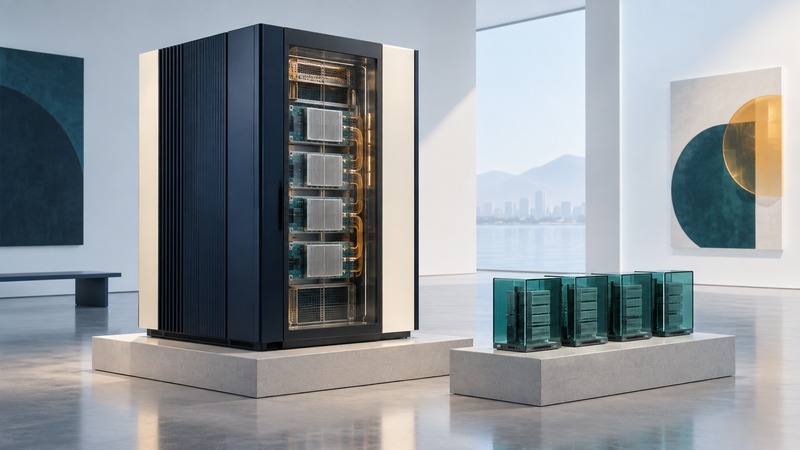
The IBM eServer p690, also documented as the pSeries 690, illustrates an early-2000s approach to large-scale computing: many POWER processors, a substantial shared-memory system, and logical partitions that divided a physical machine into separate operating environments.
Its history is useful for understanding why processor count, memory behavior, and measured application performance belong in the same explanation. A headline number of calculations per second leaves too much of the machine's work unspecified.
Place the machine in the POWER4 era
IBM's 2001 POWER4 Processor Introduction and Tuning Guide identifies the pSeries 690 Model 681 as the first POWER4-based system and describes an 8- to 32-way symmetric multiprocessing design. POWER4 integrated two processor cores on a chip, with a memory hierarchy intended to support larger systems.
In a symmetric multiprocessing system, processors can participate in a shared operating-system environment and access shared memory. Caches keep frequently used data close to processors, while the interconnect and memory subsystem support movement beyond those caches. Where the data resides and how it is accessed influence the useful work a processor completes.
Keep the model and configuration with every historical specification. The p690 name appeared across configurations and a period of product development; a particular benchmark machine provides a reproducible reference point more readily than an undated maximum specification.
Understand a logical partition
A logical partition assigns a portion of a server's resources to an operating environment. It lets administrators organize workloads and operating-system instances within one physical system. IBM's period study AIX and Linux on IBM eServer pSeries 690 provides a concrete example of research using a p690 partition.
When interpreting such a result, distinguish the whole machine from the resources assigned to the measured partition. Record its processor allocation, memory, input/output arrangement, operating system, and workload. A result produced within a partition is evidence about that test configuration.
Physical dependencies remain relevant. Several partitions can still share an enclosure and other infrastructure. For capacity planning, ask both how resources are divided and which failures affect multiple workloads. The broader dense-server planning guide explains that second question in a different architecture.
Read a benchmark as a defined experiment
IBM's 2003 PMaC benchmarking report specifies a p690 with 32 processors at 1.3 GHz, 160 GB of memory, and AIX 5.1. It reports tests of memory, communications, input/output, and floating-point work, with each benchmark repeated three times. Those configuration and method details make the results interpretable.
Scroll the table horizontally. Keyboard users can focus it and use the arrow keys.
| Metric | Question it answers | Context to retain |
|---|---|---|
| Elapsed application time | How long did this job take? | Input, software version, resource allocation, and correctness check |
| Floating-point rate | How much defined numerical work was completed per second? | Precision, operation counting, algorithm, and measured versus theoretical value |
| Memory bandwidth | How quickly did the test move data? | Working-set size, access pattern, and cache behavior |
| I/O throughput | How quickly did the storage path transfer data? | Devices, access pattern, caching, and read or write direction |
Connect architecture to research use
UTEP researcher Patricia Teller's 2011 curriculum vitae lists a February 2004 conference contribution titled “Top Gun: UTEP’s p690” and a 2003–2004 project exploring the p690 memory hierarchy. These dated records connect the machine to university work on understanding performance, beyond simply counting processors.
For a researcher, the value of a shared machine lies in completing a useful analysis with the necessary software, data, and computing allocation. A preservation record should therefore include the scheduler or access arrangement, application versions, compiler settings, input data, and resulting files alongside the hardware inventory.
To compare that model with multiple independent computers, read Cluster Computing. Shared-memory systems and clusters can both support parallel work, but the software's access and communication patterns determine which resources it uses effectively.