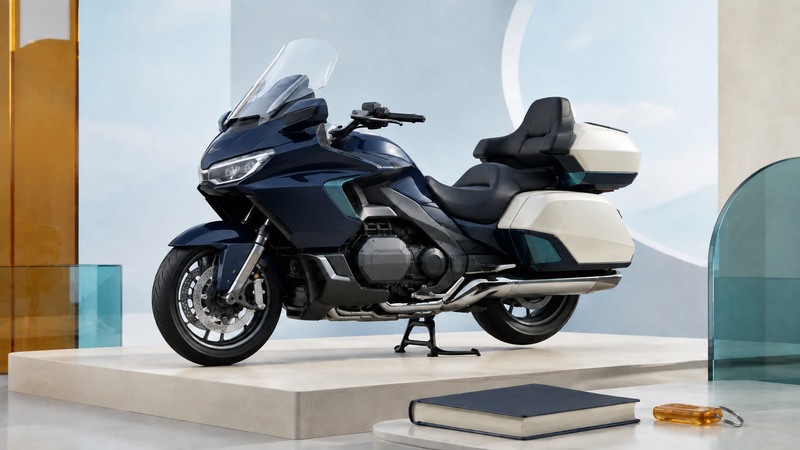
A used 2018 Honda Gold Wing Tour is easiest to evaluate when you separate three questions: which version it is, what maintenance it can document, and whether its controls and equipment suit your travel. Establish those facts before comparing asking prices or accessories.
This guide focuses on the 2018 U.S. Gold Wing Tour range. Bring the VIN, the listing, service receipts, and the owner’s manual to the discussion. For an imported bike, use documentation for its original market and ask Honda to resolve any equipment or support differences.
Identify the 2018 Tour version
Honda’s original 2018 brochure describes the redesigned 1,833 cc flat-six engine and double-wishbone front suspension. The Tour models include a trunk as well as panniers. The brochure lists 110 liters of luggage volume for the Tour; volume and permitted luggage weight are different specifications.
On a narrow screen, focus this table and scroll sideways to read all columns.
| Version | Transmission | Parking assistance and distinguishing equipment |
|---|---|---|
| Gold Wing Tour | Six-speed manual. | Electric reverse; Tour trunk and panniers. |
| Gold Wing Tour DCT | Seven-speed dual-clutch transmission. | Forward/reverse Walking Mode; Tour trunk and panniers. |
| Gold Wing Tour DCT Airbag | Seven-speed dual-clutch transmission. | DCT equipment plus the model’s airbag system. |
Confirm the identity from the bike and its records. Accessories, replacement bodywork, a changed seat, or an added luggage component can make photographs misleading. Record what is original and what has been changed, including the supplier and installation paperwork for consequential modifications.
The purpose of identifying the transmission is practical: the manual and DCT versions have different operating controls and some different maintenance requirements. Ask for a demonstration using the appropriate manual in a suitable area. Choose the version whose operation you can manage comfortably, including parking and low-speed handling.
Make service history specific enough to verify
Use the 2018 Gold Wing owner’s manual as the checklist’s backbone. It identifies model variants, contains the maintenance schedule, and separates DCT clutch-oil-filter service from engine-oil-filter service. The relevant filter section is printed page 157. “Oil changed” on a receipt leaves the exact work to clarify.
Build a dated sequence of odometer readings and work performed. Ask which fluids, filters, tires, and other service items were used; compare the records with the time and mileage requirements for the exact model. Mark missing evidence as “unknown.” A seller’s recollection can identify a shop to contact, but it cannot supply the missing invoice details.
Run a U.S. NHTSA VIN recall check and ask a Honda dealer about the bike’s campaign and service history. NHTSA explains that its VIN results omit already repaired recalls and some newly announced recalls while VIN identification is incomplete. Save the result and date, and obtain repair documentation for work the seller says was completed.
Keep ordinary service, safety recalls, other manufacturer campaigns, and infotainment updates as separate entries. Each answers a different ownership question. A current recall lookup does not establish the condition of the tires, battery, brakes, or suspension.
Test the electronics you intend to use
Bring your phone, intended cable, and headset to an agreed inspection. With the motorcycle safely parked, check that the seller can demonstrate key recognition, luggage locks, the display, audio, and the adjustable windscreen. Record exactly which functions work with your devices and which need further setup.
The bike’s installed software deserves its own entry. Honda maintains a Gold Wing navigation and software update page. Check the supported model years and market, compare its version instructions with the bike, and follow the current official installation procedure if an update is needed. Ask a Honda dealer for the applicable package if the page or version information is unavailable.
A feature mentioned in a newer listing may depend on an update or a later model. Treat the original 2018 specification, subsequent supported software, and the tested behavior of this bike as three pieces of evidence. Confirm the combination you will actually use before relying on it for a trip.
For a rider and passenger or a riding group, the motorcycle intercom compatibility guide helps distinguish phone pairing, Bluetooth intercom, and mesh connections. A successful music test alone leaves conversation and navigation priorities to check.
Use an independent inspection to resolve condition questions
Before a viewing, ask about damage, storage, water exposure, long periods of inactivity, warning lights, and modifications. Request clear photographs and receipts where relevant. Give a qualified motorcycle technician your unresolved questions so the inspection has a defined purpose.
- Mechanical condition: request an assessment of brakes, tires, steering, suspension, leaks, and any reported starting or shifting symptoms.
- Touring equipment: check pannier and trunk operation, seals, seat condition, windscreen movement, and the fitted accessories you expect to use.
- Records and identity: reconcile the VIN, mileage history, model, keys, manuals, and campaign evidence.
- Fit for your use: assess seat reach, controls, luggage access, passenger accommodation, and handling with appropriate assistance and conditions.
Have unexplained warning indications or consequential faults diagnosed before proceeding. A test ride, when agreed and appropriately insured, should follow a satisfactory safety assessment and suit the rider’s experience. It provides useful observations; it cannot replace service history or an inspection.
Compare the purchase plus the known catch-up work
Download the 2018 Gold Wing buyer’s record to keep identity, service evidence, device tests, inspection findings, and cost comparisons together. The useful result is a documented decision with a clear next action for each uncertainty.
Continue reading
Researched and updated September 7, 2026. Model, market, equipment, and rule details should be rechecked against the linked documentation.