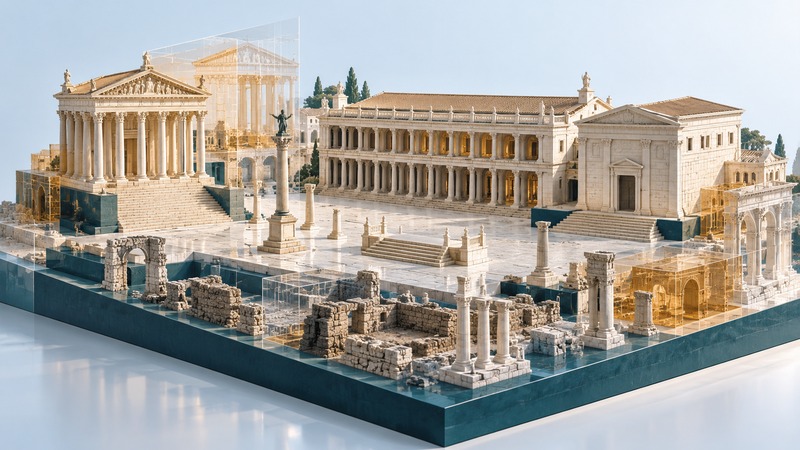
The Roman Forum was a center of public life where political debate, legal business, religious observance and displays of power occupied neighboring spaces. Its surviving monuments form a layered record: a building's foundation, rebuilding, later use and modern restoration can belong to very different centuries. Reading those layers makes the ruins more intelligible.
One forum within a growing city
A forum was a public space in a Roman town, often bringing together commercial, legal, political and religious activity. In Rome, the Forum Romanum developed in the valley between the Capitoline and Palatine hills. The archaeological park's overview of the Forum follows its transformation from an early gathering place into a monumental civic center.
As Rome grew, additional public complexes appeared nearby. The Imperial Fora, associated with rulers such as Caesar, Augustus and Trajan, are distinct spaces adjoining the older Forum. An account of the Forum Romanum should identify which square and which building it means. The same word also appears in the names of specialized markets elsewhere in the city.
Begin with a question about use: where could someone hear a speech, attend a legal proceeding, participate in a ceremony or encounter an image of imperial authority? That question connects the visible remains to the people and institutions that gave them meaning.
Match buildings to activities
Modern ruins can make ancient buildings seem interchangeable. A temple, a basilica and a senate house supported different activities, even when they stood close together. A civic basilica was a large public hall; its name in this setting describes a Roman building type used for business and legal proceedings.
| Monument | Function | Historical layer to notice |
|---|---|---|
| Curia Julia | A meeting place for the Senate. | Completed under Augustus in 29 BCE; the surviving structure reflects a later rebuilding under Diocletian. |
| Basilica Julia | A public hall associated with civil legal proceedings. | Inaugurated unfinished in 46 BCE, completed and subsequently rebuilt under Augustus. |
| Basilica of Maxentius | A monumental public hall illustrating the scale of late imperial building. | An early fourth-century CE addition, many centuries later than the Forum's beginnings. |
The park's Basilica Julia teaching booklet (Italian PDF) connects the building's architecture and legal use with its sequence of construction and repair. For the Curia's chronology, the Capitoline heritage authority's account distinguishes the Augustan project from the structure that survives.
Temples and commemorative monuments added other forms of authority to this landscape. Religious practice was part of civic life, while dedications and honorific displays made patrons and rulers conspicuous. The placement of a monument could matter as much as its size: prominence, access and visibility helped communicate who deserved attention.
Read the Forum across several periods
The Forum's long history becomes easier to follow when divided into changes in use and patronage. During the Republic, public assemblies, courts and the Senate formed part of a competitive political world. In the late Republic and early Empire, rebuilding associated with Caesar and Augustus reshaped important civic spaces. Later emperors added monuments and repaired damage, leaving further claims to public memory in stone.
After antiquity, buildings acquired new purposes, materials were reused and the ground level changed. Churches became part of the landscape. Excavation and restoration then selected and exposed particular phases. A view today therefore combines ancient remains, later survivals and modern decisions about presentation. The park's description of the Curia's fabric points to traces of former entrances, structures and burials as evidence of these changes.
This chronology helps with a common interpretive problem: an original foundation date does not date every wall visible above it. Record the date of the building's first purpose and the date of the surviving fabric separately.
Worked example: a senate house with a later history
The Curia Julia offers a compact exercise. Its name connects it with Caesar's reorganization of the area, and Augustus completed it in 29 BCE. The Capitoline heritage record identifies the existing building with Diocletian's rebuilding after the fire of 283 CE. Later use as the church of Sant'Adriano adds another chapter.
- Identify the institution: the Senate explains why an assembly hall belonged here.
- Separate the dates: 29 BCE marks completion of the earlier project; the later rebuilding explains much of the surviving structure.
- Look for reuse: compare the monument description with visible changes associated with its church phase.
- Write a qualified caption: describe a Roman senate house whose surviving fabric and later uses preserve several periods of history.
The result is more useful than assigning the whole building to a single famous ruler. It also suggests the next research question: which features belong to each phase, and what evidence dates them?
Make a visit or online study manageable
Choose three monuments and one theme, such as law, political authority or reuse. For each, note its function, a verified date, one visible feature and one uncertainty. Compare an official plan with the monument descriptions before treating a photograph's apparent arrangement as a map.
Use the archaeological park's official hours and ticket information for current access and closures. Individual interiors and routes may have different arrangements. For a broader introduction to working with documents, objects and places, return to the History collection.
Explore more documents, places and interpretations in Yenra History.