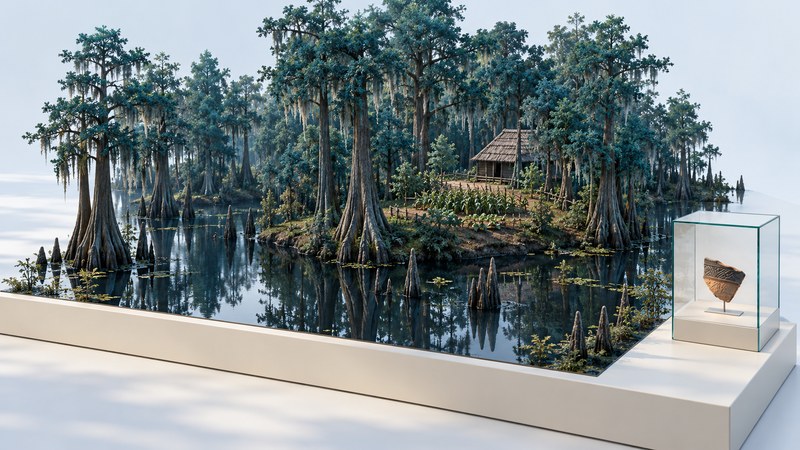
The Great Dismal Swamp was both a landscape of forced labor and a place where people escaping slavery sought freedom. Some moved through it; others established lives in its interior. Understanding that difference brings maroon communities into view and changes how we read the surviving evidence.
A lived landscape on the Virginia–North Carolina border
The swamp spans parts of southeastern Virginia and northeastern North Carolina. Indigenous people inhabited the region long before European colonization. Wet ground and dense vegetation made some areas difficult for outsiders to reach, while higher ground offered places to live. That landscape could shelter people resisting enslavement even as drainage, canal construction and timber extraction brought exploitation into it. The US Fish and Wildlife Service's refuge history connects these human histories to the changing wetland.
Today’s refuge protects a remnant of a much larger landscape. Its boundaries should not be projected backwards as the boundaries of historical settlement or movement. Nor was the swamp uniformly isolated: different places had different connections to waterways, work sites and surrounding communities.
Settlement and escape routes were different experiences
Maroons were people who escaped slavery and established lives beyond enslavers' immediate control. Marronage describes practices of flight and autonomous living, which could take different forms and durations. The National Park Service's study of marronage in the Great Dismal Swamp distinguishes temporary withdrawal, longer residence and movement through the region.
That distinction matters when using the term Underground Railroad. A person passing through toward another destination and a person building a household in the swamp were pursuing freedom in different ways. Residents could hunt, gather and exchange goods; contact with people outside a settlement did not make the settlement meaningless as a place of resistance.
The surviving evidence does not provide a reliable census of everyone who lived there at any one time. A large estimate covering many generations is not a simultaneous population. When encountering a number, ask whether it counts residents, people moving through, a particular settlement or a cumulative estimate across decades.
What Moses Grandy's narrative adds
Moses Grandy's Narrative of the Life of Moses Grandy, Late a Slave in the United States of America was published in London in 1843. The introduction explains that George Thompson recorded Grandy's oral account. The University of North Carolina's complete digital edition preserves the narrative and its publication framing, which should be read together.
Grandy describes work on boats and in the region's timber economy, the extraction of his earnings by enslavers, and his repeated efforts to secure freedom. His account makes economic arrangements concrete: earning money did not mean controlling it, and an agreement to purchase freedom did not guarantee that an enslaver would honor it. Work, movement and negotiations over payment occurred within a coercive system.
Read his descriptions as the testimony of a particular person, mediated through an abolitionist publication. That provenance is a reason to ask careful questions, not to dismiss his experience. He was explaining events to readers who could be persuaded to oppose slavery and assist people still enslaved. The publication's purpose and the lived experiences it reports are both part of its historical value.
Grandy's narrative also should not be made to stand for every maroon household. Evidence that someone worked in the swamp economy is not by itself evidence that he lived in a hidden settlement. Identify the person's legal situation, location and activity in each passage before attaching a broader label.
Small objects can answer different questions
Archaeologists investigate places that left few written descriptions. In an American University account of Becca Peixotto's fieldwork, researchers describe evidence of fires, stone-tool work, pottery and nails on an island within the swamp. They also describe older Indigenous materials and evidence of later reuse. Such findings make the landscape's long occupation visible.
An object's material, location and archaeological context matter together. A pottery fragment without its context cannot supply the same information as a carefully documented find. An older tool reused later also warns against assuming that the age of manufacture and the date of its last use are identical.
Archaeology can identify activities and patterns that a written account omits. It usually cannot, by itself, supply a person's name or a complete account of why they moved. Conversely, a narrative can name people and explain relationships while leaving their buildings or possessions undescribed. These sources become stronger when compared without asking either to answer every question.
Read for evidence, purpose and uncertainty
| Source | Useful questions | Limit to retain |
|---|---|---|
| Personal testimony | How did this person describe work, coercion, mobility and family ties? | One life does not describe every community; record the narrator and publication process. |
| Court or enslaver records | What did authorities attempt to investigate, control or punish? | Accusations and hostile descriptions are not neutral accounts or automatic proof. |
| Archaeological finds | What activities and periods of use does the context support? | Objects rarely identify individual residents or exact population totals. |
| Maps and landscape evidence | Where were waterways, higher ground and changing access routes? | A map's date and purpose shape what it shows and leaves out. |
Try one passage and one finding
Choose a passage from Grandy about work or earnings. Record what he says happened, who controlled the arrangement, and what information comes from the editor. Then select one finding in the archaeological fieldwork report. Write the question it helps answer and one question it leaves open. Keep a separate column for your inference so it does not become an attributed fact.
Learn more without losing the historical setting
Use the official refuge website for current access, trails and conditions. Read the history before visiting, and leave archaeological material in place. A visit can help convey the landscape's scale, but modern trails and water levels do not recreate a past resident's experience.
The most useful account connects human choices to the conditions in which they were made: coercive labor, opportunities for movement, community relationships and the possibility of remaining beyond an enslaver's reach. It also leaves room for people whose names were never preserved in writing.
Explore more documents, places and interpretations in Yenra History.