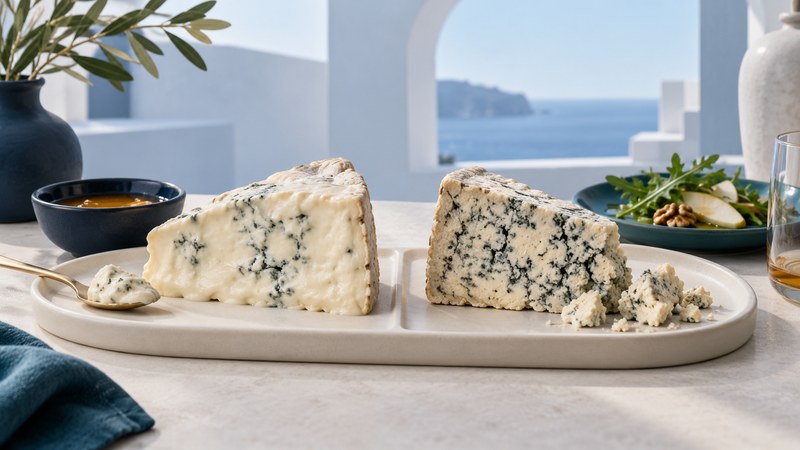
Choose Gorgonzola dolce when you want a creamy texture and a gentler blue-cheese character. Choose piccante when you want a firmer, more assertive accent. Start with the intended dish, then taste the exact cheese before deciding how much to use.
What the two names tell you
The Gorgonzola Consortium’s style and production guide describes dolce as softer and creamier, and piccante as firmer, more crumbly and stronger in flavor. Both are made with pasteurized milk and selected molds. Its specifications give maturation ranges of 50–150 days for dolce and 80–270 days for piccante. The overlapping ranges show why age alone cannot replace the style name.
On a narrow screen, focus the table and use the arrow keys to scroll.
| Task | Starting choice | How to judge it |
|---|---|---|
| Blend into a creamy sauce | Dolce | Check smoothness and intensity in a small spoonful |
| Scatter over a salad | Piccante or another firm wedge | Look for pieces that hold their shape |
| Spread on bread | Dolce | Use a modest layer and taste before adding preserves |
| Add a strong finishing bite | Piccante | Add a little at a time, then taste the whole dish |
These are practical starting choices, not fixed rules. A cold piece may feel firmer than it does while serving, and wedges differ by producer and maturity. At a cheese counter, describe your recipe and ask which available cut will serve that purpose.
Buy an identifiable piece
The consortium identifies its authenticity mark on the foil wrapper. Keep the original packaging or counter label so you know the producer, style and handling instructions. Ask for the cheese by its full name; a package labeled only “blue cheese” may work in a dish but describes a broader family.
Buy enough for the recipe plus a small tasting portion. If the supermarket sells a larger package, decide whether the remainder will become a sandwich spread, salad accent or part of a small board. Repeatedly buying more than the meal needs makes storage harder to manage.
Test the flavor before seasoning the whole dish
A suggested tasting exercise: reserve two tablespoons of a warm, plain sauce base from the recipe you are making. Off the heat, stir a small weighed amount of dolce into that sample. Taste it with a bite of the intended pasta or vegetable. Add another small amount if needed, recording the total. This reveals how the cheese works with that food before you commit the whole pan.
The sample is a flavor trial, not a replacement recipe. Use a measured source recipe for the final liquid and cheese quantities. Add the cheese with gentle heat, stir patiently and stop heating if oil begins to separate. A sauce that tastes intense by itself may taste balanced on pasta; assess it in the form it will be eaten.
Make substitutions deliberately
- Piccante for dolce: expect a stronger flavor and a different texture. Begin with a smaller taste trial rather than automatically replacing gram for gram.
- Another blue for Gorgonzola: compare creaminess, crumbliness and saltiness. The blue-cheese introduction offers a way to compare them.
- Mascarpone in a recipe: treat it as a separate creamy ingredient. It does a different job from the blue-veined cheese, even when a recipe uses both.
For a simple cold serving, try a small piece on bread with pear offered separately. Keep nuts optional and identify them for guests. Strong accompaniments are easier to balance when each person can choose their own amount.
Handle the portion you bought
Remove rind and wrapping from the portion you serve, follow the package’s storage instructions and keep the reserve refrigerated. Normal blue veins belong to the cheese; unexpected new growth requires separate attention. Use USDA guidance on mold and cheese for the relevant cheese texture, especially when the cheese is soft or already crumbled. If its condition is uncertain, discard it rather than testing it by tasting.