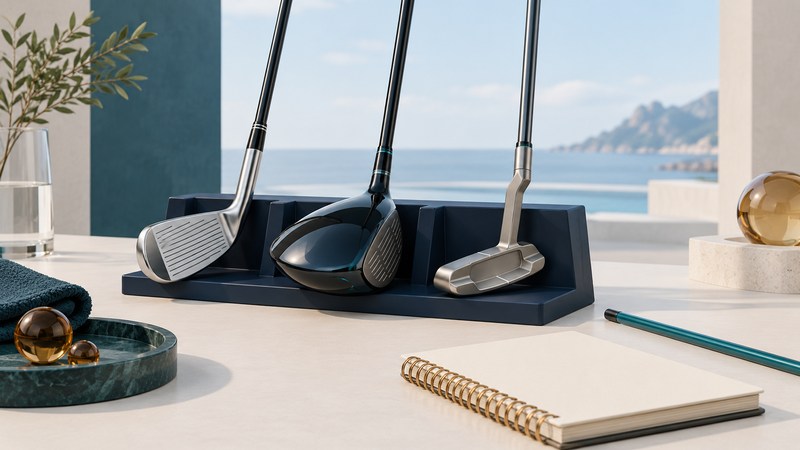
A useful set gives you distinct shots you can repeat: a tee option, clubs for different approach distances, short-game tools and a putter. Build around your actual contact and carry distances, then use a fitting to answer specific questions. The number stamped on a sole is only the beginning of the comparison.
Give every club a job
Start with the clubs you own. Record which ones you use, where you struggle and whether two clubs repeatedly travel about the same distance. A beginner can learn with a smaller selection and add clubs when a real gap appears. The Rules limit a round to 14 clubs; filling every slot is optional. Consult USGA club rules and Rule 4 for the full requirements.
Swipe the table, or focus it and use the arrow keys to see every column.
| Role | What to compare | Useful question |
|---|---|---|
| Tee shots | Driver, fairway wood or another reliable option | Which keeps a playable pattern at the distance I need? |
| Long approaches | Fairway woods, hybrids and longer irons | Can I launch it and stop it where the shot requires? |
| Approach spacing | Irons and pitching wedge | Do the normal carry ranges leave gaps or overlap? |
| Short game | Wedges and alternative lower-running shots | Which loft and sole work from my usual lies? |
| Putting | Length, setup, head shape and feel | Can I aim and control pace comfortably? |
Prepare for a fitting with a baseline
Bring your current clubs and the ball model you normally play. Explain your budget, typical course conditions, normal miss and any coaching changes already underway. Ask what the session includes: equipment categories, location, test balls, time, fees and whether buying clubs is required. Titleist’s fitting overview describes baseline testing and the role of current equipment; it is a manufacturer process, not a guarantee of improvement.
A useful fitting combines measurements with shots. Length, lie, total weight, shaft characteristics, grip and head design interact with delivery and contact. PING’s fitting process uses static measurements and shot information, including set gapping. Treat a height chart or online selector as a starting point for a fitter to check.
- Compare your current club and a candidate with the same ball and conditions.
- Record typical carry, left-right spread and strike quality; keep ordinary misses visible.
- Ask whether a longer club or stronger loft explains a distance gain, and how that affects the next club.
- For wedges and approach clubs, consider launch, descent and turf interaction as well as distance.
- Get the recommended specifications in writing before ordering.
Measure carry gaps without chasing one perfect shot
Carry is distance to first landing; total distance adds roll. Use carry for a shot that must clear trouble. On a range, ball type and distance markers affect the result. A launch monitor’s measured and estimated fields can also differ, so ask how the displayed numbers were produced.
Record sample size and the range of results alongside the median. If club A and B have heavily overlapping patterns, a nominal distance difference may be less useful on the course than a more predictable launch.
Inspect used clubs as complete equipment
- Confirm the exact model, lofts, handedness, shaft and length; compare the listing with manufacturer information.
- Inspect heads and faces for cracks, unusual dents and severe wear. Check shafts for bends, corrosion or splits and grips for slipping or hardening.
- Ask a qualified repair shop to investigate loose heads, suspect shafts or unknown modifications before use.
- Check set continuity: missing irons, mixed shafts and altered lofts can change gapping and replacement costs.
- Verify seller identity, return terms and any serial-number verification the manufacturer actually provides. Photos and a serial number alone do not establish authenticity.
Add fitting, regripping and any professional adjustment costs to the purchase price. A cheap set that needs extensive work may leave less room in the budget for lessons and practice.
Take a short decision record with you
Use the downloadable club-fitting checklist (plain text) to capture your baseline, candidates, specifications and next decision. Keep it with the quoted order so the delivered clubs can be checked against the fitting recommendation.
Before committing, ask yourself which recurring shot becomes easier and what evidence supports that judgment. If the only difference is one unusually long shot, collect more comparable results.