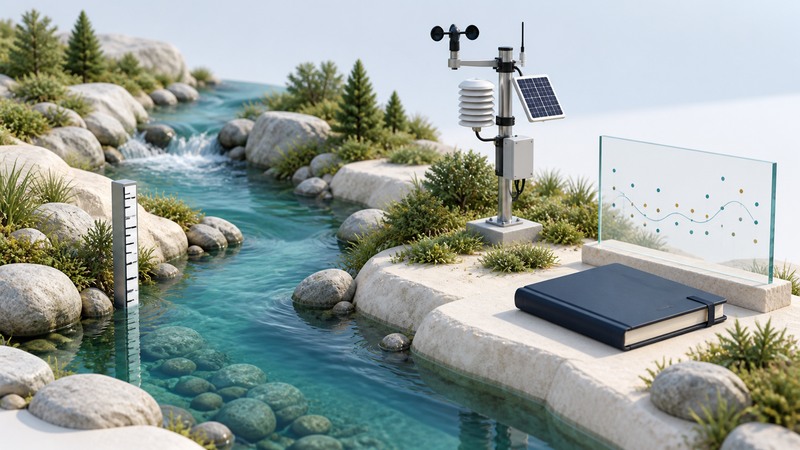
An environmental monitoring project should begin with a decision somebody can make. State what you need to learn, where and when it matters, and what evidence would justify the next step. Then select measurements and methods that can answer that question.
This guide helps community groups and project coordinators prepare a monitoring brief. Work with the intended data user before buying equipment, particularly when results may inform public-health, regulatory or engineering decisions.
Define the question and its limits
“Monitor the stream” leaves the project open-ended. A bounded question might be: “At two accessible sites, does measured turbidity differ between upstream and downstream observations during the selected sampling period?” That defines an indicator, comparison and place while leaving causation for further investigation.
EPA’s quality-assurance handbook and toolkit explains planning for data that suit the intended use. Establish a project lead, data reviewer, field roles, training and documentation. Agree the quality expectations with the agency or other recipient who will use the findings.
Separate a screening project from a compliance determination. A screening signal can justify a site review or better measurements. It needs a documented route for follow-up and a clear statement of what the data can establish.
Choose observations that support the comparison
On a narrow screen, scroll the table sideways. Keyboard users can focus it and use the arrow keys.
| Element | What to specify | Why it matters |
|---|---|---|
| Indicator | Parameter, unit and measurement method | Different methods or units can produce quantities that cannot be combined directly. |
| Sites | Locations, access permissions and reason for selection | Convenient sites alone may miss the process being studied. |
| Timing | Frequency, duration and conditions to cover | Only sampling pleasant daytime conditions can leave important events unobserved. |
| Quality checks | Instrument checks, relevant duplicates or reference comparisons, acceptance criteria | A change must be distinguishable from measurement problems. |
| Response | Review trigger, responsible person and follow-up action | An unusual reading needs an agreed path beyond a dashboard. |
For water turbidity, the USGS National Field Manual section documents methods, equipment and reporting considerations. Use the applicable protocol and qualified guidance to choose a method. Keep method-specific units, calibration records and any processing steps attached to the result.
Plan access, weather limits, permissions and field safety with the responsible team. Observing from a public bridge is a different activity from collecting a water sample or installing equipment. This brief does not supply a field operating procedure.
Combine ground and satellite evidence carefully
NASA’s SERVIR resources illustrate the connection between Earth observations and decision support. Satellite products can add wider context to ground measurements. Identify the actual dataset, version, observation date, pixel size, cloud treatment and available quality flags before using it.
A satellite pixel represents an area, while a handheld observation may represent one point and moment. Align dates and spatial support before comparing them. For a narrow stream, verify that the product can resolve the feature at all. Keep observed data, modeled estimates and forecasts labeled separately.
For community air projects, EPA’s Air Sensor Toolbox provides guidance on planning and evaluating lower-cost sensors. Co-location with an appropriate reference can help characterize performance, subject to the protocol and conditions studied.
Interpret a small result within its design
Set review triggers with the intended data user before observing results. A project’s internal investigation threshold should be labeled as such; keep it distinct from a regulatory limit or health advisory. Preserve unusual readings and the reason for any exclusion.
Keep data reviewable
Save an untouched copy of raw records. Use a consistent table with site ID, timestamp and time zone, parameter, value, unit, method, instrument ID and quality flag. Store calibration and maintenance records alongside it. Record a missing reading as missing, with a reason, rather than entering zero.
Document each correction in a separate processed copy. If a sensor drifts, mark the affected period and ask the reviewer how to handle it; do not silently smooth the record. Plot gaps visibly and explain how aggregation was performed.
AI can help draft a unit-checking or duplicate-detection script. Test it against known example rows and retain human review of exclusions and interpretation. A plausible automated narrative is weaker evidence than a reproducible calculation linked to original observations.
Report the finding and the next decision
Publish the question, methods, period, coverage, quality checks, findings and limitations together. Identify who reviewed the result and what action follows. Distinguish “we observed a difference” from “we established its cause.” Budget for maintenance and review as well as equipment.
For an unexpected visual water concern, use the water observation and reporting guide. For interpreting a public air report, use the AQI guide. Each is a different use of environmental evidence.
Environmental monitoring project brief
Environmental monitoring project brief — plain-text download. Save a copy and fill it in with your own information. It includes instructions, example assumptions and source references.